Category: Agricultural AI · Climate Technology · Smart Farming · Sustainable Agriculture
Artificial intelligence is transforming agriculture by helping farmers make better decisions about irrigation, crop health, pests, fertilizers, weather risks, and market opportunities. But an important question remains: Can AI-powered farming genuinely benefit small farmers, or will the technology mainly help large agricultural businesses?
For smallholder farmers in India and other developing countries, the answer depends on affordability, internet connectivity, local-language support, access to reliable agricultural advice, and whether the technology produces measurable improvements in income and productivity.
This research topic explores how smart farming works, its potential benefits for small farmers, its climate-related applications, and the challenges that must be addressed to make agricultural AI accessible to everyone.
🌱 How AI Is Changing Modern Agriculture


Traditional farming depends on experience, seasonal knowledge, rainfall patterns, and observation. These remain valuable, but changing weather conditions and rising production costs make timely information increasingly important.
AI can analyse information from satellite images, weather forecasts, soil sensors, crop photographs, and agricultural research. It then uses these data to help farmers decide what action may be appropriate.
For example, a farmer growing rice may receive an alert about likely rainfall, a possible disease risk, or the best time to inspect a field. A vegetable grower may use a smartphone photograph to identify a suspected pest problem. An irrigation system may use soil-moisture readings to estimate when crops need water.
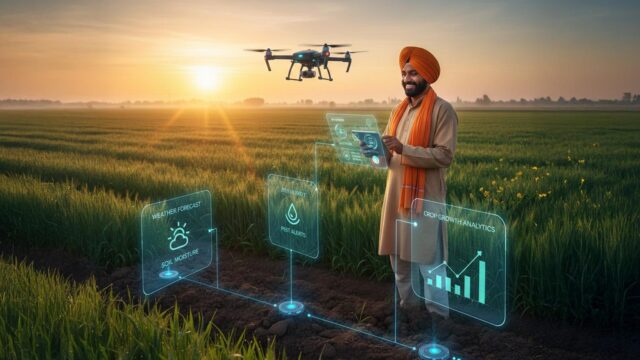
These technologies do not require every farmer to purchase an expensive robot or drone. In many cases, a basic smartphone, an affordable advisory service, and reliable agricultural information can be enough to deliver useful support.
The World Bank’s 2026 reporting on agricultural AI in India describes the growing role of local-language advisory tools, crop monitoring, and digital farming services. It also emphasizes the importance of reliable data and locally relevant guidance.
🚜 Important Applications of AI in Smart Farming

Crop disease and pest detection
AI-based image recognition can analyse photographs of leaves and flag possible diseases, nutrient deficiencies, or pest damage. This may help farmers investigate problems earlier. However, image-based diagnoses can be wrong, especially when symptoms overlap or photographs are poor.

Smart irrigation and water conservation
By combining soil moisture, crop stage, weather forecasts, and irrigation records, AI systems can help estimate when and how much to irrigate. This is particularly useful in areas exposed to dry spells or irregular rainfall. Benefits depend on the quality of sensors and the availability of water infrastructure.

Weather forecasting and climate-risk alerts
AI models can combine historical weather records and forecast data to help farmers plan sowing, harvesting, and other field operations. India’s Ministry of Agriculture reported in March 2026 that an AI-based local monsoon-onset forecasting pilot sent messages to farmers across 13 states, including in Odia and other regional languages.

Fertilizer and soil management
AI-assisted systems can combine soil tests, crop requirements, and field information to support more precise nutrient recommendations. This can help reduce unnecessary input use, but farmers should rely on locally validated recommendations rather than blindly following automated instructions.

Market information and farm planning
Digital systems can help farmers examine market prices, demand signals, transport options, and potential buyers. Better information may improve selling decisions, although AI cannot guarantee a higher price or eliminate the influence of middlemen, transport costs, and local market conditions.
🌦️ Can Smart Farming Help Farmers Adapt to Climate Change?
Climate change makes agriculture more difficult by increasing uncertainty around rainfall, temperature, drought, floods, and pest outbreaks. Small farmers may have fewer resources to absorb a failed harvest or recover from an extreme weather event.
AI could support climate adaptation in several ways. Early-warning systems can identify potential weather risks, satellite-based monitoring can help track crop stress, and local forecasts can support decisions about sowing and irrigation.
One relevant Indian initiative is the AI-powered climate advisory work led by the International Crops Research Institute for the Semi-Arid Tropics (ICRISAT), together with agricultural research partners. Its approach combines climate information with crop-specific advice to support climate-resilient farming.
However, a forecast is useful only when farmers can act on it. A warning about drought cannot create a new irrigation source, and an alert about an approaching storm cannot always prevent crop damage.
For this reason, AI should be integrated with agricultural extension services, crop insurance, water management, resilient seed varieties, and disaster preparedness.
🇮🇳 Real-World Examples: AI for Small Farmers in India

FarmerChat: Agricultural advice through AI
India · Digital Green
FarmerChat is a multilingual agricultural assistant that allows farmers to ask questions through text, voice, or crop photographs. It uses agricultural knowledge sources to provide practical guidance. Digital Green reported more than one million users in a September 2026 overview. This demonstrates adoption, although user numbers alone do not prove that all users experienced higher incomes.

AI-based monsoon forecasting
Government of India
A government pilot used AI-based local monsoon-onset forecasts to support Kharif sowing decisions. The Ministry of Agriculture reported that forecasts reached approximately 3.88 crore farmers across 13 states for the 2025 Kharif season. Surveyed farmers in Madhya Pradesh and Bihar reported changing some planting decisions after receiving forecasts.

KATHIR: Digital agricultural services
Kerala, India
The Kerala Agriculture Technology Hub and Information Repository (KATHIR) is being developed to combine agricultural information, remote sensing, and AI-supported services. Its intended uses include localized crop advice, disease identification, and links to government support. The World Bank describes the platform as an example of integrating digital tools into agricultural services.
These examples suggest that useful agricultural AI does not have to mean expensive autonomous machinery. A voice-based assistant or timely weather message may be more practical for a small farmer than a sophisticated robot.
💰 Can AI Increase Small Farmers’ Income?
AI may improve farm income through three main routes: preventing crop losses, reducing unnecessary input expenditure, and helping farmers make better production and marketing decisions.
Consider a hypothetical farmer who grows vegetables on a small plot. The farmer normally follows a fixed spraying schedule, even when pest pressure is low. An AI-supported advisory system could combine weather conditions, crop observations, and pest-risk information to recommend when closer inspection or treatment may be needed.
If the recommendation is accurate and locally appropriate, the farmer might avoid an unnecessary application, reduce input expenditure, and protect beneficial insects. If an early warning also prevents a serious crop loss, the financial benefit could be greater.
However, these outcomes are not guaranteed. AI subscriptions, smartphones, sensors, data charges, training, and equipment maintenance all have costs. A farmer should evaluate the net financial benefit, not simply whether the technology improves prediction accuracy.
A recent review of AI for smallholder agriculture in South Asia published in September 2026 also highlights an important evidence gap: technical performance does not necessarily translate into sustained use or better farmer outcomes.
⚠️ Major Challenges of AI in Small-Scale Agriculture
High initial and ongoing costs
Sensors, automated irrigation, drones, and paid software can be unaffordable for farmers with limited savings. Shared equipment, cooperative services, and pay-per-use models may offer a more accessible alternative.
Poor connectivity and digital literacy
Some rural communities have unreliable internet access or limited experience using digital applications. Voice calls, SMS, offline functionality, and assisted services can reduce these barriers.
Language and local farming knowledge
Advice must reflect local crops, soil, climate, farming practices, and regional terminology. A system trained on information from another region may recommend an unsuitable action.
Incorrect recommendations
AI can misidentify diseases, misinterpret photographs, or generate confident but incorrect advice. Pesticide selection, application rates, and other high-impact decisions should be checked against approved guidance and qualified agricultural experts.
Farmer data and privacy
Farm records, land information, photographs, yields, and purchasing patterns can be commercially sensitive. Farmers need clear explanations of what data are collected, who can access them, and whether they can opt out.
Unequal access
Farmers with better devices, education, connectivity, or financial resources may benefit first. Women farmers, tenant farmers, and remote communities could be left behind unless services are designed to include them.
These challenges are consistent with recent research reviews and guidance from the World Bank, which stress affordability, local relevance, data quality, trust, and human oversight.
🌾 A Practical Smart-Farming Strategy for Small Farmers
The most realistic approach is to start with one problem rather than invest in an entire technology system.
Step 1: Start with free or low-cost advice
Use trusted agricultural advisories and local weather updates. Compare recommendations with advice from a Krishi Vigyan Kendra (KVK) or the local agriculture department.
Step 2: Test one application
Try a crop-diagnosis tool or irrigation advisory on a limited area. Confirm suspected diseases before taking expensive or potentially harmful action.
Step 3: Explore cooperative services
Farmer Producer Organisations (FPOs), cooperatives, and community groups can investigate shared access to soil testing, drones, sensors, and technical support.
Step 4: Measure results
Compare input expenses, crop losses, water use, yield, and net income against the previous season or an untreated comparison plot where feasible. Include the full cost of the technology.
For farmers in Odisha, a sensible starting point is to explore Odia-language weather and crop advisories and consult the nearest KVK or agriculture extension office. Local rice, pulse, vegetable, and other crop requirements should guide which AI service is worth testing.
🔬 What Does Recent Research Tell Us?
Research published in 2026 offers a useful picture of both the promise and the limitations of agricultural AI.
– AI-powered agricultural advice: A July 2026 paper in Frontiers in Artificial Intelligence examined how generative AI could translate scientific information, crop models, and remote-sensing analysis into more specific advice for Indian rice farmers. The authors also highlighted the need for reliable data and human oversight.
– Voice-based agricultural services: A CGIAR report published in April 2026 discussed lessons from developing a generative AI voice agent for Telugu-speaking farmers. It emphasized language quality, local context, data governance, and farmer participation.
– The gap between prediction and impact: A September 2026 review of AI in South Asian smallholder agriculture found that evidence of technical performance is more developed than evidence demonstrating improved farmer outcomes. This makes independent evaluation particularly important.
The central research question is therefore shifting from Can AI recognize crop problems? to Does using AI help farmers make better decisions, improve their livelihoods, and withstand climate risks at an affordable cost?
🔮 The Future of AI in Agriculture
The future of smart farming is likely to involve a combination of small AI models, satellite data, inexpensive sensors, local-language assistants, and human agricultural expertise.
Instead of requiring farmers to interpret complicated dashboards, future systems may explain a problem in everyday language, identify the information behind a recommendation, and offer several options with their likely costs and risks.
AI may also support government extension workers by helping them identify emerging crop problems, prioritize field visits, and distribute advisories to more farmers. Such systems could complement agricultural expertise rather than attempt to replace it.
For climate resilience, the greatest value may come from connecting several services: weather alerts, crop-health monitoring, irrigation guidance, crop insurance, and access to resilient seeds. The benefit will depend on whether farmers can afford and act on the advice.
Conclusion: Can Smart Farming Help Small Farmers?
Yes, AI can help small farmers—but only when it is affordable, locally relevant, reliable, and connected to real agricultural support.
Smart farming offers promising tools for earlier disease detection, more informed irrigation, better weather planning, and improved access to agricultural knowledge. India’s emerging multilingual advisory services and local forecasting initiatives demonstrate practical ways to bring these capabilities closer to smallholder communities.
Yet technology alone cannot resolve the structural challenges of agriculture. Limited access to credit, irrigation, markets, insurance, and extension services must also be addressed.
The most effective model is not necessarily a fully automated farm. It is a farmer who can combine experience with timely, trustworthy information and make better decisions without taking on unsustainable costs.
The ultimate measure of success will not be the number of AI applications deployed. It will be whether small farmers experience lower avoidable losses, more efficient resource use, stronger climate resilience, and sustainable improvements in net income.