AI-Powered Personal Assistants: How They Are Changing Everyday Life

Image
Image
Image
Image
Image
Image

AI-Powered Personal Assistants: How They Are Changing Everyday Life 🤖📱

Artificial intelligence is becoming an increasingly visible part of everyday life. What once seemed like futuristic technology is now integrated into smartphones, computers, smart-home devices, search tools, productivity platforms, and online services. Among the most noticeable applications are AI-powered personal assistants.

Traditional digital assistants could answer simple questions, set alarms, provide weather information, or play music. Modern AI assistants are becoming more capable. They can understand natural language, summarize information, help write messages, organize tasks, explain complicated subjects, brainstorm ideas, analyze documents, and support people across many daily activities.

As these systems become more sophisticated, they are changing how people interact with technology. Instead of navigating multiple menus and applications, users can increasingly describe what they want in ordinary language.

The transformation is not limited to convenience. AI-powered assistants may influence productivity, education, communication, shopping, travel, entertainment, accessibility, and professional work.

At the same time, their growing capabilities raise important questions about privacy, accuracy, security, dependence, and responsible use.

Understanding both the opportunities and limitations of AI assistants can help people use them more effectively.

🤖 What Are AI-Powered Personal Assistants?

An AI-powered personal assistant is software that uses artificial intelligence to understand requests and provide information or perform certain tasks.

Traditional digital assistants often relied heavily on predefined commands.

Modern AI assistants can use natural-language processing and generative AI to interpret more complex requests.

For example, instead of saying a specific command to create a reminder, a user might say:

“Remind me tomorrow afternoon to prepare for my meeting.”

Depending on the system and its available integrations, the assistant may interpret the request and help create an appropriate reminder.

More advanced assistants can also work across different types of information, including text, images, audio, and documents.

🧠 From Commands to Conversations

One of the biggest changes is the shift from command-based interaction toward conversation.

Users can ask follow-up questions, clarify requests, change instructions, and continue a discussion without starting from scratch.

This makes technology feel more natural and accessible.

Image
Image
Image
Image
Image
Image

📅 1. Helping People Manage Daily Tasks

One of the most practical uses of AI assistants is everyday organization.

People manage appointments, deadlines, shopping lists, messages, travel plans, school assignments, and work responsibilities.

An AI assistant can help organize this information and turn vague intentions into actionable steps.

For example, a user could ask an assistant to:

  • Create a daily schedule
  • Organize a task list
  • Summarize a long email
  • Draft a reminder
  • Prepare a meeting checklist
  • Suggest ways to prioritize work
  • Break a large project into smaller tasks

These capabilities can reduce the amount of time spent on routine organization.

⏰ Better Time Management

AI assistants can help users identify priorities and structure their day.

However, users should still make the final decisions about important commitments.

An AI system may not understand every personal circumstance, deadline, or responsibility.

The best approach is to use AI as an organizational aid rather than allowing it to make important decisions without review.

✍️ 2. Changing the Way People Communicate

Writing is another area where AI assistants can be useful.

People can use them to draft emails, improve grammar, summarize documents, rewrite complicated sentences, or adjust the tone of a message.

For example, someone writing a professional email can ask an AI assistant to make the message clearer and more concise.

Students can use AI to brainstorm ideas or understand difficult writing concepts.

Professionals can use AI to organize notes and create initial drafts.

🗣️ Communication Becomes More Accessible

AI assistants can help people who find writing difficult or who communicate in languages other than their strongest language.

They can also help transform information between formats—for example, turning notes into a structured outline or summarizing a long document into key points.

However, users should review important communications before sending them.

AI-generated writing may contain incorrect information or fail to reflect the user’s intended meaning.

📚 3. Transforming Education

AI assistants are increasingly being used as learning tools.

Students can ask questions, request explanations, generate practice exercises, or explore unfamiliar topics.

A student struggling with a mathematical concept might ask for a simpler explanation.

A language learner might practice conversations.

A student studying history might request a timeline or comparison of events.

🎓 Personalized Learning Support

AI assistants can adapt explanations to different levels of understanding.

A beginner can request a simple explanation, while an advanced learner can ask for a more technical discussion.

This flexibility can supplement classroom learning.

However, students should use AI to support learning rather than simply copy answers.

The goal should be to understand concepts, develop reasoning skills, and become a more independent learner.

💼 4. Improving Workplace Productivity

AI assistants are becoming increasingly relevant to professional work.

Employees can use them to summarize meetings, organize information, draft documents, analyze data, prepare presentations, brainstorm ideas, and create initial versions of reports.

This can reduce time spent on repetitive tasks.

⚙️ Automating Routine Work

Many office tasks follow predictable patterns.

AI assistants may help with:

  • Meeting summaries
  • Email drafting
  • Document organization
  • Research summaries
  • Spreadsheet assistance
  • Project planning
  • Customer-service responses
  • Content creation
  • Basic data analysis

Automation can free employees to spend more time on complex work that requires human judgment.

However, organizations need policies governing what information employees can safely share with AI systems.

🏠 5. Making Smart Homes More Intelligent

AI assistants can also interact with connected home devices.

Depending on the available technology, users may be able to control lights, thermostats, appliances, entertainment systems, or security devices through voice or text.

The combination of AI and smart-home technology could make home automation more conversational.

Instead of remembering specific commands, users could describe what they want in natural language.

💡 More Context-Aware Homes

Future systems may become better at understanding context.

For example, an assistant might help coordinate a household schedule or remind users about recurring tasks.

However, smart-home systems also create privacy and cybersecurity considerations because connected devices can collect information about people’s homes and routines.

🛒 6. Changing Shopping and Consumer Decisions

AI assistants can also influence how people shop.

They can help users compare products, summarize specifications, organize shopping lists, and identify features that match their needs.

Instead of browsing hundreds of product pages, consumers may increasingly ask AI systems to narrow down options.

🔎 Smarter Product Research

For example, someone shopping for a laptop might ask an AI assistant to compare battery life, performance, portability, and price ranges.

However, consumers should verify important specifications and current prices before making purchasing decisions.

AI-generated recommendations can be incomplete or outdated.

✈️ 7. Simplifying Travel Planning

Travel planning often involves coordinating transportation, accommodation, activities, budgets, and schedules.

AI assistants can help users organize these elements.

They can generate itinerary ideas, summarize destination information, suggest questions to ask hotels or airlines, and help create packing lists.

🌍 Personalized Travel Assistance

An AI assistant can potentially adapt suggestions according to factors such as:

  • Trip duration
  • Budget
  • Interests
  • Transportation preferences
  • Accessibility needs
  • Travel companions

However, travelers should verify important details such as visa requirements, opening hours, transportation schedules, cancellation policies, and local regulations.

AI can assist with planning, but current official information should remain the final authority for time-sensitive travel requirements.

💰 8. Supporting Personal Finance

AI assistants can help people organize financial information and learn basic financial concepts.

For example, they can explain terms such as:

  • Budgeting
  • Compound interest
  • Inflation
  • Credit
  • Saving
  • Investment diversification

They can also help users create simple budgeting frameworks.

However, financial decisions can have significant consequences.

AI assistants should not automatically be treated as financial advisors, particularly when decisions involve investments, taxes, loans, insurance, or substantial amounts of money.

Users should verify financial information with reliable sources and qualified professionals when appropriate.

🩺 9. Supporting Health Information

AI assistants are increasingly being used to help people understand general health information.

They can explain medical terminology, summarize publicly available health information, or help users prepare questions for a healthcare professional.

For example, a person may ask an AI system to explain a medical term in simpler language.

⚠️ AI Is Not a Substitute for Medical Professionals

AI systems can make mistakes and may not have access to a person’s complete medical history.

They should not be relied upon to diagnose serious conditions or replace professional medical care.

For urgent or concerning symptoms, people should seek appropriate medical assistance rather than relying on an AI chatbot.

🧑‍🦽 10. Improving Accessibility

AI assistants may have an especially meaningful impact on accessibility.

People with certain disabilities can use voice interaction, speech-to-text, text-to-speech, image descriptions, summarization, and other AI-supported features.

For example, AI can help describe visual information or convert spoken language into written text.

These capabilities can make digital services easier to use for some people.

Accessibility improvements will depend on thoughtful design and reliable implementation.

🌐 11. Breaking Language Barriers

Translation and language support are another important application.

AI assistants can help users translate text, practice languages, explain unfamiliar phrases, and communicate across languages.

This can support international communication, education, tourism, and business.

However, translation quality can vary, especially with specialized terminology, cultural expressions, or less widely represented languages.

Important legal, medical, or business documents may still require professional translation or verification.

🎨 12. Supporting Creativity

AI assistants can also act as brainstorming partners.

Writers can use them to generate ideas.

Designers can explore concepts.

Entrepreneurs can brainstorm business models.

Students can develop project ideas.

Musicians and filmmakers can experiment with creative directions.

The value of AI in creativity is often greatest when humans remain actively involved.

💡 AI as a Creative Collaborator

Instead of asking AI to create everything, users can ask it to provide alternatives, challenge assumptions, identify weaknesses, or suggest new directions.

This keeps the human creator at the center of the process.

🔍 13. Making Information Easier to Understand

The internet contains enormous amounts of information.

AI assistants can help users summarize lengthy material and explain difficult concepts.

A user can provide a complex document and ask for:

  • A short summary
  • Key points
  • A list of important terms
  • Questions for further study
  • A simplified explanation
  • A structured outline

This can reduce the cognitive burden associated with processing large amounts of information.

However, summaries can omit important context.

For important decisions, users should review the original source material.

🧠 14. Helping People Learn New Skills

AI assistants can function as interactive learning companions.

Someone learning programming can ask for explanations of errors.

A beginner learning a language can practice conversations.

Someone learning business can ask for examples of marketing strategies.

A student can request practice questions and explanations.

The interactive nature of AI can make self-directed learning more accessible.

The key is active participation.

People learn more effectively when they attempt problems, receive feedback, and reflect on mistakes rather than simply asking AI to complete everything for them.

🔐 15. Privacy and Personal Data

The convenience of AI assistants comes with privacy considerations.

Personal assistants may process information about schedules, preferences, communications, documents, locations, or other personal activities depending on how they are configured.

Users should understand what information a particular AI service collects, how it is stored, and how it may be used.

🛡️ Practical Privacy Habits

Users can improve privacy by:

  • Avoiding unnecessary sharing of sensitive information
  • Reviewing privacy settings
  • Using strong account security
  • Enabling multi-factor authentication where available
  • Checking which applications have access to personal data
  • Reviewing connected services regularly

People should be especially cautious about entering passwords, financial credentials, confidential business information, or highly sensitive personal data into AI systems unless they understand the relevant security protections.

⚠️ 16. Accuracy and AI Hallucinations

AI assistants can sometimes generate information that sounds convincing but is incorrect.

This phenomenon is often called an AI hallucination.

The problem becomes particularly important when people assume that fluent language automatically means factual accuracy.

AI assistants may make errors involving:

  • Dates
  • Names
  • Statistics
  • Citations
  • Technical details
  • Legal information
  • Medical information
  • Product specifications

🔎 Verify Important Information

The more important the decision, the more carefully information should be verified.

Users should consult authoritative sources for legal, medical, financial, academic, and other high-stakes information.

🧑‍⚖️ 17. Ethical Questions About AI Assistants

As AI assistants become more capable, ethical questions become increasingly important.

Who is responsible if an AI assistant makes a harmful recommendation?

How should personal data be protected?

Should AI systems reveal when content was generated by AI?

How much autonomy should an assistant have?

What decisions should always require human approval?

These questions will influence the design and regulation of future AI systems.

🔄 18. The Evolution From Assistants to Agents

Today’s AI assistants are increasingly moving toward more agent-like capabilities.

A simple assistant answers questions.

A more advanced system may potentially perform multi-step tasks.

For example, instead of simply suggesting how to organize a project, an agent could potentially create a task list, draft documents, update approved software systems, and notify team members.

This transition could significantly increase productivity.

But greater autonomy also means greater responsibility.

Systems need appropriate permissions, monitoring, and safeguards to prevent unintended actions.

🏢 19. AI Assistants in Small Businesses

Small businesses may benefit significantly from AI assistants.

A small company with limited staff can use AI tools for tasks such as:

  • Drafting marketing content
  • Organizing customer inquiries
  • Creating internal documentation
  • Summarizing meetings
  • Researching competitors
  • Brainstorming products
  • Preparing basic reports

This can allow small teams to perform tasks that previously required more time or specialized resources.

However, businesses must protect confidential customer and company information.

📈 20. Changing the Nature of Productivity

AI assistants may change how productivity is measured.

In the past, productivity often meant how quickly a person could complete a task manually.

In an AI-assisted workplace, productivity may increasingly depend on how effectively a person can define objectives, provide context, evaluate AI outputs, and make final decisions.

This means human judgment becomes even more important.

🧭 From Doing Everything to Directing Work

Professionals may increasingly act as supervisors of AI-assisted workflows.

They may spend less time performing repetitive tasks and more time deciding what should be done, checking quality, and handling exceptions.

This could reshape many job roles.

🌱 21. The Importance of Human Skills

The growth of AI does not make human skills irrelevant.

In many cases, it makes them more valuable.

Skills such as:

  • Critical thinking
  • Creativity
  • Empathy
  • Leadership
  • Communication
  • Ethical judgment
  • Collaboration
  • Decision-making

remain essential.

AI can provide suggestions, but humans must determine whether those suggestions are appropriate.

🔮 22. What the Future May Look Like

The next generation of AI assistants may become more integrated across devices and applications.

Instead of having separate tools for email, calendars, documents, travel, shopping, and productivity, users may interact with a unified AI interface that can coordinate information across approved services.

Assistants may become more multimodal, understanding voice, text, images, video, and documents.

They may also become more personalized and capable of handling longer workflows.

However, the future will depend heavily on privacy protections, technical reliability, regulation, user trust, and responsible design.

🌟 Conclusion

AI-powered personal assistants are changing everyday life by making technology more conversational, accessible, and capable.

🤖 They can help people organize tasks.

📚 They can support learning.

💼 They can improve workplace productivity.

✍️ They can assist with communication.

🌍 They can support travel planning and language translation.

🧑‍🦽 They can improve accessibility.

🎨 They can support creativity and brainstorming.

At the same time, AI assistants have important limitations.

They can make mistakes, produce misleading information, create privacy concerns, and encourage overdependence if used without appropriate judgment.

The best way to use AI assistants is therefore not to treat them as perfect digital replacements for human thinking.

Instead, they should be viewed as powerful tools that can extend human capabilities.

The future of personal AI is likely to involve deeper integration into everyday devices and services. As these systems become more capable, people will need not only better AI technology but also better AI literacy.

Knowing what to ask, what to trust, what to verify, and what should remain a human decision will be essential.

The real transformation will not simply be that computers become more intelligent.

It will be that people learn how to work with intelligent systems in ways that are productive, safe, private, and responsible. 🤖🌍✨

Image
Image
Image
Image
Image
Image

The Global AI Infrastructure Boom: Who Is Building the Future?

Meta Description: Explore the global AI infrastructure boom as governments and technology companies invest billions in data centers, semiconductor manufacturing, cloud computing, and energy systems to power the future AI economy.


The Global AI Infrastructure Boom: Who Is Building the Future?

Image
Image
Image
Image
Image
Image
Image

Introduction

Artificial intelligence has rapidly evolved from a niche research field into one of the most transformative technologies of the 21st century. From intelligent chatbots and autonomous systems to advanced medical diagnostics and business automation, AI is reshaping industries worldwide. Yet behind every groundbreaking AI application lies an often-overlooked foundation: infrastructure.

The AI revolution is not powered solely by algorithms and software. It depends on massive physical infrastructure, including advanced data centers, semiconductor manufacturing facilities, cloud computing networks, fiber-optic connectivity, and enormous energy resources. Governments and technology companies across the globe are investing hundreds of billions of dollars to build the infrastructure required for increasingly powerful AI systems.

This unprecedented investment wave has sparked what many analysts call the “AI infrastructure race.” Nations view AI capability as a strategic asset, while technology companies see it as essential for future growth. The result is a worldwide competition to build the computing power that will drive the next generation of innovation.

In this article, we explore why AI requires massive infrastructure, which countries are leading the race, how data centers and semiconductors are shaping the future, the economic opportunities and risks involved, and what the future of AI infrastructure may look like.


Why AI Requires Massive Infrastructure

The Extraordinary Computing Demands of AI

Traditional software applications operate using predefined instructions. Artificial intelligence systems, particularly large language models and generative AI platforms, function differently. They learn patterns from enormous datasets and perform billions of calculations every second.

Training modern AI models requires:

  • Thousands of high-performance processors
  • Petabytes of storage
  • High-speed networking systems
  • Continuous access to electricity
  • Advanced cooling technologies

A single frontier AI model can require weeks or months of continuous processing using thousands of specialized AI chips. The infrastructure needed to support such workloads is unlike anything previously seen in computing.

The Rise of AI Data Centers

AI data centers have become the backbone of the digital economy. Unlike traditional data centers, AI facilities are specifically designed to handle machine learning workloads that require intensive computational resources.

These facilities often include:

  • Massive GPU clusters
  • High-bandwidth memory systems
  • Liquid cooling technologies
  • Redundant power supplies
  • Ultra-fast networking equipment

Technology companies are constructing AI campuses that span millions of square feet and consume as much electricity as small cities.

Cloud Computing Drives Accessibility

Cloud infrastructure has played a critical role in AI adoption. Rather than building their own expensive computing environments, businesses can access powerful AI resources through cloud providers.

Benefits include:

  • Reduced capital investment
  • Faster deployment
  • Scalable computing resources
  • Access to cutting-edge hardware
  • Improved operational flexibility

As demand continues growing, cloud providers are expanding their global infrastructure footprints at an unprecedented pace.


The Global Race to Build AI Infrastructure

Image
Image
Image
Image
Image
Image

United States: The Current Leader

The United States remains the world’s leading AI infrastructure hub thanks to its combination of technology giants, research institutions, venture capital networks, and semiconductor innovation.

Major investments are being directed toward:

  • Hyperscale data centers
  • AI cloud platforms
  • Semiconductor manufacturing
  • Advanced networking systems
  • Energy infrastructure

Leading technology companies are collectively spending hundreds of billions of dollars on AI-related infrastructure expansion.

The U.S. benefits from a strong ecosystem that includes startups, universities, investors, and established technology firms working together to accelerate innovation.

China’s Ambitious Expansion

China views AI as a strategic national priority and continues investing heavily in domestic AI capabilities.

Key focus areas include:

  • National AI computing centers
  • Domestic semiconductor production
  • Cloud infrastructure
  • AI research laboratories
  • Industrial automation systems

China’s large population and extensive digital economy provide enormous datasets that support AI development. Government-led initiatives continue driving infrastructure growth throughout the country.

Europe’s Focus on Sovereignty

European nations are pursuing a strategy that combines innovation with regulation and digital sovereignty.

European priorities include:

  • Independent semiconductor production
  • Sustainable AI infrastructure
  • Trusted AI systems
  • Cross-border research collaboration
  • Enhanced cybersecurity

Many European governments believe reducing dependence on foreign technology providers is essential for long-term competitiveness.

India’s Rapid Growth

India is emerging as a major participant in the global AI ecosystem.

Several factors contribute to India’s growing importance:

  • A large technology workforce
  • Expanding digital infrastructure
  • Government-backed AI initiatives
  • Rapid cloud adoption
  • Growing startup activity

As AI becomes increasingly important across healthcare, finance, manufacturing, and education, infrastructure investment in India is expected to accelerate significantly.

The Middle East’s AI Ambitions

Countries in the Middle East are investing heavily in AI infrastructure as part of broader economic diversification strategies.

Governments are funding:

  • AI research centers
  • Data center construction
  • Cloud computing projects
  • Smart city developments
  • Advanced digital services

Access to significant capital resources enables these nations to pursue ambitious technology initiatives.


Data Centers: The Factories of the AI Era

Image
Image
Image
Image
Image
Image

Why Data Centers Matter

Data centers have become the factories of the digital age. Instead of producing physical goods, they generate computational power that fuels AI systems.

Modern AI data centers perform functions such as:

  • Model training
  • AI inference
  • Data processing
  • Cloud computing
  • Content delivery

Without these facilities, today’s advanced AI systems would not exist.

The Scale of Modern Facilities

The size and complexity of AI data centers continue to increase.

Many new facilities include:

  • Hundreds of thousands of processors
  • Multi-gigawatt energy requirements
  • Advanced cooling systems
  • Automated management platforms
  • Extensive fiber-optic networks

Some projects represent investments worth tens of billions of dollars.

The Shift Toward Specialized Infrastructure

AI workloads differ significantly from traditional computing tasks.

As a result, infrastructure providers are increasingly deploying:

  • GPU-focused architectures
  • AI accelerators
  • High-speed interconnects
  • Liquid cooling systems
  • AI-optimized storage solutions

Specialization improves performance while helping manage growing energy demands.


Semiconductors: The Engines of Artificial Intelligence

Why AI Chips Are Essential

Semiconductors are the foundation of every modern AI system. These advanced chips perform the calculations required for machine learning, computer vision, natural language processing, and robotics.

The growing complexity of AI models has dramatically increased demand for:

  • GPUs
  • AI accelerators
  • High-bandwidth memory
  • Advanced packaging technologies

The companies producing these components have become critical players in the AI ecosystem.

The Global Semiconductor Supply Chain

Manufacturing advanced semiconductors is one of the most complex industrial processes ever developed.

The supply chain involves:

  • Chip designers
  • Equipment manufacturers
  • Materials suppliers
  • Foundries
  • Packaging specialists

Any disruption can impact global AI development efforts.

Strategic Importance

Many governments now consider semiconductor production a national security issue.

Investments are being directed toward:

  • Domestic fabrication plants
  • Research initiatives
  • Supply chain resilience
  • Workforce development
  • Advanced manufacturing technologies

The race for AI leadership increasingly overlaps with the race for semiconductor independence.


The Energy Challenge

Image
Image
Image
Image

AI’s Growing Appetite for Electricity

One of the most significant challenges facing AI infrastructure is energy consumption.

Large AI facilities require electricity to:

  • Power processors
  • Operate cooling systems
  • Maintain networking equipment
  • Ensure system reliability

As AI adoption expands, electricity demand is expected to rise substantially.

Renewable Energy and AI

Many technology companies are investing in renewable energy projects to support their AI operations.

Popular options include:

  • Solar farms
  • Wind energy projects
  • Hydroelectric power
  • Battery storage systems

These investments help reduce environmental impacts while ensuring long-term energy availability.

Nuclear Energy Reenters the Conversation

Growing AI energy requirements have renewed interest in nuclear power.

Supporters argue that nuclear energy provides:

  • Reliable baseload power
  • Low carbon emissions
  • Long-term scalability
  • Stable electricity generation

Several governments and technology firms are exploring advanced nuclear technologies to meet future AI energy needs.


Economic Opportunities Created by AI Infrastructure

Job Creation

AI infrastructure projects create jobs across multiple sectors.

Examples include:

  • Construction
  • Engineering
  • Data center operations
  • Semiconductor manufacturing
  • Cybersecurity
  • Energy management

Communities hosting large infrastructure projects often experience substantial economic benefits.

Innovation and Productivity

Access to advanced AI infrastructure enables businesses to innovate faster.

Benefits include:

  • Improved automation
  • Faster research and development
  • Enhanced decision-making
  • Increased productivity
  • New product creation

These advantages can contribute significantly to economic growth.

Investment Opportunities

Investors are increasingly focusing on industries connected to AI infrastructure.

Key sectors include:

  • Data center operators
  • Semiconductor manufacturers
  • Cloud providers
  • Energy companies
  • Networking equipment suppliers

Many analysts view these industries as essential components of the future AI economy.


Risks and Challenges

Infrastructure Bottlenecks

Demand for AI computing resources is growing faster than supply.

Challenges include:

  • Chip shortages
  • Power constraints
  • Construction delays
  • Limited skilled labor
  • Supply chain disruptions

These bottlenecks can slow AI development and increase costs.

Environmental Concerns

As AI infrastructure expands, concerns about sustainability continue growing.

Important issues include:

  • Energy consumption
  • Carbon emissions
  • Water usage
  • Electronic waste
  • Resource extraction

Balancing growth with environmental responsibility will remain a major challenge.

Geopolitical Competition

Competition for AI leadership has become increasingly intense.

Potential risks include:

  • Trade restrictions
  • Technology export controls
  • Supply chain fragmentation
  • National security concerns

These factors could reshape the global technology landscape in the years ahead.


What the Future of AI Infrastructure Looks Like

Larger and Smarter Data Centers

Future facilities will likely become more efficient and automated.

Emerging technologies include:

  • AI-managed operations
  • Advanced cooling systems
  • Predictive maintenance
  • Automated energy optimization
  • Intelligent workload distribution

These innovations could significantly reduce operating costs.

Next-Generation Chips

The semiconductor industry continues pushing technological boundaries.

Future AI processors may offer:

  • Higher performance
  • Lower power consumption
  • Greater memory capacity
  • Specialized AI capabilities

These improvements will support increasingly sophisticated applications.

Distributed AI Networks

Instead of concentrating all computing resources in a few locations, future infrastructure may become more distributed.

Benefits include:

  • Reduced latency
  • Improved reliability
  • Better scalability
  • Enhanced regional access

This approach could make AI services more accessible worldwide.

AI-Native Infrastructure

Artificial intelligence will increasingly manage the infrastructure that powers AI itself.

AI systems may optimize:

  • Energy consumption
  • Network traffic
  • Resource allocation
  • Hardware maintenance
  • Security monitoring

This creates a cycle where AI improves the infrastructure needed to run future AI systems.


Conclusion

The global AI infrastructure boom represents one of the most significant technology investment cycles in modern history. Governments, technology companies, cloud providers, semiconductor manufacturers, and energy producers are investing hundreds of billions of dollars to build the foundation of the future AI economy.

From hyperscale data centers and advanced semiconductor fabs to renewable energy projects and next-generation cloud platforms, the infrastructure supporting artificial intelligence is becoming a strategic asset of immense importance. Nations that successfully develop these capabilities may gain substantial economic, technological, and geopolitical advantages over the coming decades.

While challenges such as energy consumption, environmental sustainability, supply chain complexity, and geopolitical competition remain significant, the momentum behind AI infrastructure development shows no signs of slowing. As AI becomes increasingly integrated into business operations, public services, scientific research, and everyday life, the systems powering this transformation will become just as important as the AI applications themselves.

The race to build the future is already underway, and the winners may shape the global economy for generations to come.


Image
Image
Image
Image
Image
Image
Image

India AI Summit 2026 Highlights Global Cooperation: A New Era for AI Governance and International Collaboration

Image
Image
Image
Image

Artificial Intelligence has rapidly become one of the most transformative technologies of the 21st century. From healthcare and education to finance and national security, AI is reshaping industries and societies worldwide. As the technology grows more powerful, governments, technology companies, researchers, and international organizations are increasingly recognizing the need for coordinated governance and responsible development.

The India AI Impact Summit 2026, held at Bharat Mandapam in New Delhi, emerged as one of the most significant global gatherings focused on the future of AI. The summit brought together world leaders, policymakers, researchers, and technology executives, including Sam Altman, Sundar Pichai, Demis Hassabis, and numerous heads of state. The event highlighted a growing consensus that international cooperation is essential for managing AI’s opportunities and risks.

The summit marked a milestone not only for India but also for the broader global AI ecosystem, as it became the first major AI summit hosted in the Global South. This shift reflected the increasing influence of emerging economies in shaping the future of artificial intelligence.


Why the India AI Impact Summit Matters

The summit represented the latest chapter in a series of international AI gatherings that began with the AI Safety Summit in the United Kingdom and continued through South Korea and France. Unlike earlier meetings that primarily focused on AI safety, the India summit expanded the conversation to include AI adoption, inclusion, economic growth, and practical societal impact.

India positioned the event around three guiding principles:

  • People
  • Planet
  • Progress

These pillars aimed to ensure that AI development benefits humanity while promoting sustainable growth and innovation. The summit also featured discussions across multiple thematic groups addressing topics such as AI governance, education, workforce development, safety, and economic transformation.

For many participants, the summit demonstrated that AI governance can no longer be driven solely by a handful of developed nations. Instead, countries from Asia, Africa, Latin America, and other developing regions must have a voice in determining how AI technologies are regulated and deployed globally.


A Gathering of Global AI Leaders

Image
Image
Image
Image

One of the summit’s biggest attractions was the participation of influential leaders from the AI industry.

Attendees included:

  • Sam Altman
  • Sundar Pichai
  • Demis Hassabis
  • Dario Amodei
  • Jensen Huang
  • Yoshua Bengio
  • Narendra Modi
  • Emmanuel Macron

The participation of these figures underscored the summit’s importance as a platform for shaping the future direction of AI worldwide. More than a technology conference, it became a forum where public and private sectors discussed shared responsibilities in managing increasingly powerful AI systems.


Sam Altman’s Vision for Global AI Governance

During the summit, Sam Altman emphasized the importance of international cooperation in AI governance. As AI systems become more capable and influential, individual countries may struggle to manage the technology independently.

Altman advocated for stronger global frameworks that could coordinate safety standards, risk assessments, and responsible deployment practices. He suggested that AI governance may eventually require international institutions capable of overseeing advanced AI development, similar to how other global organizations monitor critical technologies and shared challenges.

His remarks reflected a broader concern among AI leaders that rapid technological advancement must be balanced with appropriate safeguards.

Key themes from Altman’s discussions included:

  • Responsible AI development
  • International safety standards
  • Cross-border collaboration
  • Shared risk management
  • Democratized access to AI benefits

These ideas resonated strongly with policymakers seeking practical ways to govern AI without stifling innovation.


Sundar Pichai Warns Against an AI Divide

A major topic of discussion at the summit was the risk of creating an “AI divide” between countries with advanced technological capabilities and those with limited access to AI infrastructure.

Sundar Pichai argued that the world must avoid repeating mistakes seen during previous technological revolutions. While internet access transformed economies globally, significant disparities remain between developed and developing nations.

Pichai emphasized that AI should be accessible to everyone and not become concentrated within a small number of countries or corporations. He called for investments in:

  • Computing infrastructure
  • Digital connectivity
  • Education and skills development
  • Multilingual AI systems
  • Open research collaboration

His vision aligns closely with India’s efforts to expand AI access across diverse linguistic and economic communities.


India’s Growing Role in the Global AI Landscape

Image
Image
Image
Image
Image
Image

The summit highlighted India’s emergence as a major player in artificial intelligence.

Several factors contribute to India’s growing influence:

Massive Talent Pool

India produces millions of STEM graduates and software professionals, making it one of the world’s largest sources of technical talent.

Expanding Startup Ecosystem

Hundreds of AI startups are developing solutions across healthcare, agriculture, education, financial services, and manufacturing.

Digital Infrastructure

Government initiatives have created large-scale digital public infrastructure that can support AI deployment at national scale.

Multilingual Innovation

India’s linguistic diversity provides a unique environment for developing AI systems capable of supporting multiple languages and cultural contexts.

The summit showcased numerous Indian AI projects and demonstrated how developing economies can contribute meaningfully to global AI innovation.


The Push for Responsible AI

One of the central themes throughout the conference was responsible AI development.

Participants discussed several major concerns:

AI Safety

Advanced AI systems are becoming increasingly capable, raising questions about reliability, security, and unintended consequences.

Transparency

Governments and citizens are demanding greater visibility into how AI models are trained and deployed.

Bias and Fairness

Ensuring equitable outcomes remains a critical challenge, particularly when AI systems influence employment, healthcare, and public services.

Privacy Protection

As AI relies heavily on data, protecting personal information remains a priority for regulators worldwide.

Accountability

Determining responsibility when AI systems make mistakes is becoming increasingly important.

The summit reinforced the view that governance frameworks must evolve alongside technological capabilities.


International Cooperation Takes Center Stage

Perhaps the most significant outcome of the summit was the strong emphasis on international collaboration.

Participants broadly agreed that AI development transcends national borders. Challenges such as misinformation, cybersecurity threats, labor market disruptions, and AI safety require coordinated responses.

Several areas of cooperation received particular attention:

Research Collaboration

Countries and organizations can accelerate innovation by sharing knowledge, resources, and best practices.

Safety Standards

Common standards may help ensure that advanced AI systems are developed responsibly.

Infrastructure Development

Partnerships can expand access to computing power and digital resources.

Workforce Preparation

International cooperation can support education and training programs that prepare workers for AI-driven economies.

Regulatory Alignment

While different countries may adopt unique policies, shared principles can reduce fragmentation and uncertainty.

These discussions reflected a growing recognition that AI governance must be global in scope.


AI and Economic Growth

The summit also explored how AI can drive economic development.

Experts highlighted opportunities in:

  • Healthcare diagnostics
  • Agricultural productivity
  • Manufacturing automation
  • Financial inclusion
  • Climate monitoring
  • Education technology
  • Public service delivery

For developing nations, AI presents an opportunity to accelerate growth and address longstanding challenges. However, speakers also acknowledged concerns regarding workforce displacement and economic inequality.

Balancing innovation with social protection emerged as a recurring theme throughout the event.


Challenges Ahead

Despite widespread optimism, summit participants acknowledged significant obstacles.

Regulatory Complexity

Creating regulations that encourage innovation while ensuring safety remains difficult.

Geopolitical Competition

Competition among major powers could complicate efforts to establish shared governance frameworks.

Infrastructure Gaps

Many countries still lack sufficient computing resources and digital infrastructure.

Talent Shortages

Demand for AI expertise continues to outpace supply in many regions.

Ethical Concerns

Issues involving bias, surveillance, privacy, and misinformation remain unresolved.

Addressing these challenges will require sustained cooperation between governments, companies, academic institutions, and civil society organizations. (arXiv)


What the Summit Means for the Future

The India AI Impact Summit 2026 may be remembered as a turning point in the evolution of global AI governance.

Several important trends emerged:

  1. The Global South is becoming increasingly influential in AI discussions.
  2. International cooperation is gaining momentum.
  3. AI governance is expanding beyond safety to include economic and social impact.
  4. Major technology companies are engaging more closely with policymakers.
  5. Inclusive AI development is becoming a global priority.

These developments suggest that future AI governance efforts will likely involve broader participation and more comprehensive approaches than previous initiatives.


Conclusion

The India AI Impact Summit 2026 showcased a world increasingly aware that artificial intelligence is too important to be governed in isolation. Bringing together influential leaders such as Sam Altman, Sundar Pichai, Demis Hassabis, and global policymakers, the summit reinforced the need for international collaboration in shaping AI’s future.

Discussions focused on responsible innovation, equitable access, infrastructure development, workforce readiness, and global governance frameworks. While challenges remain, the event demonstrated growing consensus around the importance of cooperation rather than competition alone.

As AI continues to transform societies and economies, the conversations initiated at the India AI Impact Summit may help define the rules, partnerships, and principles that guide artificial intelligence for years to come. The summit highlighted a powerful message: the future of AI is a shared global responsibility, and meaningful collaboration will be essential to ensure that its benefits reach all of humanity.

AI Capital Arms Race: Why Tech Giants Are Spending Billions to Win the Future of Artificial Intelligence

Artificial Intelligence has become the most important battleground in the technology industry. What started as a race to build smarter AI models has evolved into a full-scale competition involving massive investments in data centers, advanced chips, cloud infrastructure, and elite talent. Industry leaders are spending unprecedented amounts of money to secure a dominant position in what many experts believe will be the next major technological revolution.

Image
Image
Image
Image
Image
Image

The New AI Investment Boom

The rapid advancement of generative AI has dramatically increased demand for computing power. Training and running modern AI models requires enormous amounts of processing capacity, specialized hardware, and energy resources.

Major technology companies such as OpenAI, Anthropic, Google, Microsoft, and Meta are investing heavily in AI infrastructure to support increasingly powerful models and expanding user demand.

Unlike previous technology waves, AI development depends on access to vast computational resources. As a result, infrastructure spending has become a key competitive advantage.

Why Data Centers Matter

Modern AI systems require enormous data centers filled with thousands of high-performance processors working together.

These facilities are responsible for:

  • Training large AI models
  • Running AI services for millions of users
  • Processing massive datasets
  • Supporting enterprise AI applications
  • Powering future AI agents and autonomous systems

Technology companies are building new facilities worldwide to increase capacity and reduce bottlenecks. The scale of these projects is often measured in billions of dollars and years of construction planning.

Image
Image
Image
Image
Image
Image

GPUs: The Fuel Behind AI Growth

One of the most critical resources in the AI race is the Graphics Processing Unit (GPU).

GPUs are particularly effective at handling the complex mathematical calculations required by machine learning models. As AI systems become larger and more sophisticated, demand for advanced AI chips has surged.

The shortage of high-end AI processors has become a strategic challenge across the industry. Companies are competing not only for AI talent but also for access to the hardware needed to train next-generation models.

This demand has transformed chip manufacturers into some of the most influential players in the technology ecosystem.

Cloud Platforms Become Strategic Weapons

Cloud computing providers have emerged as essential partners in AI development.

Organizations increasingly rely on cloud platforms to:

  • Access AI tools
  • Train custom models
  • Deploy AI applications
  • Store large datasets
  • Scale computing resources on demand

Major cloud providers are expanding infrastructure at a historic pace to meet growing AI requirements. Businesses of all sizes are now incorporating AI capabilities into products and workflows, creating additional demand for cloud-based AI services.

The Battle for AI Talent

Infrastructure alone is not enough to win the AI race. Companies are also competing aggressively for researchers, engineers, and scientists with expertise in machine learning and artificial intelligence.

Leading AI organizations offer highly competitive compensation packages and research opportunities to attract top talent.

The competition for skilled professionals has intensified because breakthroughs often come from relatively small teams of experts capable of developing innovative architectures, training methods, and safety techniques.

OpenAI, Anthropic, Google, Microsoft, and Meta

Several organizations have emerged as central players in the AI competition:

  • OpenAI continues to expand its AI capabilities and infrastructure partnerships.
  • Anthropic has rapidly grown through its Claude AI platform and enterprise offerings.
  • Google leverages its extensive cloud infrastructure and AI research expertise.
  • Microsoft integrates AI across its software and cloud ecosystem.
  • Meta invests heavily in open AI models, infrastructure, and future AI-driven products.

Each company has adopted a different strategy, but all share a common goal: securing long-term leadership in artificial intelligence.

Economic Impact of the AI Arms Race

The AI infrastructure boom is creating ripple effects across multiple industries.

Beneficiaries include:

  • Semiconductor manufacturers
  • Cloud service providers
  • Data center operators
  • Energy companies
  • Networking equipment suppliers
  • Enterprise software vendors

Governments are also paying close attention because AI is increasingly viewed as a strategic technology with implications for economic growth, national competitiveness, and innovation leadership.

Challenges Facing the Industry

Despite the excitement, significant challenges remain:

Rising Costs

Training advanced AI models can cost hundreds of millions of dollars, making AI development increasingly expensive.

Energy Consumption

Large AI systems require substantial electricity, raising concerns about sustainability and environmental impact.

Regulatory Uncertainty

Governments worldwide are exploring new rules for AI development, deployment, and safety.

Talent Shortages

Demand for AI specialists continues to exceed supply, creating intense competition among employers.

What Happens Next?

Many analysts believe the AI capital arms race is still in its early stages. Investments are expected to continue rising as companies pursue larger models, more capable AI agents, and broader adoption across industries.

Future competition will likely focus on:

  • More efficient AI models
  • Custom AI chips
  • Advanced autonomous agents
  • Enterprise AI platforms
  • Sustainable computing infrastructure
  • Global AI deployment

The organizations that successfully balance innovation, infrastructure, talent, and responsible development may define the next era of technology.

Conclusion

The AI Capital Arms Race represents one of the largest technology investment cycles in modern history. Major companies are committing enormous resources to build the computing infrastructure, acquire the talent, and develop the AI systems that could shape the future digital economy. As spending on data centers, GPUs, and cloud platforms continues to accelerate, the competition for AI leadership is becoming a defining story of the technology industry and a major force influencing global innovation, business strategy, and economic growth.

🔒 Trust and Security for AI Agents Gain Attention as Adoption Accelerates

As AI agents become increasingly capable of performing tasks autonomously, trust, security, and accountability are emerging as some of the most important challenges facing the artificial intelligence industry. Researchers, technology companies, and governments are investing heavily in new systems designed to verify, monitor, and audit AI agent behavior.

The goal is clear: ensure that AI agents can be trusted to act safely, transparently, and according to user intentions.

As organizations deploy AI systems that can schedule meetings, access business data, execute workflows, and make decisions, questions surrounding oversight and accountability are becoming impossible to ignore.


🤖 Why AI Agent Security Matters

Unlike traditional software, AI agents can:

  • Make independent decisions
  • Interact with multiple systems
  • Access sensitive information
  • Execute complex workflows
  • Learn from changing contexts

These capabilities provide enormous productivity benefits but also introduce new risks.

Potential Concerns

Organizations worry about:

  • Unauthorized actions
  • Data leaks
  • Security vulnerabilities
  • Hallucinated decisions
  • Compliance violations
  • Lack of transparency

As AI agents gain greater autonomy, ensuring proper oversight becomes increasingly important.


🔍 The Push for AI Verification Systems

One of the fastest-growing areas of AI research focuses on verification.

What Is AI Verification?

Verification systems are designed to confirm that:

  • An AI agent performed the correct action
  • Decisions align with policy requirements
  • Tasks were executed safely
  • Outputs can be traced and reviewed

Much like financial audits verify accounting records, AI verification systems aim to validate agent behavior.

Benefits

Verification frameworks help organizations:

  • Reduce risk
  • Improve trust
  • Increase reliability
  • Meet compliance requirements
  • Detect abnormal behavior

This is becoming particularly important in highly regulated industries.


📋 AI Auditing Becomes a Core Requirement

https://images.openai.com/static-rsc-4/BUbzxtQO7qKpI5M1P2G4LULgMqlo_3-oDT24hhh6MkGYXrzd5DZqsJ9lNmCnnBPDg1Y-6csfaFN-e7fGVcEqIy1y10b38HehGm-jA-lY867xHZBUilPLM9QfSRuuTa1XYizVszkD0IOP4hl7-uT2zPTKTqs4KpGwx26CgHfBBMNCv6my8QW3vaX_MZd-Ktut?purpose=fullsize
https://images.openai.com/static-rsc-4/nYlk8JXJovq1d8eZqpkEkTCbbbViYI_KvQJwqQSDy3UyDAjHO3GjMZ9WPKjeyyDdsMQAS63hS_WgFIfMPEq6eCzJYFBcXp1eAxw0DRdgdY39LBORRZ3SuJREl651UFMFYAnqhFdm7KywNIkCFRjWt-pQmTq2PhT1jGVNThrPCzaWUkUSupGKIVqc7FFolVEw?purpose=fullsize
https://images.openai.com/static-rsc-4/ixbGMC6Yuz4O0qLw4HidC3EZ61exnoa5NSdLQ4Okl_6-zZeI7wS9O7qjjxFNPqoek1ngMXJ7XGsXWSNIGVZ74p5riuha-pufn2xJj84WOzYIzSJ7RrlzLYNDYeRdbSv4l_hPxOvfCrq_tqtfjHdqhtlsSFrk3eJeui28MJg7kCJwZ1OKoRV6td5zxbBxwng6?purpose=fullsize

7

As AI agents become more powerful, businesses increasingly require detailed audit trails.

What Are AI Audit Trails?

Audit systems can record:

  • Actions performed
  • Data accessed
  • Decisions made
  • Tools used
  • User instructions received
  • System responses generated

These records allow organizations to review exactly how an AI agent arrived at a specific outcome.

Why Auditing Matters

If an AI agent:

  • Approves a transaction
  • Modifies a document
  • Accesses customer information
  • Executes a workflow

Organizations need visibility into what happened and why.

This visibility is essential for accountability and governance.


🛡️ Security Challenges in the Age of AI Agents

The expansion of AI agents creates new cybersecurity considerations.

Common Security Risks

Prompt Injection Attacks

Attackers may attempt to manipulate AI systems through malicious instructions embedded in data or content.

Unauthorized Access

AI agents connected to enterprise systems could become targets for cybercriminals.

Data Exposure

Agents handling sensitive information require strong safeguards to prevent leaks.

Tool Misuse

Autonomous systems interacting with external software must be restricted appropriately.

Security Solutions

Organizations are implementing:

  • Access controls
  • Permission management
  • Secure authentication
  • Activity monitoring
  • Real-time threat detection

These measures help reduce operational risks.


⚖️ Transparency and Explainability Gain Importance

One of the biggest concerns surrounding advanced AI systems is understanding how decisions are made.

Explainable AI

Researchers are developing technologies that allow AI systems to provide:

  • Decision summaries
  • Reasoning paths
  • Evidence references
  • Confidence indicators

This improves user trust and supports accountability.

Why Transparency Matters

Organizations are more likely to adopt AI agents when they can:

  • Understand outcomes
  • Review decisions
  • Investigate errors
  • Demonstrate compliance

Transparency is increasingly viewed as a competitive advantage.


🏢 Enterprise Adoption Depends on Trust

Many businesses are enthusiastic about AI agents but remain cautious about deployment.

Enterprise Requirements

Before granting AI agents significant autonomy, organizations typically want:

  • Security assurances
  • Governance controls
  • Auditing capabilities
  • Compliance safeguards
  • Risk management frameworks

Without these protections, large-scale adoption may be limited.

Trust as an Adoption Driver

Industry experts increasingly believe that trust infrastructure could become just as important as AI model performance.

Organizations need confidence that agents will act predictably and responsibly.


🌍 Governments and Regulators Are Watching Closely

Governments worldwide are paying close attention to AI accountability.

Future regulations may require:

  • Documentation standards
  • Auditability requirements
  • Risk assessments
  • Transparency reporting
  • Security testing

Companies that proactively invest in trustworthy AI systems may be better positioned to comply with future regulations.


🚀 Emerging Technologies for Trustworthy AI

Researchers are exploring several promising approaches:

Cryptographic Verification

Techniques that prove actions occurred as reported.

Secure Execution Environments

Protected systems that isolate AI operations from unauthorized interference.

Agent Monitoring Platforms

Real-time oversight tools that track agent behavior.

Governance Frameworks

Policies that define how AI agents can access systems and perform tasks.

Behavioral Testing

Continuous evaluation of AI performance under different scenarios.

These technologies are becoming essential components of enterprise AI deployments.


🔮 The Future of AI Accountability

As AI agents become more autonomous, trust and security will likely become defining themes of the industry.

Future AI ecosystems may include:

  • Built-in audit logs
  • Continuous monitoring systems
  • Automated compliance checks
  • Permission-based autonomy
  • Transparent decision tracking

The most successful AI platforms may not simply be the most powerful—they may be the most trustworthy.


🎯 Conclusion

The rise of AI agents is creating enormous opportunities for productivity and automation, but it also introduces new challenges related to security, transparency, and accountability. In response, researchers and technology companies are developing sophisticated verification, auditing, and governance systems designed to ensure AI agents operate safely and responsibly.

As AI adoption continues to expand across enterprises, trust infrastructure is becoming a critical part of the technology stack. The future of AI may depend not only on what agents can do, but on how effectively organizations can verify, monitor, and trust their actions.

How AI Is Used in Social Media Algorithms

Artificial Intelligence (AI) is the invisible engine behind almost everything you see on social media today. From what appears on your feed to the ads you’re shown, AI systems continuously analyze behavior, predict interests, and decide what content keeps you engaged the longest.


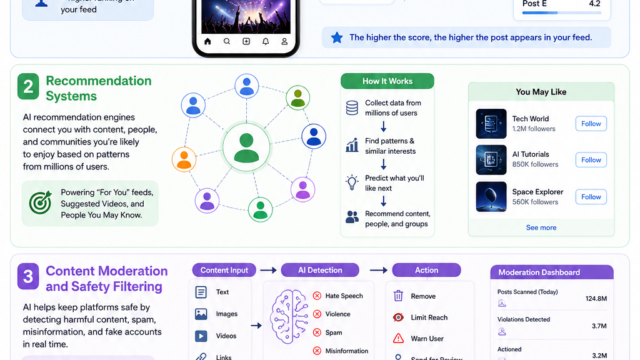
1. Personalized Feeds and Content Ranking

Every time you scroll through platforms like Instagram, Facebook, or X, AI is working in the background to rank posts. It studies what you like, comment on, share, and even how long you pause on a post.

https://images.openai.com/static-rsc-4/ZqXnISPF2w4wUvuzkVxi-BNlI1tp5njk2Ep5ESBKLStagJD52VN4SZ63f-UGmVU0o2wT6IQLUMw0IQVkHIR76TYLKXszyjDEValdLC6i5RsorHf86CZQp8rydmlZJUh7qNyO0Db5ZtpDDFWcla_VVX5QS91tc910y2iz0Ix4zsA3a8vfsSnsuJWVT2GM5Me0?purpose=fullsize
https://images.openai.com/static-rsc-4/x32kOe9HKxb363pIMbZ7xQAGhr1bs2aPvtQIqfjfXVJQmOjk4-nl0r8TsQcNliDh8crYdHVmuVY2zo2rhS929OU0LNlI4ECV0seBu3FapkOuxgEr22laKYJdQXVj1vMEepg3x7NLd3z3PLqri5mJKCPECVDevBMzmmVlsQ_weAqnyfSvgQpXTk-8dqTtbE0b?purpose=fullsize
https://images.openai.com/static-rsc-4/JM9z-g7OB2LR74zGzJvwnM9pdiL-0KIsgmUzKXtrdBar-M2vcj4rrMenFGblJ1qFcns7g-wsQHKSyPFcVfaszVaVa0Oq7t25cyIoUr8ah1LEAEZcXFPnZkDklubQZWebLG1x0xPjZR6yOL83NMkUxXtgpZ3JYFZpdB0C_bYNg0brJTOXVNSmjUG-VCmNohn4?purpose=fullsize

9

Machine learning models assign a “relevance score” to each post. Higher scores mean the post appears closer to the top of your feed. This is why two users rarely see the same timeline in the same order.


2. Recommendation Systems (What You Should Watch Next)

Recommendation engines power features like “Suggested Videos,” “People You May Know,” and “For You Pages.”

https://images.openai.com/static-rsc-4/1B-MwKneOumo1aOCYjwR8u3RF9okfs3nLm29ZV9AQ12nWae66k8BfCOomrBI6Dl9rzB4KSq_FdMeDOjwxeLv-HH242HkxqEw75k0qWeG9-pjWmejwlEIGkoRXvl554eVftv_wQVRAXRBQGhWlHy4wKnzgoh01t7zJtwraKiWbw0YWjP1VMN1W_aUzFHvlTmo?purpose=fullsize
https://images.openai.com/static-rsc-4/_Y3c2npEqIw_atQamDUKffbVD9J1duWvP9R5bF2QBu8E0ITUvMUnbP93vToQ7tzCSy5ySN4LX_UN24eDDMSpQil_O7HEou_iPaf7auXn32E2urmTeZZj0Bi3i9KZfh8RYtf12SObsxVzmYjMFrQlaLoHpDTvNWOK8lJ8KQvYHBbOqTZt4etGg8EGvrBY3Wtw?purpose=fullsize
https://images.openai.com/static-rsc-4/18Oca6__sR1zH6-o4Mvo29MwWsi4Ii8uAPcViMzR-XErzOUwGpT1RBitMTGEHrNv6Qg9W2ouddfOQmHhVx_FswssFDiWaM4wJwZY0YnX4euO9SR-pfLFbIUEUU2X8ortkCpI8r8HvlVCE9kKkFSH8eA6huXOgJB-T8a_GLD-Cva2LPxylO2zPu-VW7Ky8XD1?purpose=fullsize

8

These systems use collaborative filtering and deep learning to connect users with similar interests. For example, if many users who like tech videos also watch AI tutorials, the algorithm will recommend AI content to you even if you’ve never searched for it.


3. Content Moderation and Safety Filtering

AI also plays a major role in keeping social platforms safe by detecting harmful content, spam, misinformation, and fake accounts.

https://images.openai.com/static-rsc-4/HOgnphyAIhjLU__JuxiPZVn1zaU18RoKVc_s-nqo6fhG0a5x4iKeaapkZBy_-av-GjJUG3JpUDbUZlnwIgA5sizIlZ0-ARqoeKOt0KgFYXqYteteMoqPa7PCIAaYJN2vybqy3VS6Vk1zhYqzYMvgsm4HH5KSySxYIiN2BZXxIYorqM55uC30vV11OWqInbKl?purpose=fullsize
https://images.openai.com/static-rsc-4/aZg9CE_dA6lkge3iHv4fuvR3Qq37_6Swl242jp1P7ux9z_udVEfsGbmH_Y_6RU5UlxKlv8ELhvvlQ2uQzGSXrpUKPQ9g3dlGo5gVmhgWuvNkRLQoO7-JYSYvYwAmcROBCOGKN5DP1UbVkH2-Ca8qx1ZbzecUgUgNH7fal439AB-b4SnbLh-gi0SmtGPdkgZf?purpose=fullsize
https://images.openai.com/static-rsc-4/VSwMec-jqFbKhIvZtAnAxlvy7lfjwsKjOkxwoM8AsdNrfLRjwHlLszUShukYxGeDALETDbPpH-sR3iaKdF0H-FYb3V8TvqkJQWrwEgos_Gy1t7iTNp-bIEhnN5TGpKI_YQr4ehFxRV9_CBNQ1eCRyxtWvhlGBOkcxgx7-fku3wfZPB5I6H24cbFeqxbxoGRo?purpose=fullsize

7

Computer vision and natural language processing models scan text, images, and videos in real time. While not perfect, these systems help remove millions of violating posts every day before humans even see them.


4. Targeted Advertising and User Profiling

One of the most powerful uses of AI in social media is advertising. Platforms use AI to decide which ads you are most likely to click or buy from.

https://images.openai.com/static-rsc-4/LtbXU-NEmFpuKHp68Dxi-uTfX6kmzuIOfre2yc3t5IQipkrPLAkXWYHsxgyE4716e5-H-k_laq6zIkcPaAVAD3d9vQnNdQGR2EXPxBSPsUKhaeuedowlTauRJDpMuSi0pk6xy9kAR_lEy1qTQJ05C1Jsk0Q0B3fQWU22L5tCYL2DeQpy0gSvWVVWGEt7CVpg?purpose=fullsize
https://images.openai.com/static-rsc-4/S_ADokusYdYdBEFUtklHOYPjV4r2mYTwW8zOmFGgiBqEkYpeJc-TDX1rL9LaXEr3NkcIZ-6R9uDpAADQ7v9PfThbNfIdbIBstvTtVApFgW0CfQf8jJjYQ0yG4pbJA6yBiqFXdVBG0j_mspNnatbMYuf-4vKDI0pHY3p-OTomgiHLP2dqU-uiDtzSSUSAGEM2?purpose=fullsize
https://images.openai.com/static-rsc-4/7vUDHCOPOFk7RPyTmuhF3znAwf6akfl49VSQaB-3BhLjRfe1aszq7H0LQ35hf6KD7lxBBuWaMhQkrZXBZaXzKGkcF_5i9uBHR7GndNzxnv1LWkL0SdzosVd1QaVies3zPK5X3L3vvtNIbR4Qtu5IEUT4kuF0xG9q5LxU1FpWD1oCcFebU3cFnRA6ncwuNqNb?purpose=fullsize

6

AI builds detailed user profiles based on demographics, interests, and behavior patterns. This allows advertisers to reach highly specific audiences, improving conversion rates while making ads feel “personally relevant.”


Conclusion

AI is deeply embedded in social media, shaping what we see, how we interact, and even what we buy. While it improves personalization and safety, it also raises concerns about privacy, echo chambers, and over-personalization.

Competition Pressure in AI: How It Is Accelerating Innovation in 2026

The global artificial intelligence industry is evolving at an extremely fast pace, driven largely by intense competition among major technology companies. This competition is reshaping how quickly models are released, how capable they become, and how deeply they are integrated into everyday digital tools.

1. The Shift from Slow Releases to Rapid Iteration

In earlier years of AI development, major model upgrades took significant time—often years between large releases. However, the competitive landscape has changed dramatically.

Today, companies are prioritizing rapid iteration cycles, where models are updated frequently with incremental improvements. These updates may not always be massive breakthroughs individually, but together they create continuous performance gains in reasoning, coding, speed, and multimodal understanding.

This shift allows companies to respond quickly to user feedback and stay ahead in a highly competitive market.

2. OpenAI’s Push Toward Faster, Smarter Systems

OpenAI continues to accelerate its development cycle, focusing on improving reasoning ability, long-context understanding, and agent-like behavior.

Instead of building only conversational tools, the direction is now toward AI systems that can complete tasks, use tools, and perform multi-step workflows with minimal human input. This reflects a broader transition from chat-based models to action-oriented AI agents.

3. Google’s Ecosystem-Driven AI Strategy

Google is advancing its Gemini models with a strong emphasis on integration across its ecosystem, including Search, Android, and Workspace tools.

Rather than treating AI as a standalone product, Google is embedding intelligence directly into the services billions of users already rely on. This approach aims to make AI a seamless part of productivity, communication, and information discovery.

4. Meta’s Focus on Open and Social AI

Meta is taking a different but equally aggressive approach by focusing on open-source models and AI integration within social platforms.

By embedding AI into apps like WhatsApp, Instagram, and Facebook, Meta is scaling AI usage across global social networks. Their open model strategy also encourages developers to build new applications on top of their systems, increasing innovation outside the company itself.

5. The Result: A Fast-Moving AI Race

The combined pressure from these companies has created a rapid innovation cycle across the entire industry. Key outcomes include:

  • Faster model releases and updates
  • Continuous performance improvements instead of slow generational leaps
  • Stronger focus on AI agents that can perform real tasks
  • Wider integration of AI into everyday apps and devices

Conclusion

Competition in the AI industry is no longer just about who has the most powerful model—it is about who can iterate the fastest, integrate the deepest, and deliver the most useful real-world capabilities. As companies like OpenAI, Google, and Meta continue to push each other, the pace of innovation is likely to remain extremely high, shaping a future where AI systems become more capable, more embedded, and more autonomous.

How to Start a Career in Artificial Intelligence and Machine Learning

Starting a career in Artificial Intelligence (AI) and Machine Learning (ML) is very achievable today, but it requires a clear roadmap because the field combines math, programming, and real-world problem solving.

Here’s a structured path you can follow:


1. Understand What AI & ML Really Are

Before jumping in, get clarity:

  • Artificial Intelligence is the broader field of making machines “think” or simulate human intelligence.
  • Machine Learning is a subset of AI where systems learn patterns from data instead of being explicitly programmed.

Common areas:

  • Computer Vision (images, video)
  • Natural Language Processing (chatbots, translation)
  • Predictive Analytics (finance, business forecasting)

2. Build Strong Programming Foundations

Most AI/ML work is done in Python.

Focus on:

  • Python basics (functions, loops, OOP)
  • Libraries:
    • NumPy (math operations)
    • Pandas (data handling)
    • Matplotlib / Seaborn (visualization)

Practice platforms:

  • LeetCode (logic building)
  • HackerRank (Python practice)

3. Learn Math (Important but Practical)

You don’t need to be a mathematician, but you must understand:

  • Linear Algebra (vectors, matrices)
  • Probability & Statistics
  • Basic Calculus (gradients, optimization)

These concepts help you understand how ML models actually “learn.”


4. Learn Core Machine Learning Concepts

Start with classical ML before deep learning.

Key topics:

  • Regression (linear, logistic)
  • Classification
  • Clustering (K-Means)
  • Decision Trees & Random Forests
  • Model evaluation (accuracy, precision, recall)

Use:

  • Scikit-learn (main ML library)

5. Move to Deep Learning

Once ML basics are clear:

Learn:

  • Neural Networks
  • CNN (images)
  • RNN / Transformers (text, AI chat systems)

Frameworks:

  • TensorFlow
  • PyTorch (very popular in research & industry)

6. Work on Real Projects (Most Important Step)

Projects matter more than certificates.

Beginner ideas:

  • Spam email classifier
  • House price prediction
  • Handwritten digit recognition
  • Chatbot using NLP

Advanced ideas:

  • Fake news detection system
  • Image recognition app
  • Recommendation system (like Netflix/YouTube)

Put projects on:

  • GitHub (must-have for portfolio)

7. Learn Data Handling & Tools

Real AI work is mostly data work.

Learn:

  • SQL (databases)
  • Data cleaning techniques
  • Feature engineering
  • Basic cloud tools (AWS / Google Cloud optional)

8. Build a Portfolio + Resume

Employers look for proof of skill:

Include:

  • 3–6 strong projects
  • GitHub links
  • Kaggle profile (competitions help a lot)
  • Internship or freelance experience if possible

9. Join AI Communities

This helps you grow faster:

  • Kaggle (competitions + datasets)
  • GitHub (open-source projects)
  • Reddit / Discord AI groups
  • LinkedIn AI communities

10. Choose a Career Path

AI/ML is broad. You can specialize:

  • ML Engineer (industry-focused)
  • Data Scientist (analytics + insights)
  • AI Researcher (advanced math + innovation)
  • NLP Engineer (chatbots, language models)
  • Computer Vision Engineer (image/video AI)

11. Suggested Learning Timeline (Simple Plan)

  • Months 1–2: Python + basics of math
  • Months 3–4: Machine Learning (Scikit-learn)
  • Months 5–6: Deep Learning + first projects
  • Months 6+: Portfolio + internships + specialization

Beginner’s Guide to AI: What You Need to Know in Simple Terms

Artificial Intelligence (AI) is no longer a futuristic idea—it’s part of everyday life. From unlocking your phone with face recognition to getting personalized recommendations on Netflix or YouTube, AI is already working behind the scenes. But for beginners, it can feel confusing or overly technical. This guide breaks it down in simple terms so you can understand what AI really is, how it works, and why it matters.


What is Artificial Intelligence?

Artificial Intelligence is the ability of machines or software to perform tasks that normally require human intelligence. These tasks include learning, problem-solving, understanding language, recognizing images, and making decisions.

In simple terms, AI is when computers are trained to “think” and “learn” from data so they can do things on their own without being explicitly programmed for every step.


How Does AI Actually Work?

AI works by using large amounts of data and algorithms (step-by-step instructions) to find patterns.

Here’s a simple breakdown:

  • Data Input: AI systems are fed massive amounts of information (text, images, videos, etc.).
  • Learning Patterns: The system analyzes the data to find patterns and relationships.
  • Making Predictions: Based on what it has learned, AI makes decisions or predictions.
  • Improving Over Time: The more data it processes, the smarter it becomes.

For example, if you keep watching cooking videos, AI learns your interest and suggests similar content.


Types of AI You See in Daily Life

AI is not just one thing—it appears in different forms:

1. Narrow AI

This is the most common type of AI today. It is designed for specific tasks like voice assistants, chatbots, or recommendation systems.

2. Machine Learning

A subset of AI where systems learn from data instead of being directly programmed. For example, spam filters in email.

3. Deep Learning

A more advanced form of machine learning that uses neural networks, similar to how the human brain works. It powers things like facial recognition and self-driving technology.


Real-World Examples of AI

You probably use AI more than you realize:

  • Voice assistants like Siri or Google Assistant
  • Social media feeds that show personalized content
  • Online shopping recommendations on Amazon or Flipkart
  • Navigation apps like Google Maps
  • Chatbots on websites for customer support

AI is silently improving convenience and speed in many daily activities.


Why AI is Important

AI is changing the way the world works. Here’s why it matters:

  • Saves time: Automates repetitive tasks
  • Improves accuracy: Reduces human errors
  • Boosts productivity: Helps businesses work faster and smarter
  • Enhances decision-making: Uses data to provide better insights
  • Drives innovation: Powers new technologies like self-driving cars and smart devices

Should Beginners Learn AI?

Yes—AI is becoming a valuable skill in many industries. You don’t need to be a tech expert to start. Beginners can begin with:

  • Basic computer knowledge
  • Understanding data and logic
  • Learning simple tools like ChatGPT, Excel AI features, or beginner coding platforms

Over time, you can explore programming languages like Python or dive into machine learning concepts.


Conclusion

Artificial Intelligence may sound complex, but at its core, it’s just technology designed to learn and make decisions like humans. As AI continues to grow, understanding the basics will help you stay ahead in both your personal and professional life. Whether you’re a student, professional, or curious learner, AI is worth exploring because it’s shaping the future right now.