AI Research: Exploring the Future of Artificial Intelligence Through Discovery, Innovation, and Responsible Development 🤖🔬

https://images.openai.com/static-rsc-4/HyxZPvuetsyQH0_AYuYC0l9JOo4vpt_ZKaG_Bu02TRK-cBGMmYLclde2zHLetDNcEFblgRzfCRlsNhNSxZwKupS-iZxK3mrDQuyDUPvx9LtcBuwCC52S_z_ybFz15oGDxJ_-IB_udAF59D1LFjF-AljG832iYAbxbWxsaWnK9aAQX_IfKiW0zrtpgrRftcv-?purpose=fullsize
https://images.openai.com/static-rsc-4/gnhbfezOZHnX_xvlBiAP5lD0UPtiCCg782WWawh0vop4zz4Xasy5AmyLJ-WI0-5OCfkFIT8TZAqucqdYMEDxIU8DXq-qFBrXrhRr4D36GuYbWkCKtWT6O-QfHQg3qw65qWB7G9m6-sdCnsoNyDY-Y5W2hlQ9_ndtfx0BVHrlfJqosBAJW9rFg6CLCBIgb3nL?purpose=fullsize
https://images.openai.com/static-rsc-4/a2T_V3ANX4mRlVl3P8gn7QRXuWQCVVm5gQ8m1fqrs1sapVdaRRJ3uSrzimqfLOVfzf9efCv1LkOMdHTUXVHO7_oZwa0df0M7GCaEVvt_WhYyaP-UliDKSpjy8WqqWVD_ZVvd05umYbqF6VwXCswQyBcIVimBGXGdZWieocpmDkox6jSQ2NDMRb-xlzAJgttL?purpose=fullsize

Artificial intelligence has moved from a specialized research topic to one of the most influential areas of modern technology. From machine learning and computer vision to natural language processing and robotics, AI research is changing how researchers approach difficult scientific and technological problems. 🤖✨

The term AI research covers a remarkably broad field. It includes the development of algorithms, the study of intelligent systems, the creation of new machine-learning architectures, the investigation of human-computer interaction, and the examination of how AI should be developed and deployed responsibly.

Modern AI research is also becoming increasingly interdisciplinary. Computer scientists collaborate with mathematicians, neuroscientists, linguists, engineers, economists, medical researchers, psychologists, designers, and ethicists. This combination of expertise allows researchers to investigate AI from technical, scientific, social, and practical perspectives.

The future of artificial intelligence will not be determined by one invention alone. It will emerge through thousands of experiments, research papers, engineering improvements, datasets, evaluations, debates, and discoveries.

This article explores the world of AI research, its major areas, current challenges, practical applications, research methodology, responsible development, and the possibilities that may shape the next generation of intelligent technologies. 🔬🌎

Understanding the Foundations of AI Research 🧠📚

Artificial intelligence research is fundamentally about creating computational systems capable of performing tasks that traditionally require aspects of human intelligence.

These tasks can include recognizing patterns, understanding language, making predictions, learning from examples, solving problems, planning actions, and interpreting complex information.

However, AI does not represent a single technology.

It is an umbrella term covering many different approaches.

Machine learning allows systems to learn patterns from data rather than relying exclusively on manually written rules.

Deep learning uses multilayered neural networks to process complex data such as images, audio, text, and video.

Natural language processing focuses on enabling computers to process and generate human language.

Computer vision investigates how machines can interpret visual information.

Robotics combines perception, planning, control, and physical interaction.

Reinforcement learning investigates how systems can learn actions through feedback from an environment.

Other areas include knowledge representation, reasoning, optimization, speech recognition, multi-agent systems, AI safety, human-computer interaction, and computational creativity.

Understanding these areas is important because breakthroughs in one area can influence others.

For example, advances in machine learning can improve computer vision. Better language models can support robotics through improved instruction following. More efficient hardware can make complex models easier to deploy.

AI research therefore resembles an interconnected ecosystem rather than a collection of isolated technologies.

The Evolution of Artificial Intelligence Research 🕰️💡

The history of artificial intelligence is filled with changing ideas about what machines can accomplish.

Early AI research focused heavily on symbolic reasoning. Researchers attempted to represent knowledge explicitly and create systems capable of manipulating symbols according to defined rules.

These approaches produced important demonstrations but faced difficulties when problems became too complex or uncertain.

As computing power increased and larger datasets became available, statistical approaches to machine learning became increasingly important.

Instead of explicitly programming every rule, researchers could develop algorithms that learned patterns from examples.

Neural networks eventually became a major part of this transformation.

Although neural-network research has roots going back decades, improvements in hardware, data availability, optimization techniques, and network architectures helped produce dramatic advances in deep learning.

Computer vision systems became increasingly capable of identifying objects and patterns.

Speech recognition improved.

Machine translation became more practical.

Natural language systems became more sophisticated.

The emergence of transformer-based architectures represented another major development in modern AI research. These architectures became especially important for language modeling and subsequently influenced multimodal systems and other AI applications.

The history demonstrates an important lesson: AI progress rarely comes from algorithms alone.

It usually depends on the interaction between algorithms, computing resources, datasets, mathematical methods, engineering, and evaluation.

This is why AI research remains an active field.

Even when a method works well, researchers continue searching for ways to make it more efficient, reliable, interpretable, and useful.

Machine Learning as a Core Research Area 📊🤖

Machine learning is one of the central pillars of contemporary AI research.

Traditional computer programs typically follow instructions created by developers.

Machine-learning systems instead use algorithms that identify patterns in data.

A simple example is image classification.

Suppose researchers provide a model with thousands of labeled images. During training, the model adjusts internal parameters to identify patterns associated with different categories.

After training, researchers can evaluate whether the model correctly classifies images it has not previously encountered.

This process sounds straightforward, but effective machine learning requires careful research.

Researchers must consider:

  • Data quality
  • Dataset size
  • Model architecture
  • Training methods
  • Computational resources
  • Evaluation metrics
  • Generalization
  • Bias
  • Robustness
  • Reproducibility

A model can achieve high performance on one benchmark while performing poorly in a different environment.

That is why evaluation is such an important component of AI research.

Researchers need to understand not only whether a model works, but also where it works, why it works, and where it fails.

Machine learning research also explores different learning approaches.

Supervised learning uses labeled examples.

Unsupervised learning investigates patterns in data without conventional labels.

Self-supervised learning creates training signals from the data itself.

Reinforcement learning involves interaction with an environment and feedback.

Each approach has different strengths and limitations.

The research challenge is often finding the appropriate method for a particular problem.

Deep Learning and Neural Networks 🔬🧠

Deep learning has become one of the most influential approaches in modern AI.

Neural networks consist of interconnected computational units organized into layers. Deep networks contain many layers and can learn increasingly complex representations from data.

For image-related tasks, convolutional architectures played a major historical role in advancing computer vision.

For sequential and language tasks, recurrent architectures contributed important developments before transformer architectures became dominant in many applications.

Transformers changed the research landscape by providing powerful mechanisms for modeling relationships among elements in sequences.

They have become central to many large-scale language and multimodal systems.

However, deep learning remains an active research field.

Researchers continue investigating how models represent information internally, how they learn from data, why they make certain errors, and how their capabilities emerge as scale increases.

Efficiency is another major research challenge.

Large models can require substantial computing resources.

Researchers therefore investigate techniques such as model compression, quantization, efficient architectures, parameter-efficient adaptation, and improved training methods.

The objective is not simply to build larger systems.

In many cases, researchers want to achieve better performance with fewer resources.

This matters because computational efficiency affects cost, energy consumption, accessibility, and deployment possibilities.

The next generation of AI may therefore depend as much on efficiency research as on raw model scale. ⚡💻

Natural Language Processing and AI Communication 🗣️💬

Natural language processing, or NLP, focuses on how computers process human language.

Language is complicated because meaning depends on context, culture, grammar, world knowledge, tone, and intention.

A single sentence can have different interpretations depending on the surrounding conversation.

AI research in NLP has explored many tasks, including translation, summarization, question answering, sentiment analysis, information extraction, speech processing, and text generation.

Large language models have expanded the possibilities of NLP by demonstrating strong capabilities across multiple language tasks.

Yet important research questions remain.

How can language models produce more reliable information?

How can they better distinguish uncertainty from confidence?

How can researchers reduce unwanted biases?

How can systems understand long documents?

How can models reason effectively?

How can researchers evaluate generated content?

These questions are not purely technical.

Language systems interact directly with people, which means their design can influence education, communication, business, research, and information access.

Researchers therefore need to study both model capabilities and human interaction.

A language model that generates fluent text is not necessarily producing accurate or appropriate information.

Fluency and factual reliability are different properties.

This distinction is central to responsible AI development.

Computer Vision: Teaching Machines to Interpret Images 👁️📷

Computer vision is another major area of AI research.

The objective is to develop systems capable of extracting meaningful information from visual data.

Applications include object recognition, image classification, medical imaging, autonomous systems, satellite imagery, manufacturing inspection, agriculture, and augmented reality.

Computer vision researchers investigate how models can recognize objects despite differences in lighting, perspective, scale, background, and image quality.

Medical imaging presents particularly important challenges.

An AI system may be trained to identify patterns in X-rays, CT scans, MRI images, or other medical data.

But clinical environments can differ from research datasets.

A model developed using data from one hospital may not perform identically in another hospital with different equipment, patient populations, or imaging procedures.

This is why researchers emphasize generalization and external validation.

A successful AI system needs to work reliably beyond the specific data used during development.

Computer vision research also examines fairness and representation.

If a dataset does not adequately represent different populations or environments, model performance may vary across groups.

Responsible research therefore includes careful dataset construction and evaluation.

The goal is not simply to create systems that perform well under laboratory conditions.

The goal is to understand whether those systems remain reliable when used in real environments.

AI in Scientific Research 🔬🌌

One of the most exciting areas of AI research is the use of artificial intelligence to accelerate scientific discovery.

Scientific research often involves enormous datasets.

Astronomers analyze images and signals from space.

Biologists study genetic sequences.

Climate scientists examine environmental measurements.

Chemists investigate molecular structures.

Physicists analyze experimental observations.

AI can help researchers identify patterns within these datasets.

Machine-learning systems can sometimes detect relationships that would be difficult to identify manually.

AI can also assist with prediction, simulation, optimization, classification, and experimental design.

In drug discovery, for example, researchers can use computational models to investigate molecular properties and identify potential candidates for further study.

In materials science, AI can help researchers explore possible materials with desirable characteristics.

In astronomy, machine learning can assist with identifying objects or patterns in massive collections of observations.

The important point is that AI does not necessarily replace scientific reasoning.

Instead, it can become another research instrument.

Scientists still need to formulate questions, validate results, interpret evidence, and understand limitations.

AI can accelerate parts of this process, but scientific conclusions require careful evaluation.

The relationship between AI and science may therefore become increasingly collaborative.

Researchers can use AI to search large spaces of possibilities while relying on scientific expertise to determine which possibilities deserve deeper investigation. 🌌🤖

AI Research in Healthcare and Medicine 🩺🤖

Healthcare is one of the most important application areas for AI research.

Potential applications include medical imaging, clinical decision support, drug discovery, patient monitoring, administrative automation, personalized medicine, and biomedical research.

AI can process large quantities of healthcare information, potentially helping researchers identify patterns across datasets.

However, healthcare AI requires particularly careful evaluation.

Medical decisions can have significant consequences, so performance metrics alone are not enough.

Researchers must consider reliability, interpretability, privacy, security, clinical workflow, human oversight, and potential disparities in performance.

A model that performs well in a controlled research environment may behave differently in everyday clinical practice.

This is why collaboration between computer scientists, physicians, nurses, public health researchers, statisticians, patients, and other experts can be valuable.

Healthcare AI should be designed around real clinical needs rather than technological capability alone.

Researchers must also consider whether a system genuinely improves outcomes or simply adds another layer of complexity.

The future of medical AI will therefore depend not only on better algorithms but also on careful clinical research and responsible implementation.

Robotics and Intelligent Machines 🤖⚙️

Robotics brings AI into the physical world.

A software system can process information digitally, but a robot must perceive its environment, make decisions, move, and interact with physical objects.

This creates additional research challenges.

Robots operate in environments that are often unpredictable.

Objects may move.

Lighting can change.

People may behave unexpectedly.

Surfaces may differ.

Sensors may contain noise.

Robotic systems therefore need robust perception and control.

AI research can contribute to object recognition, navigation, planning, manipulation, and human-robot interaction.

Applications range from manufacturing and logistics to healthcare, agriculture, exploration, and household assistance.

Robotics also raises questions about human interaction.

A robot working near people needs to behave predictably and safely.

It should communicate its actions appropriately and respond to changing circumstances.

This requires more than mechanical engineering.

Robotics combines computer science, electrical engineering, mechanical engineering, cognitive science, control theory, design, and human factors.

The field demonstrates how AI becomes more complicated when intelligence must interact with the physical environment.

AI and Data: The Importance of High-Quality Information 📈🔎

Data is one of the foundations of modern AI.

Models learn from examples, making the quality of those examples extremely important.

Poor-quality data can produce unreliable systems.

Data can contain errors, duplicates, missing values, outdated information, inappropriate labels, or unintended biases.

Researchers therefore spend substantial effort collecting, cleaning, organizing, labeling, and evaluating datasets.

Data governance has become an important part of AI research.

Researchers need to understand where data came from, how it was collected, what populations it represents, and what limitations it contains.

Privacy is another major consideration.

Personal information should not automatically become training data simply because it is technically accessible.

Researchers need appropriate legal, ethical, and institutional frameworks for data use.

Synthetic data is another growing research area.

Researchers can generate artificial examples to supplement real-world datasets or investigate specific scenarios.

However, synthetic data also requires careful evaluation.

Generated data may contain artifacts or reproduce assumptions present in the systems that created it.

Good AI research therefore treats data as a scientific resource requiring documentation and critical examination.

Better data can sometimes produce more meaningful improvements than simply increasing model size. 📊✨

Responsible AI and Ethical Research ⚖️🤝

As AI systems become more capable, responsible development becomes increasingly important.

AI research can produce enormous benefits, but systems can also produce harmful outcomes when designed or deployed carelessly.

Researchers therefore examine questions involving fairness, privacy, transparency, accountability, security, reliability, and human oversight.

Bias is a particularly important topic.

AI systems learn from data and design choices created by people. If training data contains historical biases or insufficient representation, models can reproduce or amplify those patterns.

Researchers can investigate these issues through dataset analysis, fairness evaluation, model testing, and monitoring.

Transparency is another challenge.

Some complex AI models can be difficult to interpret.

Researchers are investigating explainability methods that may help users understand why a system produced a particular output.

However, explanation methods themselves must be evaluated carefully.

A simplified explanation is not automatically a complete explanation of a model’s internal behavior.

Security is also important.

AI systems can be exposed to malicious inputs, data manipulation, prompt attacks, or other forms of exploitation.

Researchers study ways to make systems more robust.

Responsible AI therefore requires ongoing research rather than a one-time checklist.

As systems change, new risks and new questions can emerge.

Ethical AI is ultimately connected to technical research, organizational practices, law, governance, and human values.

Evaluating AI Systems Properly 📋🔬

One of the most important parts of AI research is evaluation.

Researchers need reliable methods to determine whether a system actually works.

Different tasks require different metrics.

For classification, researchers may measure accuracy, precision, recall, or other statistics.

For language generation, automated metrics can provide some information, but human evaluation may also be necessary.

For robotics, researchers may examine task completion, safety, efficiency, and robustness.

For healthcare systems, evaluation may involve clinical outcomes and real-world performance.

A benchmark can be useful because it allows researchers to compare systems under standardized conditions.

But benchmarks have limitations.

A model can become optimized for a benchmark without necessarily becoming better at real-world tasks.

This is sometimes described as overfitting to evaluation environments.

Researchers therefore increasingly consider multiple forms of testing.

These can include laboratory evaluation, stress testing, human evaluation, external validation, real-world trials, and longitudinal monitoring.

The question should not simply be:

“How high is the score?”

It should also be:

“What does the score actually tell us?”

Understanding the limits of evaluation is part of good scientific practice.

The Importance of Open Research and Collaboration 🌐🤝

AI research advances through collaboration.

Researchers publish papers, release datasets, develop software, share benchmarks, attend conferences, and discuss results with other experts.

This process allows ideas to spread and mistakes to be identified.

Open-source tools have also contributed to AI development by making software frameworks, models, and research resources accessible to wider communities.

However, openness involves trade-offs.

Some AI capabilities can potentially be misused.

Researchers may therefore face difficult questions about what should be publicly released and under what conditions.

Responsible research requires balancing scientific openness with security and safety considerations.

Collaboration across institutions can also reduce duplicated effort.

Universities, companies, governments, nonprofit organizations, and independent researchers each contribute different resources and perspectives.

Universities may focus on fundamental questions.

Companies may emphasize product development and scalable systems.

Government laboratories may pursue national research priorities.

Nonprofit organizations may investigate social impact and public-interest applications.

When these groups collaborate responsibly, research can benefit from diverse expertise.

The Future of AI Research 🚀🤖

The next generation of AI research is likely to explore several interconnected directions.

One major area is multimodal intelligence.

Future systems may increasingly process text, images, audio, video, sensor information, and other data types together.

Another area is AI agents.

Researchers are investigating systems capable of planning and completing multi-step tasks rather than simply responding to individual prompts.

AI efficiency will also remain important.

Researchers are likely to continue developing smaller, faster, and more energy-efficient models.

Scientific AI could become increasingly significant as researchers use machine learning to explore complex scientific problems.

Robotics may benefit from stronger perception, planning, and learning systems.

AI safety and alignment research will remain important as capabilities increase.

Human-AI collaboration may become another major research field, focusing on how people and AI systems can work together effectively.

These areas should not be considered separate.

Progress in one may influence another.

More efficient models can improve robotics.

Better multimodal systems can support scientific research.

Improved human-AI interaction can influence how AI is used in healthcare and education.

The future will likely emerge from these connections.

Building a Career in AI Research 🎓💻

Students interested in AI research can enter the field through many academic backgrounds.

Computer science is an obvious pathway, but mathematics, statistics, electrical engineering, physics, neuroscience, linguistics, cognitive science, and other disciplines can also provide relevant foundations.

Strong mathematical skills can be particularly useful.

Linear algebra, probability, statistics, calculus, optimization, and discrete mathematics appear throughout machine learning research.

Programming skills are also important.

Python is widely used in machine-learning research, while knowledge of algorithms, data structures, software engineering, and computing systems can provide additional advantages.

Students should also learn how to read research papers critically.

A research paper is not simply a list of facts.

It contains a question, methodology, assumptions, experiments, results, limitations, and interpretation.

Understanding these components helps students evaluate research rather than accepting every published result uncritically.

Practical projects can also be valuable.

Students might build a small machine-learning model, analyze a dataset, reproduce a published experiment, contribute to an open-source project, or participate in a research laboratory.

The objective is not to create the world’s most sophisticated AI system.

The objective is to learn the research process.

Ask a question.

Build a method.

Collect evidence.

Test the idea.

Analyze the results.

Identify limitations.

Improve the approach.

Repeat.

That cycle is at the heart of research. 🔬

Conclusion: AI Research as a Continuous Journey 🌟🤖

Artificial intelligence research is not a single destination.

It is an ongoing journey driven by curiosity, experimentation, mathematics, engineering, data, and collaboration.

From machine learning and deep neural networks to natural language processing, computer vision, robotics, healthcare, scientific discovery, and responsible AI, researchers are exploring a remarkably broad landscape.

The most important developments may not always come from simply making models larger.

They may come from making them more efficient, reliable, interpretable, secure, adaptable, and useful.

The future of AI research will also depend on collaboration between technical experts and people from other disciplines.

Computer scientists need scientists.

Engineers need designers.

AI developers need domain experts.

Researchers need ethicists.

Technology needs human context.

The field therefore belongs to many communities.

For students and aspiring researchers, AI offers an opportunity to investigate difficult questions and contribute to technologies that may shape future society.

For organizations, AI research can provide new approaches to scientific, commercial, and social challenges.

For society, continued research creates an opportunity to understand both the possibilities and limitations of intelligent systems.

The most productive approach is neither unquestioning excitement nor automatic skepticism.

It is curiosity combined with evidence.

Ask what an AI system can do.

Ask how it was developed.

Ask what data it uses.

Ask how it was evaluated.

Ask where it fails.

Ask who benefits.

Ask what risks remain.

And then continue researching.

That mindset captures the spirit of AI research.

🔬 Research creates knowledge.

🧠 Knowledge enables understanding.

💡 Understanding enables innovation.

🤝 Collaboration improves discovery.

⚖️ Responsible development connects innovation with human needs.

🚀 Curiosity keeps the field moving forward.

Artificial intelligence will continue to evolve, but the fundamental principle of research remains constant: there is always another question worth asking, another experiment worth conducting, and another possibility waiting to be explored. 🌍🤖✨
:::

AI-Powered Personal Assistants: How They Are Changing Everyday Life

Image
Image
Image
Image
Image
Image

AI-Powered Personal Assistants: How They Are Changing Everyday Life 🤖📱

Artificial intelligence is becoming an increasingly visible part of everyday life. What once seemed like futuristic technology is now integrated into smartphones, computers, smart-home devices, search tools, productivity platforms, and online services. Among the most noticeable applications are AI-powered personal assistants.

Traditional digital assistants could answer simple questions, set alarms, provide weather information, or play music. Modern AI assistants are becoming more capable. They can understand natural language, summarize information, help write messages, organize tasks, explain complicated subjects, brainstorm ideas, analyze documents, and support people across many daily activities.

As these systems become more sophisticated, they are changing how people interact with technology. Instead of navigating multiple menus and applications, users can increasingly describe what they want in ordinary language.

The transformation is not limited to convenience. AI-powered assistants may influence productivity, education, communication, shopping, travel, entertainment, accessibility, and professional work.

At the same time, their growing capabilities raise important questions about privacy, accuracy, security, dependence, and responsible use.

Understanding both the opportunities and limitations of AI assistants can help people use them more effectively.

🤖 What Are AI-Powered Personal Assistants?

An AI-powered personal assistant is software that uses artificial intelligence to understand requests and provide information or perform certain tasks.

Traditional digital assistants often relied heavily on predefined commands.

Modern AI assistants can use natural-language processing and generative AI to interpret more complex requests.

For example, instead of saying a specific command to create a reminder, a user might say:

“Remind me tomorrow afternoon to prepare for my meeting.”

Depending on the system and its available integrations, the assistant may interpret the request and help create an appropriate reminder.

More advanced assistants can also work across different types of information, including text, images, audio, and documents.

🧠 From Commands to Conversations

One of the biggest changes is the shift from command-based interaction toward conversation.

Users can ask follow-up questions, clarify requests, change instructions, and continue a discussion without starting from scratch.

This makes technology feel more natural and accessible.

Image
Image
Image
Image
Image
Image

📅 1. Helping People Manage Daily Tasks

One of the most practical uses of AI assistants is everyday organization.

People manage appointments, deadlines, shopping lists, messages, travel plans, school assignments, and work responsibilities.

An AI assistant can help organize this information and turn vague intentions into actionable steps.

For example, a user could ask an assistant to:

  • Create a daily schedule
  • Organize a task list
  • Summarize a long email
  • Draft a reminder
  • Prepare a meeting checklist
  • Suggest ways to prioritize work
  • Break a large project into smaller tasks

These capabilities can reduce the amount of time spent on routine organization.

⏰ Better Time Management

AI assistants can help users identify priorities and structure their day.

However, users should still make the final decisions about important commitments.

An AI system may not understand every personal circumstance, deadline, or responsibility.

The best approach is to use AI as an organizational aid rather than allowing it to make important decisions without review.

✍️ 2. Changing the Way People Communicate

Writing is another area where AI assistants can be useful.

People can use them to draft emails, improve grammar, summarize documents, rewrite complicated sentences, or adjust the tone of a message.

For example, someone writing a professional email can ask an AI assistant to make the message clearer and more concise.

Students can use AI to brainstorm ideas or understand difficult writing concepts.

Professionals can use AI to organize notes and create initial drafts.

🗣️ Communication Becomes More Accessible

AI assistants can help people who find writing difficult or who communicate in languages other than their strongest language.

They can also help transform information between formats—for example, turning notes into a structured outline or summarizing a long document into key points.

However, users should review important communications before sending them.

AI-generated writing may contain incorrect information or fail to reflect the user’s intended meaning.

📚 3. Transforming Education

AI assistants are increasingly being used as learning tools.

Students can ask questions, request explanations, generate practice exercises, or explore unfamiliar topics.

A student struggling with a mathematical concept might ask for a simpler explanation.

A language learner might practice conversations.

A student studying history might request a timeline or comparison of events.

🎓 Personalized Learning Support

AI assistants can adapt explanations to different levels of understanding.

A beginner can request a simple explanation, while an advanced learner can ask for a more technical discussion.

This flexibility can supplement classroom learning.

However, students should use AI to support learning rather than simply copy answers.

The goal should be to understand concepts, develop reasoning skills, and become a more independent learner.

💼 4. Improving Workplace Productivity

AI assistants are becoming increasingly relevant to professional work.

Employees can use them to summarize meetings, organize information, draft documents, analyze data, prepare presentations, brainstorm ideas, and create initial versions of reports.

This can reduce time spent on repetitive tasks.

⚙️ Automating Routine Work

Many office tasks follow predictable patterns.

AI assistants may help with:

  • Meeting summaries
  • Email drafting
  • Document organization
  • Research summaries
  • Spreadsheet assistance
  • Project planning
  • Customer-service responses
  • Content creation
  • Basic data analysis

Automation can free employees to spend more time on complex work that requires human judgment.

However, organizations need policies governing what information employees can safely share with AI systems.

🏠 5. Making Smart Homes More Intelligent

AI assistants can also interact with connected home devices.

Depending on the available technology, users may be able to control lights, thermostats, appliances, entertainment systems, or security devices through voice or text.

The combination of AI and smart-home technology could make home automation more conversational.

Instead of remembering specific commands, users could describe what they want in natural language.

💡 More Context-Aware Homes

Future systems may become better at understanding context.

For example, an assistant might help coordinate a household schedule or remind users about recurring tasks.

However, smart-home systems also create privacy and cybersecurity considerations because connected devices can collect information about people’s homes and routines.

🛒 6. Changing Shopping and Consumer Decisions

AI assistants can also influence how people shop.

They can help users compare products, summarize specifications, organize shopping lists, and identify features that match their needs.

Instead of browsing hundreds of product pages, consumers may increasingly ask AI systems to narrow down options.

🔎 Smarter Product Research

For example, someone shopping for a laptop might ask an AI assistant to compare battery life, performance, portability, and price ranges.

However, consumers should verify important specifications and current prices before making purchasing decisions.

AI-generated recommendations can be incomplete or outdated.

✈️ 7. Simplifying Travel Planning

Travel planning often involves coordinating transportation, accommodation, activities, budgets, and schedules.

AI assistants can help users organize these elements.

They can generate itinerary ideas, summarize destination information, suggest questions to ask hotels or airlines, and help create packing lists.

🌍 Personalized Travel Assistance

An AI assistant can potentially adapt suggestions according to factors such as:

  • Trip duration
  • Budget
  • Interests
  • Transportation preferences
  • Accessibility needs
  • Travel companions

However, travelers should verify important details such as visa requirements, opening hours, transportation schedules, cancellation policies, and local regulations.

AI can assist with planning, but current official information should remain the final authority for time-sensitive travel requirements.

💰 8. Supporting Personal Finance

AI assistants can help people organize financial information and learn basic financial concepts.

For example, they can explain terms such as:

  • Budgeting
  • Compound interest
  • Inflation
  • Credit
  • Saving
  • Investment diversification

They can also help users create simple budgeting frameworks.

However, financial decisions can have significant consequences.

AI assistants should not automatically be treated as financial advisors, particularly when decisions involve investments, taxes, loans, insurance, or substantial amounts of money.

Users should verify financial information with reliable sources and qualified professionals when appropriate.

🩺 9. Supporting Health Information

AI assistants are increasingly being used to help people understand general health information.

They can explain medical terminology, summarize publicly available health information, or help users prepare questions for a healthcare professional.

For example, a person may ask an AI system to explain a medical term in simpler language.

⚠️ AI Is Not a Substitute for Medical Professionals

AI systems can make mistakes and may not have access to a person’s complete medical history.

They should not be relied upon to diagnose serious conditions or replace professional medical care.

For urgent or concerning symptoms, people should seek appropriate medical assistance rather than relying on an AI chatbot.

🧑‍🦽 10. Improving Accessibility

AI assistants may have an especially meaningful impact on accessibility.

People with certain disabilities can use voice interaction, speech-to-text, text-to-speech, image descriptions, summarization, and other AI-supported features.

For example, AI can help describe visual information or convert spoken language into written text.

These capabilities can make digital services easier to use for some people.

Accessibility improvements will depend on thoughtful design and reliable implementation.

🌐 11. Breaking Language Barriers

Translation and language support are another important application.

AI assistants can help users translate text, practice languages, explain unfamiliar phrases, and communicate across languages.

This can support international communication, education, tourism, and business.

However, translation quality can vary, especially with specialized terminology, cultural expressions, or less widely represented languages.

Important legal, medical, or business documents may still require professional translation or verification.

🎨 12. Supporting Creativity

AI assistants can also act as brainstorming partners.

Writers can use them to generate ideas.

Designers can explore concepts.

Entrepreneurs can brainstorm business models.

Students can develop project ideas.

Musicians and filmmakers can experiment with creative directions.

The value of AI in creativity is often greatest when humans remain actively involved.

💡 AI as a Creative Collaborator

Instead of asking AI to create everything, users can ask it to provide alternatives, challenge assumptions, identify weaknesses, or suggest new directions.

This keeps the human creator at the center of the process.

🔍 13. Making Information Easier to Understand

The internet contains enormous amounts of information.

AI assistants can help users summarize lengthy material and explain difficult concepts.

A user can provide a complex document and ask for:

  • A short summary
  • Key points
  • A list of important terms
  • Questions for further study
  • A simplified explanation
  • A structured outline

This can reduce the cognitive burden associated with processing large amounts of information.

However, summaries can omit important context.

For important decisions, users should review the original source material.

🧠 14. Helping People Learn New Skills

AI assistants can function as interactive learning companions.

Someone learning programming can ask for explanations of errors.

A beginner learning a language can practice conversations.

Someone learning business can ask for examples of marketing strategies.

A student can request practice questions and explanations.

The interactive nature of AI can make self-directed learning more accessible.

The key is active participation.

People learn more effectively when they attempt problems, receive feedback, and reflect on mistakes rather than simply asking AI to complete everything for them.

🔐 15. Privacy and Personal Data

The convenience of AI assistants comes with privacy considerations.

Personal assistants may process information about schedules, preferences, communications, documents, locations, or other personal activities depending on how they are configured.

Users should understand what information a particular AI service collects, how it is stored, and how it may be used.

🛡️ Practical Privacy Habits

Users can improve privacy by:

  • Avoiding unnecessary sharing of sensitive information
  • Reviewing privacy settings
  • Using strong account security
  • Enabling multi-factor authentication where available
  • Checking which applications have access to personal data
  • Reviewing connected services regularly

People should be especially cautious about entering passwords, financial credentials, confidential business information, or highly sensitive personal data into AI systems unless they understand the relevant security protections.

⚠️ 16. Accuracy and AI Hallucinations

AI assistants can sometimes generate information that sounds convincing but is incorrect.

This phenomenon is often called an AI hallucination.

The problem becomes particularly important when people assume that fluent language automatically means factual accuracy.

AI assistants may make errors involving:

  • Dates
  • Names
  • Statistics
  • Citations
  • Technical details
  • Legal information
  • Medical information
  • Product specifications

🔎 Verify Important Information

The more important the decision, the more carefully information should be verified.

Users should consult authoritative sources for legal, medical, financial, academic, and other high-stakes information.

🧑‍⚖️ 17. Ethical Questions About AI Assistants

As AI assistants become more capable, ethical questions become increasingly important.

Who is responsible if an AI assistant makes a harmful recommendation?

How should personal data be protected?

Should AI systems reveal when content was generated by AI?

How much autonomy should an assistant have?

What decisions should always require human approval?

These questions will influence the design and regulation of future AI systems.

🔄 18. The Evolution From Assistants to Agents

Today’s AI assistants are increasingly moving toward more agent-like capabilities.

A simple assistant answers questions.

A more advanced system may potentially perform multi-step tasks.

For example, instead of simply suggesting how to organize a project, an agent could potentially create a task list, draft documents, update approved software systems, and notify team members.

This transition could significantly increase productivity.

But greater autonomy also means greater responsibility.

Systems need appropriate permissions, monitoring, and safeguards to prevent unintended actions.

🏢 19. AI Assistants in Small Businesses

Small businesses may benefit significantly from AI assistants.

A small company with limited staff can use AI tools for tasks such as:

  • Drafting marketing content
  • Organizing customer inquiries
  • Creating internal documentation
  • Summarizing meetings
  • Researching competitors
  • Brainstorming products
  • Preparing basic reports

This can allow small teams to perform tasks that previously required more time or specialized resources.

However, businesses must protect confidential customer and company information.

📈 20. Changing the Nature of Productivity

AI assistants may change how productivity is measured.

In the past, productivity often meant how quickly a person could complete a task manually.

In an AI-assisted workplace, productivity may increasingly depend on how effectively a person can define objectives, provide context, evaluate AI outputs, and make final decisions.

This means human judgment becomes even more important.

🧭 From Doing Everything to Directing Work

Professionals may increasingly act as supervisors of AI-assisted workflows.

They may spend less time performing repetitive tasks and more time deciding what should be done, checking quality, and handling exceptions.

This could reshape many job roles.

🌱 21. The Importance of Human Skills

The growth of AI does not make human skills irrelevant.

In many cases, it makes them more valuable.

Skills such as:

  • Critical thinking
  • Creativity
  • Empathy
  • Leadership
  • Communication
  • Ethical judgment
  • Collaboration
  • Decision-making

remain essential.

AI can provide suggestions, but humans must determine whether those suggestions are appropriate.

🔮 22. What the Future May Look Like

The next generation of AI assistants may become more integrated across devices and applications.

Instead of having separate tools for email, calendars, documents, travel, shopping, and productivity, users may interact with a unified AI interface that can coordinate information across approved services.

Assistants may become more multimodal, understanding voice, text, images, video, and documents.

They may also become more personalized and capable of handling longer workflows.

However, the future will depend heavily on privacy protections, technical reliability, regulation, user trust, and responsible design.

🌟 Conclusion

AI-powered personal assistants are changing everyday life by making technology more conversational, accessible, and capable.

🤖 They can help people organize tasks.

📚 They can support learning.

💼 They can improve workplace productivity.

✍️ They can assist with communication.

🌍 They can support travel planning and language translation.

🧑‍🦽 They can improve accessibility.

🎨 They can support creativity and brainstorming.

At the same time, AI assistants have important limitations.

They can make mistakes, produce misleading information, create privacy concerns, and encourage overdependence if used without appropriate judgment.

The best way to use AI assistants is therefore not to treat them as perfect digital replacements for human thinking.

Instead, they should be viewed as powerful tools that can extend human capabilities.

The future of personal AI is likely to involve deeper integration into everyday devices and services. As these systems become more capable, people will need not only better AI technology but also better AI literacy.

Knowing what to ask, what to trust, what to verify, and what should remain a human decision will be essential.

The real transformation will not simply be that computers become more intelligent.

It will be that people learn how to work with intelligent systems in ways that are productive, safe, private, and responsible. 🤖🌍✨

Image
Image
Image
Image
Image
Image

The New Internet Era: How AI Is Changing the Way Humans Find Information

Introduction: From Searching the Web to Asking the Web

For more than two decades, the internet has been built around one simple action: searching. People opened a browser, typed keywords into a search engine, scanned through pages of results, clicked links, and collected information themselves. Search engines became the gateway to the digital world, helping billions of people discover websites, news, products, research papers, and entertainment.

However, the internet is entering a new phase. Artificial intelligence is changing not only how we search, but also how we interact with information itself. Instead of receiving a list of links, users are increasingly receiving direct answers, summaries, recommendations, and personalized explanations.

The future of online discovery may no longer be about finding the right webpage. It may be about having an intelligent system understand the question, analyze information from multiple sources, and provide the most useful response instantly.

This shift represents the beginning of a new internet era — an era powered by AI search, conversational interfaces, and intelligent digital assistants.


1. The Evolution of Internet Search

From Keywords to Understanding Intent

Traditional search engines were designed around keywords. If someone searched for “best smartphone under $500,” the search engine would identify pages containing those words and rank them based on relevance, popularity, and authority.

Although modern search engines became extremely advanced, the basic model remained similar: query → results → human evaluation.

AI is changing this process by focusing on user intent rather than only matching words.

For example, instead of searching:

“What are the symptoms of vitamin D deficiency?”

A user can ask:

“I feel tired every day despite sleeping enough. Could vitamin D deficiency be one reason?”

AI systems can understand context, interpret the problem, and provide a structured explanation rather than simply showing a collection of websites.

This represents a major transformation:

Old Internet:

  • User searches
  • Search engine provides links
  • User reads and compares information

AI Internet:

  • User asks questions
  • AI understands intent
  • AI creates a personalized answer

The internet is moving from a library model toward a conversation model.


2. The Rise of AI Search Engines

Image
Image
Image
Image
Image

AI-powered search engines are becoming the next generation of information discovery. Instead of displaying only ranked pages, they combine search technology with large language models capable of reasoning, summarizing, and generating responses.

Companies developing AI search experiences are attempting to create systems that act more like research assistants than traditional search tools.

These AI search platforms can:

  • Understand complex questions
  • Combine information from multiple sources
  • Summarize long documents
  • Explain complicated topics simply
  • Compare products and services
  • Help users make decisions

For example, someone planning a vacation might traditionally search dozens of websites for flights, hotels, weather information, and attractions.

An AI search assistant could potentially analyze these factors and provide:

  • Suggested destinations
  • Travel schedules
  • Budget estimates
  • Recommended activities
  • Personalized advice

The search experience becomes less about browsing and more about collaboration.


3. Answer-Based Browsing: The End of Endless Clicking?

One of the biggest changes AI brings to the internet is answer-based browsing.

For years, websites competed to attract visitors through search rankings. Users clicked multiple links, opened different tabs, and spent time filtering information.

AI introduces a new possibility: receiving a complete answer immediately.

Imagine asking:

“Explain climate change in simple terms for a school student.”

Instead of opening ten educational websites, an AI assistant can create a customized explanation based on the user’s needs.

This creates several advantages:

Faster Information Access

People can save time by getting summaries instead of manually researching dozens of sources.

Personalized Learning

AI can adjust explanations based on someone’s knowledge level.

A beginner may receive a simple explanation, while an expert may receive technical details and research references.

Better Decision Making

AI can compare information and highlight important differences.

For example:

  • Comparing laptops
  • Choosing financial products
  • Understanding medical research
  • Planning education paths

The internet becomes more interactive and intelligent.


4. How AI Is Transforming Online Discovery

Shopping Becomes Conversational

E-commerce discovery is one area where AI could create major changes.

Traditional online shopping requires users to:

  • Search products
  • Compare reviews
  • Check specifications
  • Read customer feedback

AI shopping assistants can simplify this process.

A user might ask:

“I need a lightweight laptop for programming and travel under $1,000.”

An AI system can analyze requirements and suggest suitable options based on performance, price, and user preferences.

Shopping becomes less about browsing thousands of products and more about having a personal digital advisor.


News Consumption Becomes Personalized

The way people consume news is also changing.

Traditional news websites present the same articles to millions of readers. AI systems can create personalized news experiences based on:

  • User interests
  • Reading habits
  • Preferred explanation style
  • Knowledge level

Instead of simply reading headlines, users may receive AI-generated summaries, background explanations, and different perspectives.

However, this also creates challenges around misinformation, bias, and the importance of verifying sources.


Education Moves Toward AI Learning Companions

Education may experience one of the biggest transformations.

Students traditionally depend on textbooks, teachers, and online resources. AI can provide personalized tutoring available anytime.

An AI learning assistant can:

  • Explain difficult concepts
  • Generate practice questions
  • Review writing
  • Provide feedback
  • Adjust lessons based on progress

Every learner could potentially have access to a personalized digital tutor.


5. The Changing Role of Websites and Content Creators

The rise of AI search creates important questions for the future of websites.

For years, businesses and creators focused on search engine optimization (SEO) to appear higher in search results.

The AI era introduces a new challenge:

How can content become valuable enough for AI systems to recognize and recommend?

Future content strategies may focus more on:

  • Original research
  • Expert insights
  • Unique experiences
  • Accurate information
  • Strong credibility

Simply creating content filled with keywords may no longer be enough.

The internet may reward creators who provide genuine value rather than content designed only for rankings.


6. The Challenges of the AI Internet

While AI-powered discovery offers enormous benefits, it also introduces risks.

Information Accuracy

AI systems can sometimes produce incorrect or incomplete answers. Users may need to verify important information, especially in areas such as health, law, and finance.

Privacy Concerns

AI assistants that understand user preferences may collect large amounts of personal information.

Questions about data ownership and privacy will become increasingly important.

Reduced Website Traffic

If users receive answers directly from AI, fewer people may visit original websites. This could impact publishers, bloggers, and online businesses.

Algorithmic Bias

AI systems learn from existing information, which means they may reflect biases present in their training data.

Building transparent and responsible AI systems will be essential.


7. The Future: A More Intelligent Digital World

The next generation of the internet may not be defined by websites, apps, or search boxes. Instead, it may be defined by intelligent interfaces that understand human needs.

Future AI systems could become:

  • Personal research assistants
  • Digital teachers
  • Shopping advisors
  • Business analysts
  • Creative partners
  • Everyday problem solvers

The internet could evolve from a place where humans search for information into a world where information actively comes to humans.

Instead of asking:

“Where can I find this information?”

People may simply ask:

“Help me understand this.”

AI will become the bridge between human curiosity and the massive amount of knowledge available online.


Conclusion: The Beginning of a New Information Age

The internet is undergoing one of its biggest transformations since the rise of search engines and smartphones. AI is changing the way humans discover, understand, and use information.

AI search engines, conversational assistants, and answer-based browsing are creating a more personalized and efficient digital experience. The future internet will not simply connect people to information — it will help people make sense of that information.

However, this new era will require balance. Accuracy, privacy, transparency, and human judgment will remain essential.

The next internet revolution is not about finding more information. It is about creating a smarter relationship between humans, technology, and knowledge itself.

Artificial Intelligence (AI): Transforming the Modern World and Future Innovation

Artificial Intelligence (AI) has become one of the most influential technologies shaping the modern era. It refers to computer systems designed to perform tasks that typically require human intelligence, such as learning, reasoning, problem-solving, and decision-making. Today, AI is not just a concept of the future—it is actively changing industries, lifestyles, and the way people interact with technology. From smartphones to advanced robotics, AI is now deeply embedded in everyday life.


Understanding the Basics of Artificial Intelligence

AI works by using algorithms and large datasets to identify patterns and make predictions. Machine learning, a core part of AI, enables systems to improve automatically through experience without being explicitly programmed for every task.

https://images.openai.com/static-rsc-4/vOFvsLkt_QRyiS2ZsgjsxlOLlBAnLUEd2PQXvTXesmvuaoRG_evasMGvdubc34mc2OF2cS6Fl_KNvMq8ZISkIk32GzS41J2HXO_GJPJEk_DYLdriakSXTV49cc5jSrUpA02hU4tYdr6_W2gplqQc0VB3un-qx_BNyGQci1RA0CHS-cOynTln0qqVKkAl59SF?purpose=fullsize
https://images.openai.com/static-rsc-4/Xhm129u1B-q7YMgydGRlTsqKzo7eWjYJz0RNWUJKFhTxhgLHpo2luplcwJSAu1saNg6-A32c5_hPwz-dZjPR0pYG8tafD_gmNMu1tSGKWJG9Oh9KFT1Iuc2Ml5LIOy-6tE0nsOtFZWJBGF1m0V3cocT3mGXpfS8l_h5aUFIyphPjg4gwjHPTGb59_j2BM0dA?purpose=fullsize
https://images.openai.com/static-rsc-4/H2h2Z4bQFwqbz8z9uoJMA-UR9-xvHTZZx1FRD-AEUr5vNYuq3ZFjoTljl7TUaiMWZalOns-kpqK7q2fX9TT68aUciWnJkCsPaENkuYYiLlaNpOqPY84Ny-KrKTz33nrh4CfxL2u6FDoWGIvcHM27bEZMyfKnBVAnZuOeNnMUHIHKNo_bMwVxJjrsK1xMLWPy?purpose=fullsize

6

These technologies form the foundation of modern AI systems used across various industries.


AI in Everyday Applications

AI is widely used in daily life, often without users even realizing it. From voice assistants and recommendation engines to navigation apps and smart devices, AI enhances convenience and personalization.

https://images.openai.com/static-rsc-4/eqDJ3y54CLCWByAgIIpZk0axtmAyPGpF4BAXYuO9kMmXiZBfVWURkp0WuI-KU3Fo-HJt5zhVakoUXnKvp8iZ9bjFSKFF4ogvnQYuoXDoHOcRxMZNIiGLQEN_w2EjwM7DgY8X8zTFFHgt8AEOJhAX7rnoqu4AfGE_9h2G81uSW6WENs53sXmFvbaYwuAODdfD?purpose=fullsize
https://images.openai.com/static-rsc-4/3Kqsgd-Lf6NMsWOsywQXHA2sLc3ekbYJiPvBQnRgVVPzIDL1-au8eXJ07rCEJysv5HUdnSU0w-EnZaZaUmA6CqyQEscIpP5lge59_q0Yd3ik0Ni4PWQlK7kA2IvmZPklj5wOw_KpvNB2rhiIn5uds_9M2Q_q5fP80r-Zti3jyAicAA-zjtIRyBn6G4mA8gf2?purpose=fullsize
https://images.openai.com/static-rsc-4/jF8CGzURa4kpMHHmy2pKvzUuY3KbIDYvI3JoJeqRuLrBRUHXXK9MVGzg9QKyvJDysD9Z2RETrW9eDkkPy7wCU5wE7LRbn3OOiN1XfiqcXYx6H25WkQTu-dI0HKm7QiQbiBsD5fHKF4IDOwkthmpVJNfFiXlKzsD4Ie7nZ0eD-kR3YkvS_TuA2AO4ge500dQy?purpose=fullsize

8

These applications help people save time and make smarter decisions in their routines.


AI in Healthcare and Science

One of the most impactful uses of AI is in healthcare and scientific research. AI systems assist doctors in diagnosing diseases, analyzing medical images, and predicting health risks more accurately.

https://images.openai.com/static-rsc-4/sNs8GM74I1c_FsRSyYCAkFztJ-qqA4YIP2OjaS880kYZ1B-M7a9C2XHqycKSWbqKDTqXzMXT1NL7waCQV9e25EMZdUZlO6EI6Ci8TRI8Eu2OUShOBVK6SU3VJ1h44BweOAcAcR-Lgnambc_Hb_47jkLBXkpe9rrfldTJdn6tbmuEV153StoU1aAs_sP7LM5L?purpose=fullsize
https://images.openai.com/static-rsc-4/niEhLPXwmw5JL0Z80c5pOA7PubXAtq09yrgCuxSSoEDRqxRDmpFxESkTjCDY1ALIwUpzTt9FknCLLzRd3NeDR9DwHoe6mmkpz4AEYuO-4TN7VEx0XHKbJwmZX0s9pEUbkLIvPgGBA4M09TtLvs6KDgCB4xmyb8PTBJhr20_rt7vvk0YFYlGcf1aPreDzmYGF?purpose=fullsize
https://images.openai.com/static-rsc-4/3lKY3j0wOWLPzV0uy50NE2NPQi0Og81wSYktO5kZPUGdAdXHrVISgvQulTLX-7bUqi4FqqTdhKlCYB5Xcb4tq9tZXAowvBUggKnNYpvTLOX-wFrEkCcuSHHDUnWxomne7NWNAlI-df_HiAXINqF7MCgPlt4COSX8gtDqxH-69QmhDwm0GSDL62pqQg8pcdLL?purpose=fullsize

7

In research, AI accelerates drug discovery and helps scientists analyze complex datasets that would otherwise take years to process.


AI in Business and Industry

Businesses around the world use AI to improve efficiency, reduce costs, and enhance customer experiences. AI-powered tools can analyze consumer behavior, automate tasks, and provide real-time insights.

https://images.openai.com/static-rsc-4/iWQ0RrP8UvVH4jo1zzS0SnsGIqBnthTJ5LhxAUpCOBx1DVFIYU5-aLBCf-HZ3-x4WeqE2tF-k42I36fh2PZ4UZmFPCGdadKOywdCg8agTpgeWGjmzFe2MGxUujpiIi6hnTqwAsOmUFGAp35rIthN59iS-J8PSZel5wXNHeCp77-FrAsIIulFb6MnBkfzJfww?purpose=fullsize
https://images.openai.com/static-rsc-4/d5iiJmRuev5hXfwvCHUmm3_n_zgw1MhXUHenCKwWXWq_-n_hsqG3piIP6wABZ0KFDxE-POoXNVoHt89GSx6VL-EiY6ee4llOeDN_oUI2JFynKdE21CMlaWjwCr7iqXO97WBjOJktw82AP4zaD8oEIDORDNzxw2vNKK6rVskti6j6gWTcd4OR0Rm99wdxKpV_?purpose=fullsize
https://images.openai.com/static-rsc-4/_XHt6S-xr-zVkoGyMOJRyHnbI8TMWa8L3h_zC_d4Im_aWqgFjOCeoBVBWamZI2PfvlJ0LsTPXZOrC0Agc-d8zPEpQ3l0NwM5Eu2zOLlWqOqm-gH9UvYF4xw_9AfvH4B6_YAEE5WPOTDVWE2bJ-VRMlSdzN2LFV8dsMu1iBCiTB-JXGhxdpsFETJ3wuPvyZUn?purpose=fullsize

4

This helps companies make better decisions and stay competitive in fast-changing markets.


Ethical Challenges of AI

Despite its benefits, AI also raises important ethical concerns. Issues such as data privacy, bias in algorithms, and job displacement must be carefully addressed.

https://images.openai.com/static-rsc-4/r930DvlzWlkztZm5G9GwyNy-6JJr-m6byb37sAVPOO6RvDeBoebCB51e47l9I2CjCh2zI7s-Z37RvF9aRr_ZXn5_UyDqN3Mvyr8RNjQsMJ8CJWV65KN9VEfcRWa3a4hchnIx-6UJz46akKJaNV3q4yYf6eL657Y87_GhLvx-N0A4EMNqVb8_Gv2-qa5eg-Nb?purpose=fullsize
https://images.openai.com/static-rsc-4/SuEi1ueX0m4Xzh0_BNhujS7yB9r7EmwrSXBQXdkk8OS5ZUSEZYz9VMxPprTmEyWXJYUDoV0JiobPcjtRMEqWwy2UuaJrUpFWwsWBrMkqoKEXk2gOl9rMfOmqF0uTq7ll3dYVEBit3759m95vr63V0vYNphB7oRBR6rP3tJjYF5HtgV4uxwthgKhqXCutghb3?purpose=fullsize
https://images.openai.com/static-rsc-4/7b6aAcOOvxXWKG0tu49nYLeEIkLXJ7g-Nk9aBNTGXVTSMUVsJnTkFr7pHkkDi1HAfXvPhBRVNJ2w7VV21QW06eL0LNWDPWJx-deR7fe-pQSHRQWf03fXpEc6IUeHmJFEXMgrME-w4DZhy9evd6heVmHyoASJRIKIJUedYo0HSdPwqM2J5kbYtnC-I9ovrJve?purpose=fullsize

4

Developing responsible AI systems is essential to ensure fairness, transparency, and trust in technology.


The Future of Artificial Intelligence

The future of AI promises even greater advancements, including smarter automation, autonomous systems, and deeper integration into daily life. AI is expected to revolutionize industries such as transportation, education, and entertainment.

https://images.openai.com/static-rsc-4/TpixjIoKsje0_TS_axX5Cugpfq_oVVjOq2dMkBdfdiH09LFGJ803UbTP8li5fAdl-eo4NxfY2q7hEIXM1dESiCsJmNMUXKaRWIbi5-NJn4xTCk-kEZkoDD4PtNWNwjGZWWGD1pSEgM7OsUpiR9XgJvbgp8ncDSXFZ-gb1k14LYJn1NuvgTkKojZxytAPBesY?purpose=fullsize
https://images.openai.com/static-rsc-4/eURRnoKc7FUijhtCer4hWlbuP2NN2BXBs1XJI5p6nlhal9zhWHS5B1rDjOuC1BMjxhbwIlc-5Ni2t1qdQcFfEUSq4SsApQwvbTFPYZYPwVOf7BWySaEoJrU51rcYT4razdHUab-knMMhbJXeG2532BcDcHFXaoiuaW91pnKlQbeEWfxc2ZGWNnTKK0vZ8QET?purpose=fullsize
https://images.openai.com/static-rsc-4/I7UnFmvDWOt99cse-dy5luAwMnNagktg26fpwSPwNL_u7PIBMUbU2NOof92zCqsM-P6lm36LX5hmp0LPPxedvW6BnxiQ0uS5R3H3qfGi4WDa5QjRbLtwhin_YG41QyLFjfR1dHt1YbpjcQfM1k76E5zD6yCtDbeo4cfeHij6FnwJT4RMbDX31LgsqzXnglLk?purpose=fullsize

8

As AI continues to evolve, it will likely work alongside humans, enhancing creativity and productivity while reshaping the global digital landscape.

How AI Is Used in Social Media Algorithms

Artificial Intelligence (AI) is the invisible engine behind almost everything you see on social media today. From what appears on your feed to the ads you’re shown, AI systems continuously analyze behavior, predict interests, and decide what content keeps you engaged the longest.


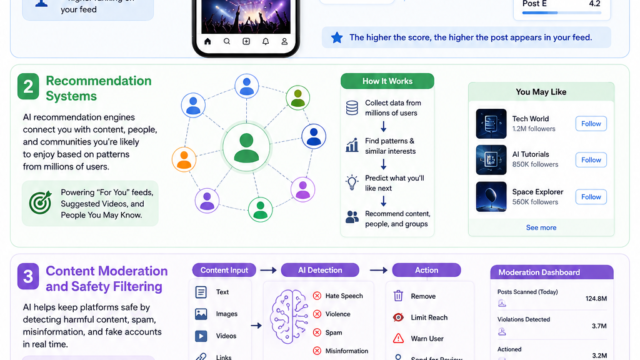
1. Personalized Feeds and Content Ranking

Every time you scroll through platforms like Instagram, Facebook, or X, AI is working in the background to rank posts. It studies what you like, comment on, share, and even how long you pause on a post.

https://images.openai.com/static-rsc-4/ZqXnISPF2w4wUvuzkVxi-BNlI1tp5njk2Ep5ESBKLStagJD52VN4SZ63f-UGmVU0o2wT6IQLUMw0IQVkHIR76TYLKXszyjDEValdLC6i5RsorHf86CZQp8rydmlZJUh7qNyO0Db5ZtpDDFWcla_VVX5QS91tc910y2iz0Ix4zsA3a8vfsSnsuJWVT2GM5Me0?purpose=fullsize
https://images.openai.com/static-rsc-4/x32kOe9HKxb363pIMbZ7xQAGhr1bs2aPvtQIqfjfXVJQmOjk4-nl0r8TsQcNliDh8crYdHVmuVY2zo2rhS929OU0LNlI4ECV0seBu3FapkOuxgEr22laKYJdQXVj1vMEepg3x7NLd3z3PLqri5mJKCPECVDevBMzmmVlsQ_weAqnyfSvgQpXTk-8dqTtbE0b?purpose=fullsize
https://images.openai.com/static-rsc-4/JM9z-g7OB2LR74zGzJvwnM9pdiL-0KIsgmUzKXtrdBar-M2vcj4rrMenFGblJ1qFcns7g-wsQHKSyPFcVfaszVaVa0Oq7t25cyIoUr8ah1LEAEZcXFPnZkDklubQZWebLG1x0xPjZR6yOL83NMkUxXtgpZ3JYFZpdB0C_bYNg0brJTOXVNSmjUG-VCmNohn4?purpose=fullsize

9

Machine learning models assign a “relevance score” to each post. Higher scores mean the post appears closer to the top of your feed. This is why two users rarely see the same timeline in the same order.


2. Recommendation Systems (What You Should Watch Next)

Recommendation engines power features like “Suggested Videos,” “People You May Know,” and “For You Pages.”

https://images.openai.com/static-rsc-4/1B-MwKneOumo1aOCYjwR8u3RF9okfs3nLm29ZV9AQ12nWae66k8BfCOomrBI6Dl9rzB4KSq_FdMeDOjwxeLv-HH242HkxqEw75k0qWeG9-pjWmejwlEIGkoRXvl554eVftv_wQVRAXRBQGhWlHy4wKnzgoh01t7zJtwraKiWbw0YWjP1VMN1W_aUzFHvlTmo?purpose=fullsize
https://images.openai.com/static-rsc-4/_Y3c2npEqIw_atQamDUKffbVD9J1duWvP9R5bF2QBu8E0ITUvMUnbP93vToQ7tzCSy5ySN4LX_UN24eDDMSpQil_O7HEou_iPaf7auXn32E2urmTeZZj0Bi3i9KZfh8RYtf12SObsxVzmYjMFrQlaLoHpDTvNWOK8lJ8KQvYHBbOqTZt4etGg8EGvrBY3Wtw?purpose=fullsize
https://images.openai.com/static-rsc-4/18Oca6__sR1zH6-o4Mvo29MwWsi4Ii8uAPcViMzR-XErzOUwGpT1RBitMTGEHrNv6Qg9W2ouddfOQmHhVx_FswssFDiWaM4wJwZY0YnX4euO9SR-pfLFbIUEUU2X8ortkCpI8r8HvlVCE9kKkFSH8eA6huXOgJB-T8a_GLD-Cva2LPxylO2zPu-VW7Ky8XD1?purpose=fullsize

8

These systems use collaborative filtering and deep learning to connect users with similar interests. For example, if many users who like tech videos also watch AI tutorials, the algorithm will recommend AI content to you even if you’ve never searched for it.


3. Content Moderation and Safety Filtering

AI also plays a major role in keeping social platforms safe by detecting harmful content, spam, misinformation, and fake accounts.

https://images.openai.com/static-rsc-4/HOgnphyAIhjLU__JuxiPZVn1zaU18RoKVc_s-nqo6fhG0a5x4iKeaapkZBy_-av-GjJUG3JpUDbUZlnwIgA5sizIlZ0-ARqoeKOt0KgFYXqYteteMoqPa7PCIAaYJN2vybqy3VS6Vk1zhYqzYMvgsm4HH5KSySxYIiN2BZXxIYorqM55uC30vV11OWqInbKl?purpose=fullsize
https://images.openai.com/static-rsc-4/aZg9CE_dA6lkge3iHv4fuvR3Qq37_6Swl242jp1P7ux9z_udVEfsGbmH_Y_6RU5UlxKlv8ELhvvlQ2uQzGSXrpUKPQ9g3dlGo5gVmhgWuvNkRLQoO7-JYSYvYwAmcROBCOGKN5DP1UbVkH2-Ca8qx1ZbzecUgUgNH7fal439AB-b4SnbLh-gi0SmtGPdkgZf?purpose=fullsize
https://images.openai.com/static-rsc-4/VSwMec-jqFbKhIvZtAnAxlvy7lfjwsKjOkxwoM8AsdNrfLRjwHlLszUShukYxGeDALETDbPpH-sR3iaKdF0H-FYb3V8TvqkJQWrwEgos_Gy1t7iTNp-bIEhnN5TGpKI_YQr4ehFxRV9_CBNQ1eCRyxtWvhlGBOkcxgx7-fku3wfZPB5I6H24cbFeqxbxoGRo?purpose=fullsize

7

Computer vision and natural language processing models scan text, images, and videos in real time. While not perfect, these systems help remove millions of violating posts every day before humans even see them.


4. Targeted Advertising and User Profiling

One of the most powerful uses of AI in social media is advertising. Platforms use AI to decide which ads you are most likely to click or buy from.

https://images.openai.com/static-rsc-4/LtbXU-NEmFpuKHp68Dxi-uTfX6kmzuIOfre2yc3t5IQipkrPLAkXWYHsxgyE4716e5-H-k_laq6zIkcPaAVAD3d9vQnNdQGR2EXPxBSPsUKhaeuedowlTauRJDpMuSi0pk6xy9kAR_lEy1qTQJ05C1Jsk0Q0B3fQWU22L5tCYL2DeQpy0gSvWVVWGEt7CVpg?purpose=fullsize
https://images.openai.com/static-rsc-4/S_ADokusYdYdBEFUtklHOYPjV4r2mYTwW8zOmFGgiBqEkYpeJc-TDX1rL9LaXEr3NkcIZ-6R9uDpAADQ7v9PfThbNfIdbIBstvTtVApFgW0CfQf8jJjYQ0yG4pbJA6yBiqFXdVBG0j_mspNnatbMYuf-4vKDI0pHY3p-OTomgiHLP2dqU-uiDtzSSUSAGEM2?purpose=fullsize
https://images.openai.com/static-rsc-4/7vUDHCOPOFk7RPyTmuhF3znAwf6akfl49VSQaB-3BhLjRfe1aszq7H0LQ35hf6KD7lxBBuWaMhQkrZXBZaXzKGkcF_5i9uBHR7GndNzxnv1LWkL0SdzosVd1QaVies3zPK5X3L3vvtNIbR4Qtu5IEUT4kuF0xG9q5LxU1FpWD1oCcFebU3cFnRA6ncwuNqNb?purpose=fullsize

6

AI builds detailed user profiles based on demographics, interests, and behavior patterns. This allows advertisers to reach highly specific audiences, improving conversion rates while making ads feel “personally relevant.”


Conclusion

AI is deeply embedded in social media, shaping what we see, how we interact, and even what we buy. While it improves personalization and safety, it also raises concerns about privacy, echo chambers, and over-personalization.

How to Start a Career in Artificial Intelligence and Machine Learning

Starting a career in Artificial Intelligence (AI) and Machine Learning (ML) is very achievable today, but it requires a clear roadmap because the field combines math, programming, and real-world problem solving.

Here’s a structured path you can follow:


1. Understand What AI & ML Really Are

Before jumping in, get clarity:

  • Artificial Intelligence is the broader field of making machines “think” or simulate human intelligence.
  • Machine Learning is a subset of AI where systems learn patterns from data instead of being explicitly programmed.

Common areas:

  • Computer Vision (images, video)
  • Natural Language Processing (chatbots, translation)
  • Predictive Analytics (finance, business forecasting)

2. Build Strong Programming Foundations

Most AI/ML work is done in Python.

Focus on:

  • Python basics (functions, loops, OOP)
  • Libraries:
    • NumPy (math operations)
    • Pandas (data handling)
    • Matplotlib / Seaborn (visualization)

Practice platforms:

  • LeetCode (logic building)
  • HackerRank (Python practice)

3. Learn Math (Important but Practical)

You don’t need to be a mathematician, but you must understand:

  • Linear Algebra (vectors, matrices)
  • Probability & Statistics
  • Basic Calculus (gradients, optimization)

These concepts help you understand how ML models actually “learn.”


4. Learn Core Machine Learning Concepts

Start with classical ML before deep learning.

Key topics:

  • Regression (linear, logistic)
  • Classification
  • Clustering (K-Means)
  • Decision Trees & Random Forests
  • Model evaluation (accuracy, precision, recall)

Use:

  • Scikit-learn (main ML library)

5. Move to Deep Learning

Once ML basics are clear:

Learn:

  • Neural Networks
  • CNN (images)
  • RNN / Transformers (text, AI chat systems)

Frameworks:

  • TensorFlow
  • PyTorch (very popular in research & industry)

6. Work on Real Projects (Most Important Step)

Projects matter more than certificates.

Beginner ideas:

  • Spam email classifier
  • House price prediction
  • Handwritten digit recognition
  • Chatbot using NLP

Advanced ideas:

  • Fake news detection system
  • Image recognition app
  • Recommendation system (like Netflix/YouTube)

Put projects on:

  • GitHub (must-have for portfolio)

7. Learn Data Handling & Tools

Real AI work is mostly data work.

Learn:

  • SQL (databases)
  • Data cleaning techniques
  • Feature engineering
  • Basic cloud tools (AWS / Google Cloud optional)

8. Build a Portfolio + Resume

Employers look for proof of skill:

Include:

  • 3–6 strong projects
  • GitHub links
  • Kaggle profile (competitions help a lot)
  • Internship or freelance experience if possible

9. Join AI Communities

This helps you grow faster:

  • Kaggle (competitions + datasets)
  • GitHub (open-source projects)
  • Reddit / Discord AI groups
  • LinkedIn AI communities

10. Choose a Career Path

AI/ML is broad. You can specialize:

  • ML Engineer (industry-focused)
  • Data Scientist (analytics + insights)
  • AI Researcher (advanced math + innovation)
  • NLP Engineer (chatbots, language models)
  • Computer Vision Engineer (image/video AI)

11. Suggested Learning Timeline (Simple Plan)

  • Months 1–2: Python + basics of math
  • Months 3–4: Machine Learning (Scikit-learn)
  • Months 5–6: Deep Learning + first projects
  • Months 6+: Portfolio + internships + specialization