AI-Powered Personal Assistants: How They Are Changing Everyday Life

Image
Image
Image
Image
Image
Image

AI-Powered Personal Assistants: How They Are Changing Everyday Life 🤖📱

Artificial intelligence is becoming an increasingly visible part of everyday life. What once seemed like futuristic technology is now integrated into smartphones, computers, smart-home devices, search tools, productivity platforms, and online services. Among the most noticeable applications are AI-powered personal assistants.

Traditional digital assistants could answer simple questions, set alarms, provide weather information, or play music. Modern AI assistants are becoming more capable. They can understand natural language, summarize information, help write messages, organize tasks, explain complicated subjects, brainstorm ideas, analyze documents, and support people across many daily activities.

As these systems become more sophisticated, they are changing how people interact with technology. Instead of navigating multiple menus and applications, users can increasingly describe what they want in ordinary language.

The transformation is not limited to convenience. AI-powered assistants may influence productivity, education, communication, shopping, travel, entertainment, accessibility, and professional work.

At the same time, their growing capabilities raise important questions about privacy, accuracy, security, dependence, and responsible use.

Understanding both the opportunities and limitations of AI assistants can help people use them more effectively.

🤖 What Are AI-Powered Personal Assistants?

An AI-powered personal assistant is software that uses artificial intelligence to understand requests and provide information or perform certain tasks.

Traditional digital assistants often relied heavily on predefined commands.

Modern AI assistants can use natural-language processing and generative AI to interpret more complex requests.

For example, instead of saying a specific command to create a reminder, a user might say:

“Remind me tomorrow afternoon to prepare for my meeting.”

Depending on the system and its available integrations, the assistant may interpret the request and help create an appropriate reminder.

More advanced assistants can also work across different types of information, including text, images, audio, and documents.

🧠 From Commands to Conversations

One of the biggest changes is the shift from command-based interaction toward conversation.

Users can ask follow-up questions, clarify requests, change instructions, and continue a discussion without starting from scratch.

This makes technology feel more natural and accessible.

Image
Image
Image
Image
Image
Image

📅 1. Helping People Manage Daily Tasks

One of the most practical uses of AI assistants is everyday organization.

People manage appointments, deadlines, shopping lists, messages, travel plans, school assignments, and work responsibilities.

An AI assistant can help organize this information and turn vague intentions into actionable steps.

For example, a user could ask an assistant to:

  • Create a daily schedule
  • Organize a task list
  • Summarize a long email
  • Draft a reminder
  • Prepare a meeting checklist
  • Suggest ways to prioritize work
  • Break a large project into smaller tasks

These capabilities can reduce the amount of time spent on routine organization.

⏰ Better Time Management

AI assistants can help users identify priorities and structure their day.

However, users should still make the final decisions about important commitments.

An AI system may not understand every personal circumstance, deadline, or responsibility.

The best approach is to use AI as an organizational aid rather than allowing it to make important decisions without review.

✍️ 2. Changing the Way People Communicate

Writing is another area where AI assistants can be useful.

People can use them to draft emails, improve grammar, summarize documents, rewrite complicated sentences, or adjust the tone of a message.

For example, someone writing a professional email can ask an AI assistant to make the message clearer and more concise.

Students can use AI to brainstorm ideas or understand difficult writing concepts.

Professionals can use AI to organize notes and create initial drafts.

🗣️ Communication Becomes More Accessible

AI assistants can help people who find writing difficult or who communicate in languages other than their strongest language.

They can also help transform information between formats—for example, turning notes into a structured outline or summarizing a long document into key points.

However, users should review important communications before sending them.

AI-generated writing may contain incorrect information or fail to reflect the user’s intended meaning.

📚 3. Transforming Education

AI assistants are increasingly being used as learning tools.

Students can ask questions, request explanations, generate practice exercises, or explore unfamiliar topics.

A student struggling with a mathematical concept might ask for a simpler explanation.

A language learner might practice conversations.

A student studying history might request a timeline or comparison of events.

🎓 Personalized Learning Support

AI assistants can adapt explanations to different levels of understanding.

A beginner can request a simple explanation, while an advanced learner can ask for a more technical discussion.

This flexibility can supplement classroom learning.

However, students should use AI to support learning rather than simply copy answers.

The goal should be to understand concepts, develop reasoning skills, and become a more independent learner.

💼 4. Improving Workplace Productivity

AI assistants are becoming increasingly relevant to professional work.

Employees can use them to summarize meetings, organize information, draft documents, analyze data, prepare presentations, brainstorm ideas, and create initial versions of reports.

This can reduce time spent on repetitive tasks.

⚙️ Automating Routine Work

Many office tasks follow predictable patterns.

AI assistants may help with:

  • Meeting summaries
  • Email drafting
  • Document organization
  • Research summaries
  • Spreadsheet assistance
  • Project planning
  • Customer-service responses
  • Content creation
  • Basic data analysis

Automation can free employees to spend more time on complex work that requires human judgment.

However, organizations need policies governing what information employees can safely share with AI systems.

🏠 5. Making Smart Homes More Intelligent

AI assistants can also interact with connected home devices.

Depending on the available technology, users may be able to control lights, thermostats, appliances, entertainment systems, or security devices through voice or text.

The combination of AI and smart-home technology could make home automation more conversational.

Instead of remembering specific commands, users could describe what they want in natural language.

💡 More Context-Aware Homes

Future systems may become better at understanding context.

For example, an assistant might help coordinate a household schedule or remind users about recurring tasks.

However, smart-home systems also create privacy and cybersecurity considerations because connected devices can collect information about people’s homes and routines.

🛒 6. Changing Shopping and Consumer Decisions

AI assistants can also influence how people shop.

They can help users compare products, summarize specifications, organize shopping lists, and identify features that match their needs.

Instead of browsing hundreds of product pages, consumers may increasingly ask AI systems to narrow down options.

🔎 Smarter Product Research

For example, someone shopping for a laptop might ask an AI assistant to compare battery life, performance, portability, and price ranges.

However, consumers should verify important specifications and current prices before making purchasing decisions.

AI-generated recommendations can be incomplete or outdated.

✈️ 7. Simplifying Travel Planning

Travel planning often involves coordinating transportation, accommodation, activities, budgets, and schedules.

AI assistants can help users organize these elements.

They can generate itinerary ideas, summarize destination information, suggest questions to ask hotels or airlines, and help create packing lists.

🌍 Personalized Travel Assistance

An AI assistant can potentially adapt suggestions according to factors such as:

  • Trip duration
  • Budget
  • Interests
  • Transportation preferences
  • Accessibility needs
  • Travel companions

However, travelers should verify important details such as visa requirements, opening hours, transportation schedules, cancellation policies, and local regulations.

AI can assist with planning, but current official information should remain the final authority for time-sensitive travel requirements.

💰 8. Supporting Personal Finance

AI assistants can help people organize financial information and learn basic financial concepts.

For example, they can explain terms such as:

  • Budgeting
  • Compound interest
  • Inflation
  • Credit
  • Saving
  • Investment diversification

They can also help users create simple budgeting frameworks.

However, financial decisions can have significant consequences.

AI assistants should not automatically be treated as financial advisors, particularly when decisions involve investments, taxes, loans, insurance, or substantial amounts of money.

Users should verify financial information with reliable sources and qualified professionals when appropriate.

🩺 9. Supporting Health Information

AI assistants are increasingly being used to help people understand general health information.

They can explain medical terminology, summarize publicly available health information, or help users prepare questions for a healthcare professional.

For example, a person may ask an AI system to explain a medical term in simpler language.

⚠️ AI Is Not a Substitute for Medical Professionals

AI systems can make mistakes and may not have access to a person’s complete medical history.

They should not be relied upon to diagnose serious conditions or replace professional medical care.

For urgent or concerning symptoms, people should seek appropriate medical assistance rather than relying on an AI chatbot.

🧑‍🦽 10. Improving Accessibility

AI assistants may have an especially meaningful impact on accessibility.

People with certain disabilities can use voice interaction, speech-to-text, text-to-speech, image descriptions, summarization, and other AI-supported features.

For example, AI can help describe visual information or convert spoken language into written text.

These capabilities can make digital services easier to use for some people.

Accessibility improvements will depend on thoughtful design and reliable implementation.

🌐 11. Breaking Language Barriers

Translation and language support are another important application.

AI assistants can help users translate text, practice languages, explain unfamiliar phrases, and communicate across languages.

This can support international communication, education, tourism, and business.

However, translation quality can vary, especially with specialized terminology, cultural expressions, or less widely represented languages.

Important legal, medical, or business documents may still require professional translation or verification.

🎨 12. Supporting Creativity

AI assistants can also act as brainstorming partners.

Writers can use them to generate ideas.

Designers can explore concepts.

Entrepreneurs can brainstorm business models.

Students can develop project ideas.

Musicians and filmmakers can experiment with creative directions.

The value of AI in creativity is often greatest when humans remain actively involved.

💡 AI as a Creative Collaborator

Instead of asking AI to create everything, users can ask it to provide alternatives, challenge assumptions, identify weaknesses, or suggest new directions.

This keeps the human creator at the center of the process.

🔍 13. Making Information Easier to Understand

The internet contains enormous amounts of information.

AI assistants can help users summarize lengthy material and explain difficult concepts.

A user can provide a complex document and ask for:

  • A short summary
  • Key points
  • A list of important terms
  • Questions for further study
  • A simplified explanation
  • A structured outline

This can reduce the cognitive burden associated with processing large amounts of information.

However, summaries can omit important context.

For important decisions, users should review the original source material.

🧠 14. Helping People Learn New Skills

AI assistants can function as interactive learning companions.

Someone learning programming can ask for explanations of errors.

A beginner learning a language can practice conversations.

Someone learning business can ask for examples of marketing strategies.

A student can request practice questions and explanations.

The interactive nature of AI can make self-directed learning more accessible.

The key is active participation.

People learn more effectively when they attempt problems, receive feedback, and reflect on mistakes rather than simply asking AI to complete everything for them.

🔐 15. Privacy and Personal Data

The convenience of AI assistants comes with privacy considerations.

Personal assistants may process information about schedules, preferences, communications, documents, locations, or other personal activities depending on how they are configured.

Users should understand what information a particular AI service collects, how it is stored, and how it may be used.

🛡️ Practical Privacy Habits

Users can improve privacy by:

  • Avoiding unnecessary sharing of sensitive information
  • Reviewing privacy settings
  • Using strong account security
  • Enabling multi-factor authentication where available
  • Checking which applications have access to personal data
  • Reviewing connected services regularly

People should be especially cautious about entering passwords, financial credentials, confidential business information, or highly sensitive personal data into AI systems unless they understand the relevant security protections.

⚠️ 16. Accuracy and AI Hallucinations

AI assistants can sometimes generate information that sounds convincing but is incorrect.

This phenomenon is often called an AI hallucination.

The problem becomes particularly important when people assume that fluent language automatically means factual accuracy.

AI assistants may make errors involving:

  • Dates
  • Names
  • Statistics
  • Citations
  • Technical details
  • Legal information
  • Medical information
  • Product specifications

🔎 Verify Important Information

The more important the decision, the more carefully information should be verified.

Users should consult authoritative sources for legal, medical, financial, academic, and other high-stakes information.

🧑‍⚖️ 17. Ethical Questions About AI Assistants

As AI assistants become more capable, ethical questions become increasingly important.

Who is responsible if an AI assistant makes a harmful recommendation?

How should personal data be protected?

Should AI systems reveal when content was generated by AI?

How much autonomy should an assistant have?

What decisions should always require human approval?

These questions will influence the design and regulation of future AI systems.

🔄 18. The Evolution From Assistants to Agents

Today’s AI assistants are increasingly moving toward more agent-like capabilities.

A simple assistant answers questions.

A more advanced system may potentially perform multi-step tasks.

For example, instead of simply suggesting how to organize a project, an agent could potentially create a task list, draft documents, update approved software systems, and notify team members.

This transition could significantly increase productivity.

But greater autonomy also means greater responsibility.

Systems need appropriate permissions, monitoring, and safeguards to prevent unintended actions.

🏢 19. AI Assistants in Small Businesses

Small businesses may benefit significantly from AI assistants.

A small company with limited staff can use AI tools for tasks such as:

  • Drafting marketing content
  • Organizing customer inquiries
  • Creating internal documentation
  • Summarizing meetings
  • Researching competitors
  • Brainstorming products
  • Preparing basic reports

This can allow small teams to perform tasks that previously required more time or specialized resources.

However, businesses must protect confidential customer and company information.

📈 20. Changing the Nature of Productivity

AI assistants may change how productivity is measured.

In the past, productivity often meant how quickly a person could complete a task manually.

In an AI-assisted workplace, productivity may increasingly depend on how effectively a person can define objectives, provide context, evaluate AI outputs, and make final decisions.

This means human judgment becomes even more important.

🧭 From Doing Everything to Directing Work

Professionals may increasingly act as supervisors of AI-assisted workflows.

They may spend less time performing repetitive tasks and more time deciding what should be done, checking quality, and handling exceptions.

This could reshape many job roles.

🌱 21. The Importance of Human Skills

The growth of AI does not make human skills irrelevant.

In many cases, it makes them more valuable.

Skills such as:

  • Critical thinking
  • Creativity
  • Empathy
  • Leadership
  • Communication
  • Ethical judgment
  • Collaboration
  • Decision-making

remain essential.

AI can provide suggestions, but humans must determine whether those suggestions are appropriate.

🔮 22. What the Future May Look Like

The next generation of AI assistants may become more integrated across devices and applications.

Instead of having separate tools for email, calendars, documents, travel, shopping, and productivity, users may interact with a unified AI interface that can coordinate information across approved services.

Assistants may become more multimodal, understanding voice, text, images, video, and documents.

They may also become more personalized and capable of handling longer workflows.

However, the future will depend heavily on privacy protections, technical reliability, regulation, user trust, and responsible design.

🌟 Conclusion

AI-powered personal assistants are changing everyday life by making technology more conversational, accessible, and capable.

🤖 They can help people organize tasks.

📚 They can support learning.

💼 They can improve workplace productivity.

✍️ They can assist with communication.

🌍 They can support travel planning and language translation.

🧑‍🦽 They can improve accessibility.

🎨 They can support creativity and brainstorming.

At the same time, AI assistants have important limitations.

They can make mistakes, produce misleading information, create privacy concerns, and encourage overdependence if used without appropriate judgment.

The best way to use AI assistants is therefore not to treat them as perfect digital replacements for human thinking.

Instead, they should be viewed as powerful tools that can extend human capabilities.

The future of personal AI is likely to involve deeper integration into everyday devices and services. As these systems become more capable, people will need not only better AI technology but also better AI literacy.

Knowing what to ask, what to trust, what to verify, and what should remain a human decision will be essential.

The real transformation will not simply be that computers become more intelligent.

It will be that people learn how to work with intelligent systems in ways that are productive, safe, private, and responsible. 🤖🌍✨

Image
Image
Image
Image
Image
Image

🔬 AI Research: Exploring the Future of Artificial Intelligence Innovation, Discovery, and Technology in 2026

https://images.openai.com/static-rsc-4/rXkw4x3Oz7c0CIF4MsnzsnLwBOEfMrYOSI8kYnJFyQiFE316Kpr3CtXAE1dROHs3ojojWP_ajCybCO1Dh6ARcvh70sugT06hp9lHNWcvnJlnAHPfOKbBZ78oEc0S_i33KYGYjXZ-e-XbOeOSFEw6ev5MCLsRJitq4Lq1xl25mIZhbztqdrw5iedytLT-ODae?purpose=fullsize
https://images.openai.com/static-rsc-4/iGV-KCQ8PXhVRdWcFJzY1RYO_JPaf6H0U0kjyoFu5iM5UMSLKE06L5OlX_dRTLqZm64ITj2qTffpucO5WnOhQ3NFQMq3B8s8LNQ-ij_WIYbcdQzEFpa_VDnTHKM6fLgVJJ7beaHykTvd5iTt5y6USfKKfPweSLMDBuVfwnQ-Jigiw4eZvxzdtKKENNqhIKHE?purpose=fullsize
https://images.openai.com/static-rsc-4/LXM9C7d3Y_ush8MQi3utdRWs48Wkg4NOEob3bOx2Vslm-f3IJ9RBs0qOShpG3ciHMachOXToHSUfFscQ4ZPz71x_blSE7hZ8JCoLm8py3nF1CigD2bKd7ci9zpyb2meCiVSAl_qj979VVhmJypE75xpzu-vBPY-FImgFttRgS8Kj5GcWRoFHAOEOmiD73OV9?purpose=fullsize

🌟 Introduction

Artificial Intelligence (AI) has become one of the most influential fields of scientific research in the modern era. AI Research focuses on developing intelligent systems that can learn, reason, understand information, solve complex problems, and assist humans across various industries. From healthcare and climate science to robotics, education, and advanced computing, AI research continues to push the boundaries of what technology can achieve. 🤖🔬

In 2026, AI research is advancing at an unprecedented pace. Researchers are developing more powerful algorithms, improving machine learning techniques, creating intelligent autonomous systems, and exploring new approaches that make AI more efficient, reliable, and responsible.

This comprehensive guide explores the world of AI research, including its history, major fields, applications, benefits, challenges, and the future possibilities that will shape the next generation of intelligent technology.

🧠 What Is AI Research?

https://images.openai.com/static-rsc-4/YowA2y61EEAkqeJu-mZgJJFvGlcCLXxW6wZOktHrgA1cHf39R9pNf49dRBV8ObdJmUXRF9g9R5avXHiISjlrnTacmh-r1Emq6DXxailz0EdGsBnCNbNqjLGCVUMm-gZOHBsjV2B9QTzBRSQ8NUqx0W7-TJKMsKMPY7BAbIgPdNxl9DW9wFarpsGKvpHRdnw-?purpose=fullsize
https://images.openai.com/static-rsc-4/mBeZbycR8OWgMBoqnTDNqEDgoInKAGFhWlgPwrMpAE0oK3-2cKnZQbL-cCYVnfcZaEshjiANpUavchat-Pp2Zpb06A3wRZuP8HMhrqj3CFOjBfhLcIxBfsOu582a_JkYvcx0NKBVgsFSCW2QNKn1E_OAVefAu7bssfKuDMrpv2oW_lpxDH8yFFw4LE6EHTP4?purpose=fullsize
https://images.openai.com/static-rsc-4/_WjsFEdHXk-YIL33p78ZfFoM479lCY4AdMGyKxtsS3ek6OOAluON3xkbicbyw4BuUPRrB522Nv_FFRvuu5h9IbV6409T_gXDjPa6HLqDe31GFGymw4kAVa2WnaHyYqx7dr0XgUiv75V4Ok4i4zUGMbVuxjCpNK4p6aQRlUbgQQZHhuJO2QGhQJikc1b4XAc9?purpose=fullsize

AI research is the scientific study and development of technologies that enable machines to perform tasks typically associated with human intelligence.

The main goals of AI research include:

  • 🧠 Creating intelligent algorithms
  • 📊 Understanding complex data patterns
  • 💬 Improving machine communication
  • 👁️ Developing computer vision systems
  • 🤖 Building autonomous machines
  • 🔬 Solving scientific and real-world problems

AI researchers combine computer science, mathematics, neuroscience, statistics, engineering, and cognitive science to create advanced intelligent systems.

📜 The Evolution of AI Research

The history of AI research has gone through several important stages.

💻 Early Artificial Intelligence

Early researchers explored the possibility of creating machines that could imitate human reasoning. These systems focused on logical rules and symbolic processing.

📈 Machine Learning Era

Machine learning introduced algorithms that allowed computers to learn from data instead of relying only on programmed instructions.

🧠 Deep Learning Revolution

Deep learning transformed AI by using multi-layer neural networks capable of recognizing complex patterns in images, language, and large datasets.

🌐 Modern Generative AI

Recent AI research has produced advanced systems capable of:

  • Writing text
  • Creating images
  • Generating videos
  • Understanding speech
  • Writing computer code
  • Supporting scientific discovery

🔬 Major Areas of AI Research

AI research covers many specialized fields.

🧠 Machine Learning Research

Machine learning focuses on developing algorithms that improve through experience.

Research areas include:

  • Supervised learning
  • Unsupervised learning
  • Reinforcement learning
  • Transfer learning
  • Automated machine learning

These methods help computers identify patterns and make predictions.

💬 Natural Language Processing Research

Natural Language Processing (NLP) enables machines to understand and generate human language.

Research includes:

  • Language understanding
  • Machine translation
  • Text generation
  • Sentiment analysis
  • Conversational AI

NLP powers modern AI assistants, translation systems, and intelligent search tools.

👁️ Computer Vision Research

Computer vision allows machines to interpret visual information.

Applications include:

  • Image recognition
  • Medical imaging analysis
  • Autonomous vehicles
  • Facial recognition
  • Industrial inspection

Researchers continue improving AI systems’ ability to understand complex visual environments.

🤖 Robotics and Autonomous Systems

https://images.openai.com/static-rsc-4/tUHDO8JxBOoFASF8VBt7S34uIidkLr8cjWtnfJ_s5bLfXYtadVRgkDm2mrEy9eQIpp70NHSbhmqyZWeuXrg19WRj7sAGimQymzpI6zc6tmSFaYaCALerSCw6QvtbdkPyDmmhZ-uFr20yGj1FyXeh5k0b_Kf4vi6aElLPpalS-NOjP3VlhcqWW8mlilviqz2K?purpose=fullsize
https://images.openai.com/static-rsc-4/HvBivpfFN2a9v2utd0NqM62SML6z28fHvOqw0FWeZZf4yDydjqEVRsv5pMJSZFIxDFbNy4VG9-jvNDsax26qfv7sLhInVCuhLS6EQys6DNglW0dYfttefs9p7LVOJEJ47_IwCbxS3HsijCHv1SHXMy8dp3HT5e9uj_djjB6Wxo2Lsv-7Yh_k12xbpcllCDs9?purpose=fullsize
https://images.openai.com/static-rsc-4/nBtK8Aqx7dLD3fMzIwV5X5jAEj1LEfaF5s3EPn_7-78tH9OPhAWFqZqgagdoSTCIllesBXP206LM7GkFnwzRB9gmioRu4XdvdpNoQf2Rn_-PB2V9HIl2V9oD7sTTsW_fzlRxp-MSLK2a1xTLZVVEFJkllPC3_LEQHbuWtBYoB0hJiDfskAdqaNbGmj1bjJCz?purpose=fullsize

AI research plays a major role in robotics.

Researchers develop systems capable of:

  • Navigating environments
  • Learning tasks
  • Interacting with humans
  • Making autonomous decisions
  • Performing physical activities

Robotics research supports industries such as manufacturing, healthcare, logistics, and exploration.

🏥 AI Research in Healthcare

Healthcare is one of the most important areas benefiting from AI research.

Researchers are exploring:

  • 🧬 Disease prediction
  • 🩺 Medical image analysis
  • 💊 Drug discovery
  • 🧠 Brain research
  • 📋 Personalized medicine
  • 🏥 Healthcare automation

AI can help healthcare professionals analyze large amounts of information and discover new approaches to diagnosis and treatment.

🌍 AI Research for Climate and Environment

AI researchers are developing solutions for environmental challenges.

Applications include:

  • 🌱 Climate modeling
  • 🌦️ Weather prediction
  • 🌊 Ocean monitoring
  • 🌳 Wildlife conservation
  • ⚡ Renewable energy optimization
  • ♻️ Resource management

AI helps scientists process environmental data and make more accurate predictions.

🎓 AI Research in Education

Education is another growing area of AI research.

Researchers are developing:

  • 📚 Intelligent tutoring systems
  • 🎯 Personalized learning platforms
  • 📝 Automated assessment tools
  • 🌍 Language learning assistants
  • 🧠 Adaptive educational technologies

These innovations aim to make education more accessible and personalized.

💻 AI Research in Computer Science

AI research continues to transform software development and computing.

Important areas include:

  • Code generation
  • Software testing automation
  • Cybersecurity
  • Database optimization
  • Cloud computing intelligence
  • Human-computer interaction

AI-powered development tools help programmers build software more efficiently.

📊 Data and AI Research

Data is the foundation of modern AI research.

Researchers study:

  • Data collection methods
  • Data quality improvement
  • Privacy-preserving techniques
  • Large-scale data processing
  • Data visualization

Better data leads to more accurate and reliable AI systems.

🌟 Benefits of AI Research

AI research creates numerous benefits:

  • 🚀 Faster innovation
  • 🧠 Better decision-making
  • 🏥 Improved healthcare solutions
  • 🌍 Environmental protection
  • 📈 Business optimization
  • 🤖 Advanced automation
  • 🔬 Scientific breakthroughs

AI research helps society solve increasingly complex problems.

⚠️ Challenges in AI Research

Despite rapid progress, AI research faces important challenges.

🔒 Data Privacy

Researchers must protect sensitive information and develop secure AI systems.

⚖️ Ethical Concerns

Important considerations include:

  • Fairness
  • Transparency
  • Accountability
  • Responsible use

💻 Computing Requirements

Advanced AI models require significant computing resources and energy.

🔍 Explainability

Researchers continue working on methods to make AI decisions easier to understand.

🛡️ Responsible AI Research

Responsible AI research focuses on creating systems that are:

  • Fair
  • Secure
  • Transparent
  • Reliable
  • Beneficial to society

Researchers collaborate with policymakers, organizations, and communities to ensure AI development supports positive outcomes.

🏢 AI Research in Industry

https://images.openai.com/static-rsc-4/sqrmH-sYxuafnPnWdpCYnziQl2sDEIDW1tkltRmNlkIG4zHYVUbnH_BRLZcnkUz-1hUle4YY-5bC9iyvIRt0GNCDxMGmsMaCqXKG_11yHpbVLrsScDvPp7bo4C89GPG-JxfVDNtbx-ACSOW2GBMfWBOL0nRoQsTIXZAyf0B6Y2nP8lKr-DttP3El3baeHdMZ?purpose=fullsize
https://images.openai.com/static-rsc-4/eW2y2Q98IR0bwgvnRA4_cAm0eqC4Mk_U57OKxONAVZu2MntQdybkbB6jVaBIPJPSvCLMmYGXt6axyfdVW_VY4zqIDphsF3Bp6TZtdT0YPKSkCZ0KdkWkKh0lMYKM0YtFs6Okv-hzKTyjgDHp9MmLC0Y13kNiQxvKp4z3OhlWN5nC08kIX-CKyi3hqdMwGjLo?purpose=fullsize
https://images.openai.com/static-rsc-4/WnHVIpORtTBdViRIqZ5-EhRQ61yP7nlyFghjr3KqxfZd60qgxigRQnsafhPD_WGrmhM-1x6saZ30-3xtNIhE8KxH69g9ExWqPTSoQ04x76T80dkH96fEMdlZNm45202dlSaOQ3fFpbNgLPMiX93ACAooHz67slGnKMnKQ9Sg8l8mS4f9Z5YwKy6sSbWJcm39?purpose=fullsize

Companies invest heavily in AI research to develop new products and services.

Industries using AI research include:

  • 🚗 Automotive
  • 🏦 Finance
  • 🛒 Retail
  • 🏥 Healthcare
  • 📡 Telecommunications
  • 🎮 Gaming
  • 🏭 Manufacturing
  • ✈️ Aviation

Industrial AI research drives innovation and economic growth.

🔮 Future Trends in AI Research

The future of AI research is expected to focus on:

🤖 Advanced AI Agents

Researchers are developing AI systems capable of completing complex tasks independently.

🧠 More Efficient Models

Future AI systems may require less computing power while delivering stronger performance.

🌐 Multimodal AI

AI will increasingly combine:

  • Text
  • Images
  • Audio
  • Video
  • Sensor data

⚛️ AI and Quantum Computing

Researchers are exploring how quantum technologies may enhance AI capabilities.

🔬 AI-Assisted Scientific Discovery

AI may accelerate discoveries in:

  • Medicine
  • Physics
  • Chemistry
  • Biology
  • Engineering

💡 How to Get Started in AI Research

Students and professionals interested in AI research can develop skills in:

  • 🧮 Mathematics
  • 💻 Programming
  • 📊 Data Science
  • 🧠 Machine Learning
  • 🔬 Scientific Research
  • 📚 Academic Reading

Useful activities include:

  • Building AI projects
  • Studying research papers
  • Joining research communities
  • Experimenting with machine learning tools

🌍 The Importance of Collaboration

AI research requires collaboration between:

  • Computer scientists
  • Engineers
  • Healthcare experts
  • Environmental researchers
  • Social scientists
  • Policy experts

Interdisciplinary teamwork helps create AI solutions that address real-world needs.

📝 Conclusion

AI research is driving some of the most important technological advancements of the 21st century. Through machine learning, deep learning, robotics, natural language processing, and advanced data analysis, researchers are creating intelligent systems that can improve healthcare, education, business, science, and everyday life.

Although challenges involving ethics, privacy, security, and resource requirements remain, responsible AI research continues to open new possibilities for innovation and discovery.

The future of artificial intelligence will depend on continued research, collaboration, and responsible development. As scientists and engineers explore new frontiers, AI research will continue shaping a smarter, more connected, and more innovative world. 🤖🔬🌍✨

Artificial Intelligence (AI): Transforming the Modern World and Future Innovation

Artificial Intelligence (AI) has become one of the most influential technologies shaping the modern era. It refers to computer systems designed to perform tasks that typically require human intelligence, such as learning, reasoning, problem-solving, and decision-making. Today, AI is not just a concept of the future—it is actively changing industries, lifestyles, and the way people interact with technology. From smartphones to advanced robotics, AI is now deeply embedded in everyday life.


Understanding the Basics of Artificial Intelligence

AI works by using algorithms and large datasets to identify patterns and make predictions. Machine learning, a core part of AI, enables systems to improve automatically through experience without being explicitly programmed for every task.

https://images.openai.com/static-rsc-4/vOFvsLkt_QRyiS2ZsgjsxlOLlBAnLUEd2PQXvTXesmvuaoRG_evasMGvdubc34mc2OF2cS6Fl_KNvMq8ZISkIk32GzS41J2HXO_GJPJEk_DYLdriakSXTV49cc5jSrUpA02hU4tYdr6_W2gplqQc0VB3un-qx_BNyGQci1RA0CHS-cOynTln0qqVKkAl59SF?purpose=fullsize
https://images.openai.com/static-rsc-4/Xhm129u1B-q7YMgydGRlTsqKzo7eWjYJz0RNWUJKFhTxhgLHpo2luplcwJSAu1saNg6-A32c5_hPwz-dZjPR0pYG8tafD_gmNMu1tSGKWJG9Oh9KFT1Iuc2Ml5LIOy-6tE0nsOtFZWJBGF1m0V3cocT3mGXpfS8l_h5aUFIyphPjg4gwjHPTGb59_j2BM0dA?purpose=fullsize
https://images.openai.com/static-rsc-4/H2h2Z4bQFwqbz8z9uoJMA-UR9-xvHTZZx1FRD-AEUr5vNYuq3ZFjoTljl7TUaiMWZalOns-kpqK7q2fX9TT68aUciWnJkCsPaENkuYYiLlaNpOqPY84Ny-KrKTz33nrh4CfxL2u6FDoWGIvcHM27bEZMyfKnBVAnZuOeNnMUHIHKNo_bMwVxJjrsK1xMLWPy?purpose=fullsize

6

These technologies form the foundation of modern AI systems used across various industries.


AI in Everyday Applications

AI is widely used in daily life, often without users even realizing it. From voice assistants and recommendation engines to navigation apps and smart devices, AI enhances convenience and personalization.

https://images.openai.com/static-rsc-4/eqDJ3y54CLCWByAgIIpZk0axtmAyPGpF4BAXYuO9kMmXiZBfVWURkp0WuI-KU3Fo-HJt5zhVakoUXnKvp8iZ9bjFSKFF4ogvnQYuoXDoHOcRxMZNIiGLQEN_w2EjwM7DgY8X8zTFFHgt8AEOJhAX7rnoqu4AfGE_9h2G81uSW6WENs53sXmFvbaYwuAODdfD?purpose=fullsize
https://images.openai.com/static-rsc-4/3Kqsgd-Lf6NMsWOsywQXHA2sLc3ekbYJiPvBQnRgVVPzIDL1-au8eXJ07rCEJysv5HUdnSU0w-EnZaZaUmA6CqyQEscIpP5lge59_q0Yd3ik0Ni4PWQlK7kA2IvmZPklj5wOw_KpvNB2rhiIn5uds_9M2Q_q5fP80r-Zti3jyAicAA-zjtIRyBn6G4mA8gf2?purpose=fullsize
https://images.openai.com/static-rsc-4/jF8CGzURa4kpMHHmy2pKvzUuY3KbIDYvI3JoJeqRuLrBRUHXXK9MVGzg9QKyvJDysD9Z2RETrW9eDkkPy7wCU5wE7LRbn3OOiN1XfiqcXYx6H25WkQTu-dI0HKm7QiQbiBsD5fHKF4IDOwkthmpVJNfFiXlKzsD4Ie7nZ0eD-kR3YkvS_TuA2AO4ge500dQy?purpose=fullsize

8

These applications help people save time and make smarter decisions in their routines.


AI in Healthcare and Science

One of the most impactful uses of AI is in healthcare and scientific research. AI systems assist doctors in diagnosing diseases, analyzing medical images, and predicting health risks more accurately.

https://images.openai.com/static-rsc-4/sNs8GM74I1c_FsRSyYCAkFztJ-qqA4YIP2OjaS880kYZ1B-M7a9C2XHqycKSWbqKDTqXzMXT1NL7waCQV9e25EMZdUZlO6EI6Ci8TRI8Eu2OUShOBVK6SU3VJ1h44BweOAcAcR-Lgnambc_Hb_47jkLBXkpe9rrfldTJdn6tbmuEV153StoU1aAs_sP7LM5L?purpose=fullsize
https://images.openai.com/static-rsc-4/niEhLPXwmw5JL0Z80c5pOA7PubXAtq09yrgCuxSSoEDRqxRDmpFxESkTjCDY1ALIwUpzTt9FknCLLzRd3NeDR9DwHoe6mmkpz4AEYuO-4TN7VEx0XHKbJwmZX0s9pEUbkLIvPgGBA4M09TtLvs6KDgCB4xmyb8PTBJhr20_rt7vvk0YFYlGcf1aPreDzmYGF?purpose=fullsize
https://images.openai.com/static-rsc-4/3lKY3j0wOWLPzV0uy50NE2NPQi0Og81wSYktO5kZPUGdAdXHrVISgvQulTLX-7bUqi4FqqTdhKlCYB5Xcb4tq9tZXAowvBUggKnNYpvTLOX-wFrEkCcuSHHDUnWxomne7NWNAlI-df_HiAXINqF7MCgPlt4COSX8gtDqxH-69QmhDwm0GSDL62pqQg8pcdLL?purpose=fullsize

7

In research, AI accelerates drug discovery and helps scientists analyze complex datasets that would otherwise take years to process.


AI in Business and Industry

Businesses around the world use AI to improve efficiency, reduce costs, and enhance customer experiences. AI-powered tools can analyze consumer behavior, automate tasks, and provide real-time insights.

https://images.openai.com/static-rsc-4/iWQ0RrP8UvVH4jo1zzS0SnsGIqBnthTJ5LhxAUpCOBx1DVFIYU5-aLBCf-HZ3-x4WeqE2tF-k42I36fh2PZ4UZmFPCGdadKOywdCg8agTpgeWGjmzFe2MGxUujpiIi6hnTqwAsOmUFGAp35rIthN59iS-J8PSZel5wXNHeCp77-FrAsIIulFb6MnBkfzJfww?purpose=fullsize
https://images.openai.com/static-rsc-4/d5iiJmRuev5hXfwvCHUmm3_n_zgw1MhXUHenCKwWXWq_-n_hsqG3piIP6wABZ0KFDxE-POoXNVoHt89GSx6VL-EiY6ee4llOeDN_oUI2JFynKdE21CMlaWjwCr7iqXO97WBjOJktw82AP4zaD8oEIDORDNzxw2vNKK6rVskti6j6gWTcd4OR0Rm99wdxKpV_?purpose=fullsize
https://images.openai.com/static-rsc-4/_XHt6S-xr-zVkoGyMOJRyHnbI8TMWa8L3h_zC_d4Im_aWqgFjOCeoBVBWamZI2PfvlJ0LsTPXZOrC0Agc-d8zPEpQ3l0NwM5Eu2zOLlWqOqm-gH9UvYF4xw_9AfvH4B6_YAEE5WPOTDVWE2bJ-VRMlSdzN2LFV8dsMu1iBCiTB-JXGhxdpsFETJ3wuPvyZUn?purpose=fullsize

4

This helps companies make better decisions and stay competitive in fast-changing markets.


Ethical Challenges of AI

Despite its benefits, AI also raises important ethical concerns. Issues such as data privacy, bias in algorithms, and job displacement must be carefully addressed.

https://images.openai.com/static-rsc-4/r930DvlzWlkztZm5G9GwyNy-6JJr-m6byb37sAVPOO6RvDeBoebCB51e47l9I2CjCh2zI7s-Z37RvF9aRr_ZXn5_UyDqN3Mvyr8RNjQsMJ8CJWV65KN9VEfcRWa3a4hchnIx-6UJz46akKJaNV3q4yYf6eL657Y87_GhLvx-N0A4EMNqVb8_Gv2-qa5eg-Nb?purpose=fullsize
https://images.openai.com/static-rsc-4/SuEi1ueX0m4Xzh0_BNhujS7yB9r7EmwrSXBQXdkk8OS5ZUSEZYz9VMxPprTmEyWXJYUDoV0JiobPcjtRMEqWwy2UuaJrUpFWwsWBrMkqoKEXk2gOl9rMfOmqF0uTq7ll3dYVEBit3759m95vr63V0vYNphB7oRBR6rP3tJjYF5HtgV4uxwthgKhqXCutghb3?purpose=fullsize
https://images.openai.com/static-rsc-4/7b6aAcOOvxXWKG0tu49nYLeEIkLXJ7g-Nk9aBNTGXVTSMUVsJnTkFr7pHkkDi1HAfXvPhBRVNJ2w7VV21QW06eL0LNWDPWJx-deR7fe-pQSHRQWf03fXpEc6IUeHmJFEXMgrME-w4DZhy9evd6heVmHyoASJRIKIJUedYo0HSdPwqM2J5kbYtnC-I9ovrJve?purpose=fullsize

4

Developing responsible AI systems is essential to ensure fairness, transparency, and trust in technology.


The Future of Artificial Intelligence

The future of AI promises even greater advancements, including smarter automation, autonomous systems, and deeper integration into daily life. AI is expected to revolutionize industries such as transportation, education, and entertainment.

https://images.openai.com/static-rsc-4/TpixjIoKsje0_TS_axX5Cugpfq_oVVjOq2dMkBdfdiH09LFGJ803UbTP8li5fAdl-eo4NxfY2q7hEIXM1dESiCsJmNMUXKaRWIbi5-NJn4xTCk-kEZkoDD4PtNWNwjGZWWGD1pSEgM7OsUpiR9XgJvbgp8ncDSXFZ-gb1k14LYJn1NuvgTkKojZxytAPBesY?purpose=fullsize
https://images.openai.com/static-rsc-4/eURRnoKc7FUijhtCer4hWlbuP2NN2BXBs1XJI5p6nlhal9zhWHS5B1rDjOuC1BMjxhbwIlc-5Ni2t1qdQcFfEUSq4SsApQwvbTFPYZYPwVOf7BWySaEoJrU51rcYT4razdHUab-knMMhbJXeG2532BcDcHFXaoiuaW91pnKlQbeEWfxc2ZGWNnTKK0vZ8QET?purpose=fullsize
https://images.openai.com/static-rsc-4/I7UnFmvDWOt99cse-dy5luAwMnNagktg26fpwSPwNL_u7PIBMUbU2NOof92zCqsM-P6lm36LX5hmp0LPPxedvW6BnxiQ0uS5R3H3qfGi4WDa5QjRbLtwhin_YG41QyLFjfR1dHt1YbpjcQfM1k76E5zD6yCtDbeo4cfeHij6FnwJT4RMbDX31LgsqzXnglLk?purpose=fullsize

8

As AI continues to evolve, it will likely work alongside humans, enhancing creativity and productivity while reshaping the global digital landscape.

AI in Gaming: Smarter NPCs and Dynamic Storytelling

AI in gaming enables smarter NPCs, adaptive storytelling, and dynamic worlds. Games now respond to player choices, creating unique experiences with evolving narratives, realistic behavior, and endless replayability.

Gaming has always been a space where technology and creativity evolve together. From pixelated arcade characters to hyper-realistic open worlds, every leap in computing power has reshaped how games are played and experienced. Now, artificial intelligence (AI) is driving the next major transformation—making non-player characters (NPCs) smarter, worlds more reactive, and stories more dynamic than ever before.

In this blog, we’ll explore how AI is reshaping gaming through intelligent NPC behavior, adaptive storytelling, procedural content generation, and what this means for the future of interactive entertainment.


The Evolution of NPCs: From Scripted to Intelligent

https://images.openai.com/static-rsc-4/tMhm2haKCozV2p4EQ9r8IiSlN0oqDfws52jUh88eU8_q-7DYoVulpatW4JGgsN7clWTLN_hntOJLEmtu30mH6G5ryqd5ADvIqAIvwPLXw0N6cWzf_hZAJENuB6UUKY8mrqxyQPzGMz0jNXPUChIJo20KVXxh1wLXibu-jEj43YI4eUurr1IAMIq2Ib78Udt-?purpose=fullsize
https://images.openai.com/static-rsc-4/lAFIRmV0KBG4Vj-SfXrbV9B4v7FSatkh7gZkQoUCiOz0q_9c8myMuWpMRQwT4C9EX2U6hC0yFDfcl25pHxuaXIEKxhFgzfRjzF5HVRougSJkJbl76lAAi_-w3JBTdTzyUHBMlBUGUkHkMNAt2s5bqD-tM82mY9uDMcEsV50Gu4ddcVUKbfUKOWsbOsBbAi45?purpose=fullsize
https://images.openai.com/static-rsc-4/WpjrZi5lu3w58-KOPfjb1YCwF2gWLe8r08v-hMfn23kaK4rR841lYCkm3QIteWj3S2Xnq9z11a-jaWnxqtlBqj4lxiunn7lANpVh1tk_dRW2KJXNJqpB13gp-q2uHEOP4ZHc2GOi6mXJifxGOnNH3qImRHhfOWoYmgrPgVJIp8riNz9FfDBxzq0Ta9u0sVun?purpose=fullsize

Non-player characters (NPCs) used to follow rigid scripts. In early games, NPCs had predictable patterns: they would repeat the same dialogue, follow fixed patrol routes, and respond only to specific player actions. While this worked for simple gameplay, it often broke immersion.

AI has changed that dramatically.

Modern NPCs use a combination of machine learning, behavior trees, and decision-making algorithms to react dynamically to players. Instead of repeating fixed lines, they can:

  • Adjust dialogue based on player reputation or past choices
  • React emotionally to events in the game world
  • Coordinate with other NPCs in real time
  • Adapt strategies in combat situations

For example, in modern open-world games, enemies don’t just attack blindly—they flank, retreat, call reinforcements, or even change tactics depending on how the player behaves.

This shift transforms NPCs from background props into living participants in the game world.


Smarter AI Systems Behind Game Worlds

https://images.openai.com/static-rsc-4/cjO3a72ayuKWjGhmjK9k9j9Un_TAbL9C5AQoR28BDQZPWh5G__zUDf0Yfkm4BUom_rrqydAxFD-kRxQp4C8m0v_rzgGH49Q7QmhgK19Z2ubfiQVKQa8EIxM8OPk4UsbO_bjA9JNgUeXn530LzWxpSdjmH4_8NnIvsr0VFOD1K9dOdyAoghcG--tt5Eo04tcg?purpose=fullsize
https://images.openai.com/static-rsc-4/d7rPh-Y9RQebRP8QC5KEPiJ-ZH6SMLP7fvqAoHmJz_qQ--T3xjAOUgq5SWO3gEPsqQ0qSK9L74Fip9zBg6B81TSrtQFLIR5sKRujWozJSwCTTgEZ4FhjDJXLWCZ5Emo4XHgIExlKyQ3nHtVKu26mEIfS9LYlkMafA58yy8odcGKiblpcM-m-9OLnI8BCKcoz?purpose=fullsize
https://images.openai.com/static-rsc-4/4wmtsQ7zEKn4AYDjPfgL5YVsJZNzNwhJNFAyZkb3Jz3GEASXSJQSI_88hcetxfOvAo0dIgOX_bC_3-Og5frKI82UUGlJH8ovWM_hZ7mDD-eOnc-_cNImSslBHOssgvcbrsSUmmfan5Z2fspizUF7MNV05xml8TCGkiV0PRJu85PyWoR_LmVivZvN6x9KPgwI?purpose=fullsize

Behind the scenes, gaming AI is powered by several advanced techniques:

1. Behavior Trees and Decision Systems

Behavior trees allow NPCs to make decisions based on conditions. Instead of a single scripted response, NPCs evaluate multiple possibilities before acting.

Example:

  • If health is low → retreat
  • If player is weak → attack aggressively
  • If allies are nearby → coordinate attack

2. Pathfinding Algorithms

Algorithms like A* (A-star) help NPCs navigate complex environments efficiently. This is why enemies in modern games can move naturally through cities, forests, or dungeons without getting stuck.

3. Reinforcement Learning

Some modern games experiment with reinforcement learning, where AI agents learn from repeated play sessions. Over time, these NPCs improve their strategies by “learning” what works against players.

4. Procedural Generation

AI is also used to generate worlds, maps, quests, and even items. Instead of manually designing every detail, developers can rely on algorithms to create vast, varied environments.

Together, these systems create game worlds that feel alive and unpredictable.


Dynamic Storytelling: Games That Adapt to You

https://images.openai.com/static-rsc-4/aV0Vn2U-KCD8rQMZxmd6FR-MP3yty071W5goP9tnvecQ7SYbFUu4h6CPY8tA5msHQrBPNCkyW_XtiAmYXvPxo14B7QH7jCrJ4j8TsRTmT5YCQWUSnGWWbrHrOLCPJzksil3iv1_nvoxey9t9yMr3jjN4yDk4uOKRLp0Ba8uarN3wIuTNkRNui5F9gTXTC0JF?purpose=fullsize
https://images.openai.com/static-rsc-4/4BdEFFt9z3-ErpAwt2Ml8iUUY8kXS9Dkevrl1ZrPJ2PvivCJ2-uIElzgDIo6n0kS-p1iCAsD2CHuchQ8ZyHudMPlof_ry_BYXfLaKGsHVdSrfNvLJnG8u8ssdMJyPAS4d1bTL1Swx27jLjyp7zaaXJi8qwdNNykVo84pa-BUW7C3uqKBhepBRqs957Q7327T?purpose=fullsize
https://images.openai.com/static-rsc-4/RarzCpFYss9iP_GDTs-7oJjr6RafmkaoAQkOuO0j_gUQ0C6NGE7du5zL8MjbC3mcxgOnHSJu89rD3wsKXKRksjOX1OFl2JoFfXPM_qXiC9SNOvZTcc2OcnZBEmqyzsNfhphUHaHt8c4vszbH3Bkyo5U2ClV-1cTs7At6pI_V1_1IDfYsrQcg80naP1v5R5e8?purpose=fullsize

One of the most exciting applications of AI in gaming is dynamic storytelling.

Traditionally, game narratives are linear or semi-linear. Players follow a fixed story path with limited branching choices. But AI enables something more powerful: stories that adapt in real time.

How It Works

AI-driven storytelling systems track player behavior such as:

  • Moral decisions
  • Combat style (aggressive vs stealth)
  • Dialogue choices
  • Exploration patterns

Based on this data, the game adjusts:

  • NPC relationships
  • Available missions
  • World events
  • Story outcomes

This creates a personalized narrative experience where no two players experience the exact same story.

Example in Practice

Imagine a fantasy RPG:

  • If you consistently spare enemies, NPC factions begin to trust you.
  • If you frequently steal, towns may lock you out or send guards after you.
  • If you help a kingdom, it may rise in power and alter the political map.

The result is a living narrative that evolves with your actions, making the player feel truly responsible for the world’s outcome.


AI-Powered NPC Conversations: Beyond Scripted Dialogue

https://images.openai.com/static-rsc-4/G040mp0E5A930sndn-fWBc2ilNrSt8IZVxw38ZIBeQyx2xebdFP7yMk4YxJNXYPdzZ5XKJErOM0pHw208ULWsXJYT-6mUfGS-aYGiAdvlXfoVIrWhBDegwIxfShQUQOypIYvTglldx4k-6QehBZQNUpraCRQLzPR-mcdwsyPllufGpQllJd_mYXw4_Xbf074?purpose=fullsize
https://images.openai.com/static-rsc-4/Zl7I6h77i13TgL6mtS-UYvXP9FOe1M_Yx-wR3OXeWzjyJiMArJGidDNRsPNYMQqYc_nfOuy6TR_pHx3fUQcsHVlsI0Aibro7H6NSc2BrMvCUIo_AfLWCCb67HWh9sDGL9UBxdHl7HrqJPieJn-A1boGE26dZGijxtscnAGsWmrU5ub3-34634DzNDDhvE-2D?purpose=fullsize
https://images.openai.com/static-rsc-4/ZoPEV2rd6T0BdmmTHfgduOv4Owkd24YhJHf8F4VDnoOR83fZQCYDmb_0Bc67lpCPqE7TQ4QLlzXBvYjOvshS91VoKUAFdUMO0Ky8hGkC5lC8KZnt02F88U8EPMznE_Nd9e_e8XbqGJtxuhsbyxGS0R7SWMvuSoQ8tUYVyX9VEX5WM0GoAPMLkq0nCpTdGpZR?purpose=fullsize

One of the biggest breakthroughs in gaming AI is natural language interaction.

Instead of selecting from pre-written dialogue options, players can now sometimes type or speak freely to NPCs. AI systems interpret the input and generate appropriate responses in real time.

This creates several advantages:

  • More immersive role-playing experiences
  • Less repetitive dialogue trees
  • Greater emotional depth in conversations
  • Emergent storytelling possibilities

For example, instead of choosing:

  • “Ask about the quest”
  • “Say goodbye”

You might type:

“Why should I trust you after what happened in the village?”

The NPC responds dynamically based on context, personality, and past interactions.

This kind of system blurs the line between scripted game dialogue and real conversation.


Adaptive Difficulty: Games That Learn From You

https://images.openai.com/static-rsc-4/hKImSoSUfW28agjp2tTJdIsxXq6zVHBdsSsTiQlIflc5OuDLGIpHSJ9TaHflkLhic4PNDUQNMahi92koKJ6KC6381bPSQ8T64ZXszDC6FOLMb8N8CgK3cORNp1IN3dSPI9ooUcgc-76QBCLkS002-rqb74Jr5Y2qhz6EykUY4TWm9EcG_xzU15KZRRj8ftv_?purpose=fullsize
https://images.openai.com/static-rsc-4/ZYlxuyMVZhSzNxKHiivnykNdhhNtLZoVAC4LNsjgm97hVxu3FUrngZoVfmWG1txpkher6HDBeehqecy4s77YEVn7pv94io-ksITf6raw_mayAjNWg3tC3iUXxxfGkWWwW6k5iV1SNpCQlfk6MNN8k1MPWQ8C1HHcGVLgdSQSKO8gRLzx7wMTwZHeZHN6CFBa?purpose=fullsize
https://images.openai.com/static-rsc-4/ymhcmzvZE2-1YyR_Gufq3tKklZCD6z0_94QoEMagWXgFYy4A2eDd41wNFmIFXbbwqkRcshC-KRu854ntIDIKfbJ-ejKFQvzFkSnSzQbPVtjmeppIcj_6Sh5hqxNtVZ-kTMPe31fjxUklU_fa3wdWs5yL_2gjAtFv4H1FViZ2QRxqT3lAD12cM76XmQ3sOLxD?purpose=fullsize

Another major AI innovation is adaptive difficulty systems.

Instead of fixed difficulty settings like Easy, Medium, or Hard, AI can continuously adjust the game based on how the player performs.

What AI Tracks:

  • Reaction time
  • Accuracy
  • Strategy effectiveness
  • Survival rate

What It Changes:

  • Enemy aggression
  • Resource availability
  • Puzzle complexity
  • Damage scaling

This ensures players stay in a “flow state”—not too easy, not too hard, but just challenging enough to stay engaged.

However, developers must balance this carefully. If players notice the game is “cheating” or adjusting too obviously, it can break immersion.


Procedural Content Generation: Infinite Game Worlds

https://images.openai.com/static-rsc-4/X4nA9MiC1c_7FjpJEKB6fCmR-4BTEIyx-A9zhicTJPL_pDB1s8HY_I33bT4Yyzj31_1k1c9NdFrlfDxo9xTF7CfVSrY0bfE-78VeGHHo4kCqMJxrLPZzw4NcN0JKywmPv7OKP6VMXXJi35cdFsoT_WlZ6XwASVI_IM8fmKIerZZFl_j6AVrTozUdbLJzYDMX?purpose=fullsize
https://images.openai.com/static-rsc-4/SLEp31ydmg0cdHTJXXKXVgl2UGACXfR7BNkFadhHbXUjUSmBzGWKjqyHwUINHvMhS9S2bcfDJFK8xjVqPAuDorA4nie9T5-Muzzkd_94F3KWf4K7LBV5bwaVUWaC20d3XINgYOw5Q04oO6p7o-_sQMw3H1zJ1aeENPsUK4potYjbe6s9pmeb0FfHLuyrG9Dj?purpose=fullsize
https://images.openai.com/static-rsc-4/KjHK5TQy21yBO67fiRvMhcLNRu14wnSEyz8pDrxFI1uiPcdrP1cNk5eIFtEyokT31XKyDfL0XTDoGQNh7-RGgSoyH0TMXj-YTQbrPcQC2ZiZ3lqcCItAcOjAmUNWz_3glDLT5JTZQV36EbbUDBiAlKA_XfwYED4Ns7h4T0BihszQfLKsjWqTciFCckplTBDD?purpose=fullsize

Procedural generation is one of AI’s most powerful contributions to gaming.

Instead of manually designing every map or level, developers can use algorithms to generate content automatically.

This includes:

  • Landscapes and terrain
  • Dungeons and caves
  • Entire planets or galaxies
  • Side quests and loot systems

Games like exploration or survival titles often rely heavily on this technology to create nearly infinite replayability.

Why It Matters

  • No two playthroughs are identical
  • Developers can build massive worlds with smaller teams
  • Players experience constant discovery

However, procedural generation must be carefully designed to avoid repetitive or meaningless content.

The best systems combine AI randomness with handcrafted rules to maintain quality and coherence.


The Future of AI in Gaming

https://images.openai.com/static-rsc-4/tuOhigy-hpo54soWKk9qvNYW6GXiVyd3VYhWTk_L6bqaHK-VW1hsbY3ZjLJ__qsrvdKhG9Q6cYE0XYc8cEBl1kfgNt4WUvTZzPYUy5fY75DneNmzfr3aUQPDXxBMnS_GSyK6ZTR9IDDlyk24J-CL5P6abZ413aBTmKAG6rI1UUQ3nxrSTuS8rA_P3mY4dj24?purpose=fullsize
https://images.openai.com/static-rsc-4/3ksexQwevkyswT-mIo7iXd8tFF4DFhrFCiCZQ076I_MnVkuIL93dS4K767sqllqComexyl9pHDTpQHm2uX-W86rYLCci_nl7UzypPNYOsiLcYQoK1LdXfyS7BntbJsMzh5cq29j-5LPwZek6UldFQRYmbmpOHMDb5wSL9MP65cEqKStXBI-o49ppCXWbAniF?purpose=fullsize
https://images.openai.com/static-rsc-4/AUk15AnwT234nTFR9Yg1jTYJtfKMDUQ9Ogaj1m3y-sFT7DFdA56oT3ReJzRlLYgizff1eigfWla7fktOIFeasq8SUC_sgkArfO_8wulxeCoOs5WEEgSJVZswPPv8w2ewgLg6yk74shk89BRcAKTiqVadxWeOQI6K6RrHaWhXN1GHyhbxOoXkTx3RtFJozJVl?purpose=fullsize

The future of AI in gaming is moving toward fully immersive, responsive worlds where every element reacts intelligently to the player.

Here are some trends we are likely to see:

1. Fully Autonomous NPC Societies

NPCs will have routines, jobs, relationships, and evolving goals—even without player interaction.

2. AI-Generated Story Campaigns

Games may generate entire story arcs on the fly, tailored uniquely to each player.

3. Emotion-Aware Gameplay

Future systems may detect player emotions through voice or behavior and adjust the game accordingly.

4. Hybrid Human-AI Game Design

Developers and AI will collaborate in real time to build evolving game worlds.


Challenges and Ethical Concerns

Despite its promise, AI in gaming also raises challenges:

  • Predictability vs chaos: Too much randomness can break game design
  • Fairness issues: Adaptive systems may feel inconsistent
  • Content control: AI-generated dialogue must remain appropriate
  • Performance costs: Advanced AI requires powerful hardware

Developers must strike a balance between innovation and control to ensure enjoyable gameplay.


Conclusion

AI is fundamentally reshaping the gaming industry. Smarter NPCs make worlds feel alive. Dynamic storytelling makes every choice meaningful. Procedural generation expands game universes beyond what human designers alone could build.

We are moving toward a future where games are no longer static experiences—but living systems that evolve with every player interaction.

In this new era, every playthrough tells a different story, and every decision truly matters.

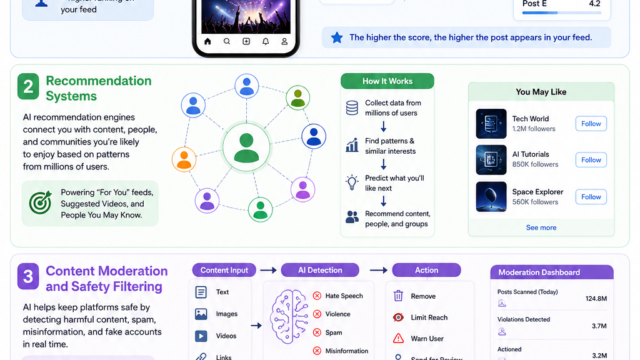
How AI Is Used in Social Media Algorithms

Artificial Intelligence (AI) is the invisible engine behind almost everything you see on social media today. From what appears on your feed to the ads you’re shown, AI systems continuously analyze behavior, predict interests, and decide what content keeps you engaged the longest.


1. Personalized Feeds and Content Ranking

Every time you scroll through platforms like Instagram, Facebook, or X, AI is working in the background to rank posts. It studies what you like, comment on, share, and even how long you pause on a post.

https://images.openai.com/static-rsc-4/ZqXnISPF2w4wUvuzkVxi-BNlI1tp5njk2Ep5ESBKLStagJD52VN4SZ63f-UGmVU0o2wT6IQLUMw0IQVkHIR76TYLKXszyjDEValdLC6i5RsorHf86CZQp8rydmlZJUh7qNyO0Db5ZtpDDFWcla_VVX5QS91tc910y2iz0Ix4zsA3a8vfsSnsuJWVT2GM5Me0?purpose=fullsize
https://images.openai.com/static-rsc-4/x32kOe9HKxb363pIMbZ7xQAGhr1bs2aPvtQIqfjfXVJQmOjk4-nl0r8TsQcNliDh8crYdHVmuVY2zo2rhS929OU0LNlI4ECV0seBu3FapkOuxgEr22laKYJdQXVj1vMEepg3x7NLd3z3PLqri5mJKCPECVDevBMzmmVlsQ_weAqnyfSvgQpXTk-8dqTtbE0b?purpose=fullsize
https://images.openai.com/static-rsc-4/JM9z-g7OB2LR74zGzJvwnM9pdiL-0KIsgmUzKXtrdBar-M2vcj4rrMenFGblJ1qFcns7g-wsQHKSyPFcVfaszVaVa0Oq7t25cyIoUr8ah1LEAEZcXFPnZkDklubQZWebLG1x0xPjZR6yOL83NMkUxXtgpZ3JYFZpdB0C_bYNg0brJTOXVNSmjUG-VCmNohn4?purpose=fullsize

9

Machine learning models assign a “relevance score” to each post. Higher scores mean the post appears closer to the top of your feed. This is why two users rarely see the same timeline in the same order.


2. Recommendation Systems (What You Should Watch Next)

Recommendation engines power features like “Suggested Videos,” “People You May Know,” and “For You Pages.”

https://images.openai.com/static-rsc-4/1B-MwKneOumo1aOCYjwR8u3RF9okfs3nLm29ZV9AQ12nWae66k8BfCOomrBI6Dl9rzB4KSq_FdMeDOjwxeLv-HH242HkxqEw75k0qWeG9-pjWmejwlEIGkoRXvl554eVftv_wQVRAXRBQGhWlHy4wKnzgoh01t7zJtwraKiWbw0YWjP1VMN1W_aUzFHvlTmo?purpose=fullsize
https://images.openai.com/static-rsc-4/_Y3c2npEqIw_atQamDUKffbVD9J1duWvP9R5bF2QBu8E0ITUvMUnbP93vToQ7tzCSy5ySN4LX_UN24eDDMSpQil_O7HEou_iPaf7auXn32E2urmTeZZj0Bi3i9KZfh8RYtf12SObsxVzmYjMFrQlaLoHpDTvNWOK8lJ8KQvYHBbOqTZt4etGg8EGvrBY3Wtw?purpose=fullsize
https://images.openai.com/static-rsc-4/18Oca6__sR1zH6-o4Mvo29MwWsi4Ii8uAPcViMzR-XErzOUwGpT1RBitMTGEHrNv6Qg9W2ouddfOQmHhVx_FswssFDiWaM4wJwZY0YnX4euO9SR-pfLFbIUEUU2X8ortkCpI8r8HvlVCE9kKkFSH8eA6huXOgJB-T8a_GLD-Cva2LPxylO2zPu-VW7Ky8XD1?purpose=fullsize

8

These systems use collaborative filtering and deep learning to connect users with similar interests. For example, if many users who like tech videos also watch AI tutorials, the algorithm will recommend AI content to you even if you’ve never searched for it.


3. Content Moderation and Safety Filtering

AI also plays a major role in keeping social platforms safe by detecting harmful content, spam, misinformation, and fake accounts.

https://images.openai.com/static-rsc-4/HOgnphyAIhjLU__JuxiPZVn1zaU18RoKVc_s-nqo6fhG0a5x4iKeaapkZBy_-av-GjJUG3JpUDbUZlnwIgA5sizIlZ0-ARqoeKOt0KgFYXqYteteMoqPa7PCIAaYJN2vybqy3VS6Vk1zhYqzYMvgsm4HH5KSySxYIiN2BZXxIYorqM55uC30vV11OWqInbKl?purpose=fullsize
https://images.openai.com/static-rsc-4/aZg9CE_dA6lkge3iHv4fuvR3Qq37_6Swl242jp1P7ux9z_udVEfsGbmH_Y_6RU5UlxKlv8ELhvvlQ2uQzGSXrpUKPQ9g3dlGo5gVmhgWuvNkRLQoO7-JYSYvYwAmcROBCOGKN5DP1UbVkH2-Ca8qx1ZbzecUgUgNH7fal439AB-b4SnbLh-gi0SmtGPdkgZf?purpose=fullsize
https://images.openai.com/static-rsc-4/VSwMec-jqFbKhIvZtAnAxlvy7lfjwsKjOkxwoM8AsdNrfLRjwHlLszUShukYxGeDALETDbPpH-sR3iaKdF0H-FYb3V8TvqkJQWrwEgos_Gy1t7iTNp-bIEhnN5TGpKI_YQr4ehFxRV9_CBNQ1eCRyxtWvhlGBOkcxgx7-fku3wfZPB5I6H24cbFeqxbxoGRo?purpose=fullsize

7

Computer vision and natural language processing models scan text, images, and videos in real time. While not perfect, these systems help remove millions of violating posts every day before humans even see them.


4. Targeted Advertising and User Profiling

One of the most powerful uses of AI in social media is advertising. Platforms use AI to decide which ads you are most likely to click or buy from.

https://images.openai.com/static-rsc-4/LtbXU-NEmFpuKHp68Dxi-uTfX6kmzuIOfre2yc3t5IQipkrPLAkXWYHsxgyE4716e5-H-k_laq6zIkcPaAVAD3d9vQnNdQGR2EXPxBSPsUKhaeuedowlTauRJDpMuSi0pk6xy9kAR_lEy1qTQJ05C1Jsk0Q0B3fQWU22L5tCYL2DeQpy0gSvWVVWGEt7CVpg?purpose=fullsize
https://images.openai.com/static-rsc-4/S_ADokusYdYdBEFUtklHOYPjV4r2mYTwW8zOmFGgiBqEkYpeJc-TDX1rL9LaXEr3NkcIZ-6R9uDpAADQ7v9PfThbNfIdbIBstvTtVApFgW0CfQf8jJjYQ0yG4pbJA6yBiqFXdVBG0j_mspNnatbMYuf-4vKDI0pHY3p-OTomgiHLP2dqU-uiDtzSSUSAGEM2?purpose=fullsize
https://images.openai.com/static-rsc-4/7vUDHCOPOFk7RPyTmuhF3znAwf6akfl49VSQaB-3BhLjRfe1aszq7H0LQ35hf6KD7lxBBuWaMhQkrZXBZaXzKGkcF_5i9uBHR7GndNzxnv1LWkL0SdzosVd1QaVies3zPK5X3L3vvtNIbR4Qtu5IEUT4kuF0xG9q5LxU1FpWD1oCcFebU3cFnRA6ncwuNqNb?purpose=fullsize

6

AI builds detailed user profiles based on demographics, interests, and behavior patterns. This allows advertisers to reach highly specific audiences, improving conversion rates while making ads feel “personally relevant.”


Conclusion

AI is deeply embedded in social media, shaping what we see, how we interact, and even what we buy. While it improves personalization and safety, it also raises concerns about privacy, echo chambers, and over-personalization.

Competition Pressure in AI: How It Is Accelerating Innovation in 2026

The global artificial intelligence industry is evolving at an extremely fast pace, driven largely by intense competition among major technology companies. This competition is reshaping how quickly models are released, how capable they become, and how deeply they are integrated into everyday digital tools.

1. The Shift from Slow Releases to Rapid Iteration

In earlier years of AI development, major model upgrades took significant time—often years between large releases. However, the competitive landscape has changed dramatically.

Today, companies are prioritizing rapid iteration cycles, where models are updated frequently with incremental improvements. These updates may not always be massive breakthroughs individually, but together they create continuous performance gains in reasoning, coding, speed, and multimodal understanding.

This shift allows companies to respond quickly to user feedback and stay ahead in a highly competitive market.

2. OpenAI’s Push Toward Faster, Smarter Systems

OpenAI continues to accelerate its development cycle, focusing on improving reasoning ability, long-context understanding, and agent-like behavior.

Instead of building only conversational tools, the direction is now toward AI systems that can complete tasks, use tools, and perform multi-step workflows with minimal human input. This reflects a broader transition from chat-based models to action-oriented AI agents.

3. Google’s Ecosystem-Driven AI Strategy

Google is advancing its Gemini models with a strong emphasis on integration across its ecosystem, including Search, Android, and Workspace tools.

Rather than treating AI as a standalone product, Google is embedding intelligence directly into the services billions of users already rely on. This approach aims to make AI a seamless part of productivity, communication, and information discovery.

4. Meta’s Focus on Open and Social AI

Meta is taking a different but equally aggressive approach by focusing on open-source models and AI integration within social platforms.

By embedding AI into apps like WhatsApp, Instagram, and Facebook, Meta is scaling AI usage across global social networks. Their open model strategy also encourages developers to build new applications on top of their systems, increasing innovation outside the company itself.

5. The Result: A Fast-Moving AI Race

The combined pressure from these companies has created a rapid innovation cycle across the entire industry. Key outcomes include:

  • Faster model releases and updates
  • Continuous performance improvements instead of slow generational leaps
  • Stronger focus on AI agents that can perform real tasks
  • Wider integration of AI into everyday apps and devices

Conclusion

Competition in the AI industry is no longer just about who has the most powerful model—it is about who can iterate the fastest, integrate the deepest, and deliver the most useful real-world capabilities. As companies like OpenAI, Google, and Meta continue to push each other, the pace of innovation is likely to remain extremely high, shaping a future where AI systems become more capable, more embedded, and more autonomous.

How to Start a Career in Artificial Intelligence and Machine Learning

Starting a career in Artificial Intelligence (AI) and Machine Learning (ML) is very achievable today, but it requires a clear roadmap because the field combines math, programming, and real-world problem solving.

Here’s a structured path you can follow:


1. Understand What AI & ML Really Are

Before jumping in, get clarity:

  • Artificial Intelligence is the broader field of making machines “think” or simulate human intelligence.
  • Machine Learning is a subset of AI where systems learn patterns from data instead of being explicitly programmed.

Common areas:

  • Computer Vision (images, video)
  • Natural Language Processing (chatbots, translation)
  • Predictive Analytics (finance, business forecasting)

2. Build Strong Programming Foundations

Most AI/ML work is done in Python.

Focus on:

  • Python basics (functions, loops, OOP)
  • Libraries:
    • NumPy (math operations)
    • Pandas (data handling)
    • Matplotlib / Seaborn (visualization)

Practice platforms:

  • LeetCode (logic building)
  • HackerRank (Python practice)

3. Learn Math (Important but Practical)

You don’t need to be a mathematician, but you must understand:

  • Linear Algebra (vectors, matrices)
  • Probability & Statistics
  • Basic Calculus (gradients, optimization)

These concepts help you understand how ML models actually “learn.”


4. Learn Core Machine Learning Concepts

Start with classical ML before deep learning.

Key topics:

  • Regression (linear, logistic)
  • Classification
  • Clustering (K-Means)
  • Decision Trees & Random Forests
  • Model evaluation (accuracy, precision, recall)

Use:

  • Scikit-learn (main ML library)

5. Move to Deep Learning

Once ML basics are clear:

Learn:

  • Neural Networks
  • CNN (images)
  • RNN / Transformers (text, AI chat systems)

Frameworks:

  • TensorFlow
  • PyTorch (very popular in research & industry)

6. Work on Real Projects (Most Important Step)

Projects matter more than certificates.

Beginner ideas:

  • Spam email classifier
  • House price prediction
  • Handwritten digit recognition
  • Chatbot using NLP

Advanced ideas:

  • Fake news detection system
  • Image recognition app
  • Recommendation system (like Netflix/YouTube)

Put projects on:

  • GitHub (must-have for portfolio)

7. Learn Data Handling & Tools

Real AI work is mostly data work.

Learn:

  • SQL (databases)
  • Data cleaning techniques
  • Feature engineering
  • Basic cloud tools (AWS / Google Cloud optional)

8. Build a Portfolio + Resume

Employers look for proof of skill:

Include:

  • 3–6 strong projects
  • GitHub links
  • Kaggle profile (competitions help a lot)
  • Internship or freelance experience if possible

9. Join AI Communities

This helps you grow faster:

  • Kaggle (competitions + datasets)
  • GitHub (open-source projects)
  • Reddit / Discord AI groups
  • LinkedIn AI communities

10. Choose a Career Path

AI/ML is broad. You can specialize:

  • ML Engineer (industry-focused)
  • Data Scientist (analytics + insights)
  • AI Researcher (advanced math + innovation)
  • NLP Engineer (chatbots, language models)
  • Computer Vision Engineer (image/video AI)

11. Suggested Learning Timeline (Simple Plan)

  • Months 1–2: Python + basics of math
  • Months 3–4: Machine Learning (Scikit-learn)
  • Months 5–6: Deep Learning + first projects
  • Months 6+: Portfolio + internships + specialization

Machine Learning vs Deep Learning: What’s the Difference?

Machine Learning (ML) and Deep Learning (DL) are closely related fields under the umbrella of Artificial Intelligence, but they differ in how they learn from data and how much human guidance they need.

Machine Learning: Learning with Human Guidance

Machine Learning is a method where computers learn patterns from data to make predictions or decisions without being explicitly programmed for every task.

In traditional ML:

  • Humans select and design features (important input details).
  • The model learns patterns based on those features.
  • Works well with smaller to medium-sized datasets.

Example:
To detect spam emails, engineers might manually identify features like:

  • Number of links
  • Presence of certain keywords
  • Email sender reputation

Common ML algorithms include:

  • Decision Trees
  • Support Vector Machines (SVM)
  • Logistic Regression
  • Random Forests

Deep Learning: Learning Like a Human Brain (Neural Networks)

Deep Learning is a specialized subset of Machine Learning that uses neural networks with many layers (hence “deep”) to automatically learn patterns from raw data.

In deep learning:

  • The system automatically learns features (no manual feature engineering needed).
  • Requires large amounts of data and high computing power.
  • Excels in complex tasks like images, speech, and natural language.

Example:
For image recognition, instead of telling the model what to look for, it learns:

  • edges → shapes → objects → meaning (step by step)

Common deep learning models include:

  • Convolutional Neural Networks (CNNs) – image tasks
  • Recurrent Neural Networks (RNNs) – sequence data
  • Transformers – language models (like chatbots)

Key Differences Between ML and DL

FeatureMachine LearningDeep Learning
Feature selectionManually doneAutomatically learned
Data requirementWorks with less dataNeeds large datasets
HardwareCan run on CPUsOften needs GPUs/TPUs
PerformanceGood for simpler tasksBest for complex tasks
InterpretabilityMore explainableOften a “black box”

Relationship Between ML and DL

Deep Learning is actually a subset of Machine Learning.

Think of it like this:

  • Artificial Intelligence → the big umbrella
  • Machine Learning → a branch of AI
  • Deep Learning → a deeper branch inside ML

So all deep learning is machine learning, but not all machine learning is deep learning.


In Simple Terms

  • Machine Learning: You guide the computer on what to look for.
  • Deep Learning: The computer figures out what to look for on its own.