AI Capital Arms Race: Why Tech Giants Are Spending Billions to Win the Future of Artificial Intelligence

Artificial Intelligence has become the most important battleground in the technology industry. What started as a race to build smarter AI models has evolved into a full-scale competition involving massive investments in data centers, advanced chips, cloud infrastructure, and elite talent. Industry leaders are spending unprecedented amounts of money to secure a dominant position in what many experts believe will be the next major technological revolution.

Image
Image
Image
Image
Image
Image

The New AI Investment Boom

The rapid advancement of generative AI has dramatically increased demand for computing power. Training and running modern AI models requires enormous amounts of processing capacity, specialized hardware, and energy resources.

Major technology companies such as OpenAI, Anthropic, Google, Microsoft, and Meta are investing heavily in AI infrastructure to support increasingly powerful models and expanding user demand.

Unlike previous technology waves, AI development depends on access to vast computational resources. As a result, infrastructure spending has become a key competitive advantage.

Why Data Centers Matter

Modern AI systems require enormous data centers filled with thousands of high-performance processors working together.

These facilities are responsible for:

  • Training large AI models
  • Running AI services for millions of users
  • Processing massive datasets
  • Supporting enterprise AI applications
  • Powering future AI agents and autonomous systems

Technology companies are building new facilities worldwide to increase capacity and reduce bottlenecks. The scale of these projects is often measured in billions of dollars and years of construction planning.

Image
Image
Image
Image
Image
Image

GPUs: The Fuel Behind AI Growth

One of the most critical resources in the AI race is the Graphics Processing Unit (GPU).

GPUs are particularly effective at handling the complex mathematical calculations required by machine learning models. As AI systems become larger and more sophisticated, demand for advanced AI chips has surged.

The shortage of high-end AI processors has become a strategic challenge across the industry. Companies are competing not only for AI talent but also for access to the hardware needed to train next-generation models.

This demand has transformed chip manufacturers into some of the most influential players in the technology ecosystem.

Cloud Platforms Become Strategic Weapons

Cloud computing providers have emerged as essential partners in AI development.

Organizations increasingly rely on cloud platforms to:

  • Access AI tools
  • Train custom models
  • Deploy AI applications
  • Store large datasets
  • Scale computing resources on demand

Major cloud providers are expanding infrastructure at a historic pace to meet growing AI requirements. Businesses of all sizes are now incorporating AI capabilities into products and workflows, creating additional demand for cloud-based AI services.

The Battle for AI Talent

Infrastructure alone is not enough to win the AI race. Companies are also competing aggressively for researchers, engineers, and scientists with expertise in machine learning and artificial intelligence.

Leading AI organizations offer highly competitive compensation packages and research opportunities to attract top talent.

The competition for skilled professionals has intensified because breakthroughs often come from relatively small teams of experts capable of developing innovative architectures, training methods, and safety techniques.

OpenAI, Anthropic, Google, Microsoft, and Meta

Several organizations have emerged as central players in the AI competition:

  • OpenAI continues to expand its AI capabilities and infrastructure partnerships.
  • Anthropic has rapidly grown through its Claude AI platform and enterprise offerings.
  • Google leverages its extensive cloud infrastructure and AI research expertise.
  • Microsoft integrates AI across its software and cloud ecosystem.
  • Meta invests heavily in open AI models, infrastructure, and future AI-driven products.

Each company has adopted a different strategy, but all share a common goal: securing long-term leadership in artificial intelligence.

Economic Impact of the AI Arms Race

The AI infrastructure boom is creating ripple effects across multiple industries.

Beneficiaries include:

  • Semiconductor manufacturers
  • Cloud service providers
  • Data center operators
  • Energy companies
  • Networking equipment suppliers
  • Enterprise software vendors

Governments are also paying close attention because AI is increasingly viewed as a strategic technology with implications for economic growth, national competitiveness, and innovation leadership.

Challenges Facing the Industry

Despite the excitement, significant challenges remain:

Rising Costs

Training advanced AI models can cost hundreds of millions of dollars, making AI development increasingly expensive.

Energy Consumption

Large AI systems require substantial electricity, raising concerns about sustainability and environmental impact.

Regulatory Uncertainty

Governments worldwide are exploring new rules for AI development, deployment, and safety.

Talent Shortages

Demand for AI specialists continues to exceed supply, creating intense competition among employers.

What Happens Next?

Many analysts believe the AI capital arms race is still in its early stages. Investments are expected to continue rising as companies pursue larger models, more capable AI agents, and broader adoption across industries.

Future competition will likely focus on:

  • More efficient AI models
  • Custom AI chips
  • Advanced autonomous agents
  • Enterprise AI platforms
  • Sustainable computing infrastructure
  • Global AI deployment

The organizations that successfully balance innovation, infrastructure, talent, and responsible development may define the next era of technology.

Conclusion

The AI Capital Arms Race represents one of the largest technology investment cycles in modern history. Major companies are committing enormous resources to build the computing infrastructure, acquire the talent, and develop the AI systems that could shape the future digital economy. As spending on data centers, GPUs, and cloud platforms continues to accelerate, the competition for AI leadership is becoming a defining story of the technology industry and a major force influencing global innovation, business strategy, and economic growth.

AI in Gaming: Smarter NPCs and Dynamic Storytelling

AI in gaming enables smarter NPCs, adaptive storytelling, and dynamic worlds. Games now respond to player choices, creating unique experiences with evolving narratives, realistic behavior, and endless replayability.

Gaming has always been a space where technology and creativity evolve together. From pixelated arcade characters to hyper-realistic open worlds, every leap in computing power has reshaped how games are played and experienced. Now, artificial intelligence (AI) is driving the next major transformation—making non-player characters (NPCs) smarter, worlds more reactive, and stories more dynamic than ever before.

In this blog, we’ll explore how AI is reshaping gaming through intelligent NPC behavior, adaptive storytelling, procedural content generation, and what this means for the future of interactive entertainment.


The Evolution of NPCs: From Scripted to Intelligent

https://images.openai.com/static-rsc-4/tMhm2haKCozV2p4EQ9r8IiSlN0oqDfws52jUh88eU8_q-7DYoVulpatW4JGgsN7clWTLN_hntOJLEmtu30mH6G5ryqd5ADvIqAIvwPLXw0N6cWzf_hZAJENuB6UUKY8mrqxyQPzGMz0jNXPUChIJo20KVXxh1wLXibu-jEj43YI4eUurr1IAMIq2Ib78Udt-?purpose=fullsize
https://images.openai.com/static-rsc-4/lAFIRmV0KBG4Vj-SfXrbV9B4v7FSatkh7gZkQoUCiOz0q_9c8myMuWpMRQwT4C9EX2U6hC0yFDfcl25pHxuaXIEKxhFgzfRjzF5HVRougSJkJbl76lAAi_-w3JBTdTzyUHBMlBUGUkHkMNAt2s5bqD-tM82mY9uDMcEsV50Gu4ddcVUKbfUKOWsbOsBbAi45?purpose=fullsize
https://images.openai.com/static-rsc-4/WpjrZi5lu3w58-KOPfjb1YCwF2gWLe8r08v-hMfn23kaK4rR841lYCkm3QIteWj3S2Xnq9z11a-jaWnxqtlBqj4lxiunn7lANpVh1tk_dRW2KJXNJqpB13gp-q2uHEOP4ZHc2GOi6mXJifxGOnNH3qImRHhfOWoYmgrPgVJIp8riNz9FfDBxzq0Ta9u0sVun?purpose=fullsize

Non-player characters (NPCs) used to follow rigid scripts. In early games, NPCs had predictable patterns: they would repeat the same dialogue, follow fixed patrol routes, and respond only to specific player actions. While this worked for simple gameplay, it often broke immersion.

AI has changed that dramatically.

Modern NPCs use a combination of machine learning, behavior trees, and decision-making algorithms to react dynamically to players. Instead of repeating fixed lines, they can:

  • Adjust dialogue based on player reputation or past choices
  • React emotionally to events in the game world
  • Coordinate with other NPCs in real time
  • Adapt strategies in combat situations

For example, in modern open-world games, enemies don’t just attack blindly—they flank, retreat, call reinforcements, or even change tactics depending on how the player behaves.

This shift transforms NPCs from background props into living participants in the game world.


Smarter AI Systems Behind Game Worlds

https://images.openai.com/static-rsc-4/cjO3a72ayuKWjGhmjK9k9j9Un_TAbL9C5AQoR28BDQZPWh5G__zUDf0Yfkm4BUom_rrqydAxFD-kRxQp4C8m0v_rzgGH49Q7QmhgK19Z2ubfiQVKQa8EIxM8OPk4UsbO_bjA9JNgUeXn530LzWxpSdjmH4_8NnIvsr0VFOD1K9dOdyAoghcG--tt5Eo04tcg?purpose=fullsize
https://images.openai.com/static-rsc-4/d7rPh-Y9RQebRP8QC5KEPiJ-ZH6SMLP7fvqAoHmJz_qQ--T3xjAOUgq5SWO3gEPsqQ0qSK9L74Fip9zBg6B81TSrtQFLIR5sKRujWozJSwCTTgEZ4FhjDJXLWCZ5Emo4XHgIExlKyQ3nHtVKu26mEIfS9LYlkMafA58yy8odcGKiblpcM-m-9OLnI8BCKcoz?purpose=fullsize
https://images.openai.com/static-rsc-4/4wmtsQ7zEKn4AYDjPfgL5YVsJZNzNwhJNFAyZkb3Jz3GEASXSJQSI_88hcetxfOvAo0dIgOX_bC_3-Og5frKI82UUGlJH8ovWM_hZ7mDD-eOnc-_cNImSslBHOssgvcbrsSUmmfan5Z2fspizUF7MNV05xml8TCGkiV0PRJu85PyWoR_LmVivZvN6x9KPgwI?purpose=fullsize

Behind the scenes, gaming AI is powered by several advanced techniques:

1. Behavior Trees and Decision Systems

Behavior trees allow NPCs to make decisions based on conditions. Instead of a single scripted response, NPCs evaluate multiple possibilities before acting.

Example:

  • If health is low → retreat
  • If player is weak → attack aggressively
  • If allies are nearby → coordinate attack

2. Pathfinding Algorithms

Algorithms like A* (A-star) help NPCs navigate complex environments efficiently. This is why enemies in modern games can move naturally through cities, forests, or dungeons without getting stuck.

3. Reinforcement Learning

Some modern games experiment with reinforcement learning, where AI agents learn from repeated play sessions. Over time, these NPCs improve their strategies by “learning” what works against players.

4. Procedural Generation

AI is also used to generate worlds, maps, quests, and even items. Instead of manually designing every detail, developers can rely on algorithms to create vast, varied environments.

Together, these systems create game worlds that feel alive and unpredictable.


Dynamic Storytelling: Games That Adapt to You

https://images.openai.com/static-rsc-4/aV0Vn2U-KCD8rQMZxmd6FR-MP3yty071W5goP9tnvecQ7SYbFUu4h6CPY8tA5msHQrBPNCkyW_XtiAmYXvPxo14B7QH7jCrJ4j8TsRTmT5YCQWUSnGWWbrHrOLCPJzksil3iv1_nvoxey9t9yMr3jjN4yDk4uOKRLp0Ba8uarN3wIuTNkRNui5F9gTXTC0JF?purpose=fullsize
https://images.openai.com/static-rsc-4/4BdEFFt9z3-ErpAwt2Ml8iUUY8kXS9Dkevrl1ZrPJ2PvivCJ2-uIElzgDIo6n0kS-p1iCAsD2CHuchQ8ZyHudMPlof_ry_BYXfLaKGsHVdSrfNvLJnG8u8ssdMJyPAS4d1bTL1Swx27jLjyp7zaaXJi8qwdNNykVo84pa-BUW7C3uqKBhepBRqs957Q7327T?purpose=fullsize
https://images.openai.com/static-rsc-4/RarzCpFYss9iP_GDTs-7oJjr6RafmkaoAQkOuO0j_gUQ0C6NGE7du5zL8MjbC3mcxgOnHSJu89rD3wsKXKRksjOX1OFl2JoFfXPM_qXiC9SNOvZTcc2OcnZBEmqyzsNfhphUHaHt8c4vszbH3Bkyo5U2ClV-1cTs7At6pI_V1_1IDfYsrQcg80naP1v5R5e8?purpose=fullsize

One of the most exciting applications of AI in gaming is dynamic storytelling.

Traditionally, game narratives are linear or semi-linear. Players follow a fixed story path with limited branching choices. But AI enables something more powerful: stories that adapt in real time.

How It Works

AI-driven storytelling systems track player behavior such as:

  • Moral decisions
  • Combat style (aggressive vs stealth)
  • Dialogue choices
  • Exploration patterns

Based on this data, the game adjusts:

  • NPC relationships
  • Available missions
  • World events
  • Story outcomes

This creates a personalized narrative experience where no two players experience the exact same story.

Example in Practice

Imagine a fantasy RPG:

  • If you consistently spare enemies, NPC factions begin to trust you.
  • If you frequently steal, towns may lock you out or send guards after you.
  • If you help a kingdom, it may rise in power and alter the political map.

The result is a living narrative that evolves with your actions, making the player feel truly responsible for the world’s outcome.


AI-Powered NPC Conversations: Beyond Scripted Dialogue

https://images.openai.com/static-rsc-4/G040mp0E5A930sndn-fWBc2ilNrSt8IZVxw38ZIBeQyx2xebdFP7yMk4YxJNXYPdzZ5XKJErOM0pHw208ULWsXJYT-6mUfGS-aYGiAdvlXfoVIrWhBDegwIxfShQUQOypIYvTglldx4k-6QehBZQNUpraCRQLzPR-mcdwsyPllufGpQllJd_mYXw4_Xbf074?purpose=fullsize
https://images.openai.com/static-rsc-4/Zl7I6h77i13TgL6mtS-UYvXP9FOe1M_Yx-wR3OXeWzjyJiMArJGidDNRsPNYMQqYc_nfOuy6TR_pHx3fUQcsHVlsI0Aibro7H6NSc2BrMvCUIo_AfLWCCb67HWh9sDGL9UBxdHl7HrqJPieJn-A1boGE26dZGijxtscnAGsWmrU5ub3-34634DzNDDhvE-2D?purpose=fullsize
https://images.openai.com/static-rsc-4/ZoPEV2rd6T0BdmmTHfgduOv4Owkd24YhJHf8F4VDnoOR83fZQCYDmb_0Bc67lpCPqE7TQ4QLlzXBvYjOvshS91VoKUAFdUMO0Ky8hGkC5lC8KZnt02F88U8EPMznE_Nd9e_e8XbqGJtxuhsbyxGS0R7SWMvuSoQ8tUYVyX9VEX5WM0GoAPMLkq0nCpTdGpZR?purpose=fullsize

One of the biggest breakthroughs in gaming AI is natural language interaction.

Instead of selecting from pre-written dialogue options, players can now sometimes type or speak freely to NPCs. AI systems interpret the input and generate appropriate responses in real time.

This creates several advantages:

  • More immersive role-playing experiences
  • Less repetitive dialogue trees
  • Greater emotional depth in conversations
  • Emergent storytelling possibilities

For example, instead of choosing:

  • “Ask about the quest”
  • “Say goodbye”

You might type:

“Why should I trust you after what happened in the village?”

The NPC responds dynamically based on context, personality, and past interactions.

This kind of system blurs the line between scripted game dialogue and real conversation.


Adaptive Difficulty: Games That Learn From You

https://images.openai.com/static-rsc-4/hKImSoSUfW28agjp2tTJdIsxXq6zVHBdsSsTiQlIflc5OuDLGIpHSJ9TaHflkLhic4PNDUQNMahi92koKJ6KC6381bPSQ8T64ZXszDC6FOLMb8N8CgK3cORNp1IN3dSPI9ooUcgc-76QBCLkS002-rqb74Jr5Y2qhz6EykUY4TWm9EcG_xzU15KZRRj8ftv_?purpose=fullsize
https://images.openai.com/static-rsc-4/ZYlxuyMVZhSzNxKHiivnykNdhhNtLZoVAC4LNsjgm97hVxu3FUrngZoVfmWG1txpkher6HDBeehqecy4s77YEVn7pv94io-ksITf6raw_mayAjNWg3tC3iUXxxfGkWWwW6k5iV1SNpCQlfk6MNN8k1MPWQ8C1HHcGVLgdSQSKO8gRLzx7wMTwZHeZHN6CFBa?purpose=fullsize
https://images.openai.com/static-rsc-4/ymhcmzvZE2-1YyR_Gufq3tKklZCD6z0_94QoEMagWXgFYy4A2eDd41wNFmIFXbbwqkRcshC-KRu854ntIDIKfbJ-ejKFQvzFkSnSzQbPVtjmeppIcj_6Sh5hqxNtVZ-kTMPe31fjxUklU_fa3wdWs5yL_2gjAtFv4H1FViZ2QRxqT3lAD12cM76XmQ3sOLxD?purpose=fullsize

Another major AI innovation is adaptive difficulty systems.

Instead of fixed difficulty settings like Easy, Medium, or Hard, AI can continuously adjust the game based on how the player performs.

What AI Tracks:

  • Reaction time
  • Accuracy
  • Strategy effectiveness
  • Survival rate

What It Changes:

  • Enemy aggression
  • Resource availability
  • Puzzle complexity
  • Damage scaling

This ensures players stay in a “flow state”—not too easy, not too hard, but just challenging enough to stay engaged.

However, developers must balance this carefully. If players notice the game is “cheating” or adjusting too obviously, it can break immersion.


Procedural Content Generation: Infinite Game Worlds

https://images.openai.com/static-rsc-4/X4nA9MiC1c_7FjpJEKB6fCmR-4BTEIyx-A9zhicTJPL_pDB1s8HY_I33bT4Yyzj31_1k1c9NdFrlfDxo9xTF7CfVSrY0bfE-78VeGHHo4kCqMJxrLPZzw4NcN0JKywmPv7OKP6VMXXJi35cdFsoT_WlZ6XwASVI_IM8fmKIerZZFl_j6AVrTozUdbLJzYDMX?purpose=fullsize
https://images.openai.com/static-rsc-4/SLEp31ydmg0cdHTJXXKXVgl2UGACXfR7BNkFadhHbXUjUSmBzGWKjqyHwUINHvMhS9S2bcfDJFK8xjVqPAuDorA4nie9T5-Muzzkd_94F3KWf4K7LBV5bwaVUWaC20d3XINgYOw5Q04oO6p7o-_sQMw3H1zJ1aeENPsUK4potYjbe6s9pmeb0FfHLuyrG9Dj?purpose=fullsize
https://images.openai.com/static-rsc-4/KjHK5TQy21yBO67fiRvMhcLNRu14wnSEyz8pDrxFI1uiPcdrP1cNk5eIFtEyokT31XKyDfL0XTDoGQNh7-RGgSoyH0TMXj-YTQbrPcQC2ZiZ3lqcCItAcOjAmUNWz_3glDLT5JTZQV36EbbUDBiAlKA_XfwYED4Ns7h4T0BihszQfLKsjWqTciFCckplTBDD?purpose=fullsize

Procedural generation is one of AI’s most powerful contributions to gaming.

Instead of manually designing every map or level, developers can use algorithms to generate content automatically.

This includes:

  • Landscapes and terrain
  • Dungeons and caves
  • Entire planets or galaxies
  • Side quests and loot systems

Games like exploration or survival titles often rely heavily on this technology to create nearly infinite replayability.

Why It Matters

  • No two playthroughs are identical
  • Developers can build massive worlds with smaller teams
  • Players experience constant discovery

However, procedural generation must be carefully designed to avoid repetitive or meaningless content.

The best systems combine AI randomness with handcrafted rules to maintain quality and coherence.


The Future of AI in Gaming

https://images.openai.com/static-rsc-4/tuOhigy-hpo54soWKk9qvNYW6GXiVyd3VYhWTk_L6bqaHK-VW1hsbY3ZjLJ__qsrvdKhG9Q6cYE0XYc8cEBl1kfgNt4WUvTZzPYUy5fY75DneNmzfr3aUQPDXxBMnS_GSyK6ZTR9IDDlyk24J-CL5P6abZ413aBTmKAG6rI1UUQ3nxrSTuS8rA_P3mY4dj24?purpose=fullsize
https://images.openai.com/static-rsc-4/3ksexQwevkyswT-mIo7iXd8tFF4DFhrFCiCZQ076I_MnVkuIL93dS4K767sqllqComexyl9pHDTpQHm2uX-W86rYLCci_nl7UzypPNYOsiLcYQoK1LdXfyS7BntbJsMzh5cq29j-5LPwZek6UldFQRYmbmpOHMDb5wSL9MP65cEqKStXBI-o49ppCXWbAniF?purpose=fullsize
https://images.openai.com/static-rsc-4/AUk15AnwT234nTFR9Yg1jTYJtfKMDUQ9Ogaj1m3y-sFT7DFdA56oT3ReJzRlLYgizff1eigfWla7fktOIFeasq8SUC_sgkArfO_8wulxeCoOs5WEEgSJVZswPPv8w2ewgLg6yk74shk89BRcAKTiqVadxWeOQI6K6RrHaWhXN1GHyhbxOoXkTx3RtFJozJVl?purpose=fullsize

The future of AI in gaming is moving toward fully immersive, responsive worlds where every element reacts intelligently to the player.

Here are some trends we are likely to see:

1. Fully Autonomous NPC Societies

NPCs will have routines, jobs, relationships, and evolving goals—even without player interaction.

2. AI-Generated Story Campaigns

Games may generate entire story arcs on the fly, tailored uniquely to each player.

3. Emotion-Aware Gameplay

Future systems may detect player emotions through voice or behavior and adjust the game accordingly.

4. Hybrid Human-AI Game Design

Developers and AI will collaborate in real time to build evolving game worlds.


Challenges and Ethical Concerns

Despite its promise, AI in gaming also raises challenges:

  • Predictability vs chaos: Too much randomness can break game design
  • Fairness issues: Adaptive systems may feel inconsistent
  • Content control: AI-generated dialogue must remain appropriate
  • Performance costs: Advanced AI requires powerful hardware

Developers must strike a balance between innovation and control to ensure enjoyable gameplay.


Conclusion

AI is fundamentally reshaping the gaming industry. Smarter NPCs make worlds feel alive. Dynamic storytelling makes every choice meaningful. Procedural generation expands game universes beyond what human designers alone could build.

We are moving toward a future where games are no longer static experiences—but living systems that evolve with every player interaction.

In this new era, every playthrough tells a different story, and every decision truly matters.

AI’s Enterprise Push Is Coming for IT Services Work

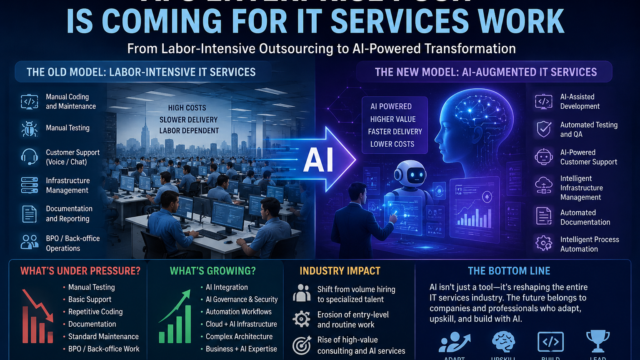
The rapid expansion of artificial intelligence into the enterprise world is beginning to reshape the global IT services industry. For decades, major technology outsourcing firms built their businesses around large workforces handling software maintenance, customer support, testing, infrastructure management, and back-office operations. Now, AI is changing how that work is performed — and in some cases, reducing the need for large teams altogether.

AI Is Transforming Traditional IT Services

Enterprise AI tools are becoming more capable of handling repetitive and time-consuming tasks that were once managed by human employees. AI-powered coding assistants can generate software code, automation tools can monitor infrastructure, and intelligent systems can manage customer support requests with minimal human involvement.

This shift is creating pressure on traditional outsourcing models that rely heavily on labor-intensive work. Tasks such as manual testing, basic software maintenance, documentation, and repetitive operational support are increasingly being automated through generative AI and machine learning systems.

Large enterprises are also investing directly in AI transformation projects instead of simply outsourcing routine operations. Companies now want AI-driven efficiency, faster deployment cycles, and lower operational costs.

IT Companies Are Adapting to a New Reality

Major IT service providers are responding by restructuring their strategies around AI integration and digital transformation. Instead of focusing only on large-scale staffing contracts, companies are moving toward higher-value consulting services that involve AI implementation, cloud modernization, cybersecurity, and enterprise automation.

The demand for professionals with expertise in AI engineering, cloud platforms, data science, and cybersecurity is growing rapidly. Organizations still require skilled workers who can integrate AI systems into legacy infrastructure, ensure compliance, manage governance, and oversee security risks.

At the same time, entry-level and repetitive IT jobs are facing increased uncertainty as AI systems become more efficient.

The Rise of AI-Augmented Workplaces

Rather than completely replacing IT workers, AI is changing the nature of their roles. Many professionals are now expected to work alongside AI tools that improve productivity and automate repetitive tasks.

Software developers increasingly use AI coding assistants to accelerate development. Customer service teams rely on AI chatbots for first-level support. Infrastructure teams use predictive AI systems to detect outages and optimize performance.

This evolution is creating what many analysts describe as an “AI-augmented workforce,” where human expertise remains essential for strategy, oversight, decision-making, and complex problem-solving.

Challenges Facing the Industry

Despite rapid adoption, enterprises still face major concerns regarding AI reliability, security, and governance. AI systems can generate inaccurate outputs, expose sensitive data, or create compliance risks if not carefully monitored.

Businesses also worry about workforce disruption. As automation expands, companies must retrain employees and prepare workers for more specialized technical roles. Governments and industry leaders are increasingly discussing the long-term impact of AI on employment and economic stability.

Another challenge is balancing cost savings with innovation. While AI can reduce operational expenses, implementing enterprise-grade AI systems requires significant investment in infrastructure, talent, and cybersecurity.

The Future of IT Services in the AI Era

The IT services industry is entering a major transition period. Traditional outsourcing models based on large labor pools may gradually decline, while AI-focused consulting and automation services continue to grow.

Companies that successfully adapt to AI-driven enterprise demand are likely to remain competitive. Businesses that fail to modernize may struggle as clients seek faster, more efficient, and AI-powered solutions.

Ultimately, AI is not eliminating the IT services sector — it is reshaping it into a more specialized, technology-driven industry where human expertise and intelligent automation work together.

Conclusion

AI’s growing presence in enterprise technology is redefining the future of IT services work. Automation is reducing reliance on repetitive tasks while increasing demand for advanced technical expertise in AI integration, cybersecurity, cloud computing, and data management. As organizations continue investing in AI transformation, the global IT industry will likely experience both disruption and opportunity in equal measure.