Category: Education · India · Artificial Intelligence · Digital Literacy
Artificial intelligence is changing how students learn, research, communicate, and prepare for future careers. From AI chatbots that answer questions to image generators that create realistic pictures, these technologies offer new educational opportunities—but they also introduce challenges involving misinformation, deepfakes, privacy, and academic integrity.
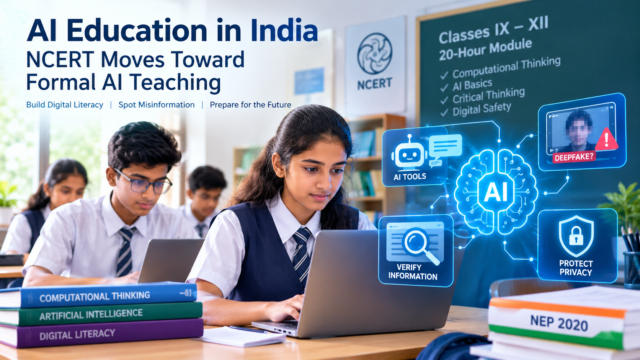
The reported move toward an introductory AI module developed by the National Council of Educational Research and Training (NCERT), intended for Classes IX–XII, highlights an important question for India’s education system: Can teaching students how AI works help them become more informed, responsible, and independent digital citizens?
An introductory 20-hour module, as described in news reports dated October 26, 2026, could provide a starting point for helping students understand AI tools and evaluate their outputs. The long-term impact, however, will depend on how the curriculum is taught, how teachers are trained, and whether students get opportunities to practise critical thinking rather than simply use AI applications.
What Does the New NCERT AI Module Include?
According to reports published on October 25–26, 2026, NCERT has introduced a 20-hour introductory module on Computational Thinking (CT) and Artificial Intelligence for Classes IX–XII. It was developed with input from faculty members at IIT Madras and IIT Jodhpur and is aligned with the National Education Policy (NEP) 2020.
The module is designed for students who have no previous knowledge of AI. Its activity-based approach focuses on understanding how AI works, identifying its limitations, protecting personal information, and evaluating AI-generated content.

Understanding AI in everyday life
Students explore familiar examples such as predictive text, recommendation systems, and automated services to distinguish AI from conventional rule-based technology.

Learning how machines recognise patterns
Practical activities introduce training data, pattern recognition, and the reasons AI systems may produce incorrect or biased results.

Recognising misinformation and deepfakes
Students learn to question convincing-looking content and verify information instead of automatically trusting an AI-generated answer.

Privacy, fairness, and responsible use
Lessons address data protection, ethical decision-making, digital safety, and the responsible use of AI tools.

Using AI tools effectively
Students practise writing prompts, assessing responses, correcting errors, and treating AI as a learning assistant rather than a replacement for their own thinking.
Source: NCERT module details reported by Moneycontrol and The Times of India.
Why AI Literacy Matters for Indian Students
Understanding the difference between information and evidence
AI chatbots can explain difficult concepts, summarise lengthy documents, and answer questions in natural language. However, a fluent response is not necessarily a correct one. AI systems can produce fabricated facts, incorrect statistics, misleading citations, or outdated information.
Students who understand these limitations can learn to ask better questions: What is the original source? Does the evidence support the claim? Can another reliable source confirm it?
For example, a student researching a government scholarship might receive an incorrect eligibility requirement from an AI chatbot. Rather than copying the answer into an assignment, the student should check the relevant official government website or published notification.
This habit is valuable far beyond examinations. It encourages evidence-based thinking when students encounter claims about health, employment, science, public policy, and current affairs.
Learning how to identify deepfakes
Deepfakes are synthetic or manipulated images, audio recordings, and videos that can make people appear to say or do things they never did. Improvements in generative AI have made some fabricated content increasingly convincing.
Students may encounter fake celebrity videos, fabricated news interviews, misleading audio clips, or manipulated images circulated through social media and messaging groups.
AI education can introduce a practical verification process:
- Check the original source and publication date.
- Look for independent reporting from reliable news organisations.
- Search for the original photograph, recording, or video when possible.
- Examine the surrounding context instead of judging a clip in isolation.
- Avoid forwarding unverified material, especially when it could harm someone’s reputation.
Visual clues such as unnatural movements or inconsistent lighting can sometimes help, but they are not dependable proof. Likewise, an AI detection tool can make mistakes. Verification should combine source checking, contextual investigation, and independent evidence.
Developing independent thinking
Another important goal is to prevent students from becoming overly dependent on AI tools. If a chatbot completes every assignment, students may miss opportunities to practise writing, reasoning, problem-solving, and independent research.
A more productive approach is to attempt a problem first, use AI to explore alternative explanations, and then evaluate the response. Students should be able to explain the final answer in their own words.
This is especially important for mathematics and science. An AI system may produce the correct numerical answer but use an invalid step in its reasoning. Students need subject knowledge to recognise such mistakes.
The new module’s emphasis on practical activities and reflection supports this broader educational objective.
Can AI Education Reduce Misinformation in India?
AI education can help students become more careful consumers of online information, but it cannot eliminate misinformation by itself. Its effectiveness will depend on whether students regularly practise verification and apply those skills outside the classroom.
India’s digital environment includes multiple languages, social media platforms, messaging services, and communities with different levels of digital access. Students may encounter misinformation in English, Hindi, Odia, Bengali, and other languages. A useful AI curriculum should reflect this diversity.
For instance, students could examine two social media posts making contradictory claims about a public examination. They could identify the original announcement, compare the dates, check the relevant official website, and explain which claim is supported by evidence.
Such exercises teach a transferable skill: do not confuse popularity, confidence, or realistic presentation with truth.
Schools could also organise media-literacy projects in which students analyse misleading headlines, identify missing context, and practise responsible sharing. These activities would connect AI literacy with communication, citizenship, and everyday decision-making.
The Challenges of Introducing AI Education in Indian Schools
Although the initiative offers opportunities, successful implementation will require attention to several practical challenges.
Unequal access to digital resources
Not every school has reliable internet access, sufficient computers, or modern digital infrastructure. Students in rural and economically disadvantaged communities may have fewer opportunities to experiment with AI tools.
The module’s reported provision for device-based, teacher-led, and offline activities is therefore important. Schools should be able to teach the core concepts without requiring every student to own a smartphone or pay for an AI subscription.
Teacher training and confidence
Teachers do not need to become advanced AI engineers to teach foundational AI literacy. However, they should understand how AI systems generate responses, why errors occur, how bias can influence results, and how to evaluate digital information.
Professional development should include practical classroom exercises, examples of AI-generated misinformation, and guidance on academic integrity. Teachers also need clear rules about when AI assistance is acceptable in assignments and assessments.
Privacy and responsible data use
Students may unknowingly share names, photographs, school information, passwords, or other sensitive details with online AI services. AI education should explain why information entered into a digital tool may be processed or retained according to that service’s policies.
Students should be taught never to enter passwords, one-time passwords, Aadhaar or PAN details, or private documents into untrusted AI tools. Schools should also follow applicable data-protection requirements and use age-appropriate, institutionally approved platforms.
Keeping the curriculum up to date
AI technologies change rapidly. Tools that are widely used today may be replaced or significantly modified within a few years.
Consequently, education should focus on enduring principles rather than teaching students to memorise the features of a particular chatbot. Source verification, privacy awareness, critical thinking, fairness, and responsible technology use will remain useful even as AI applications evolve.
How Schools Can Make AI Education More Effective
The following approaches could help schools translate introductory lessons into lasting skills.
Teach a repeatable fact-checking method
Ask students to identify the claim, find its original source, compare independent evidence, check the date, and decide whether the available evidence supports it.
Use group investigations
Let students investigate the same claim independently, compare their findings, and explain why their sources are reliable or unreliable.
Integrate AI literacy across subjects
Mathematics classes can examine numerical errors, science classes can evaluate scientific claims, and language classes can analyse misleading headlines and persuasive writing.
Assess judgement, not just tool usage
Students should explain how they verified an answer, corrected an AI error, protected personal information, and reached their final conclusion.
The Future of AI Education in India
The introduction of a dedicated introductory module for Classes IX–XII is part of a broader effort to integrate computational thinking and AI literacy into school education. CBSE has also outlined computational-thinking and AI learning for younger classes, with the objective of developing foundational skills progressively.
For India, the opportunity extends beyond preparing students for technology-related careers. AI literacy can help learners become more thoughtful researchers, more responsible online participants, and more confident problem-solvers.
Students do not all need to become AI developers. However, they increasingly need to understand how AI influences the information they encounter and the decisions they make.
The ultimate measure of success will not be how many students can operate a chatbot. It will be whether they can recognise uncertainty, question unsupported claims, respect privacy, and make informed decisions even when an AI system sounds completely confident.
Conclusion
AI education in India represents an opportunity to connect technological knowledge with critical thinking and digital responsibility. The reported NCERT 20-hour module for Classes IX–XII addresses several important areas, including computational thinking, misinformation, deepfakes, data privacy, and the limitations of AI-generated answers.
If schools support the initiative with trained teachers, inclusive classroom activities, practical fact-checking exercises, and clear ethical guidelines, students could develop skills that remain useful throughout their education and working lives.
Nevertheless, a short introductory module alone cannot guarantee that students will identify every deepfake or avoid every misleading claim. Building digital literacy requires repeated practice, access to reliable information, and a willingness to question even the answers that appear most convincing.
The central lesson is simple: AI can assist learning, but human judgement must remain at the centre of it.