
Exploring how step-by-step artificial intelligence tutoring can strengthen student understanding, improve problem-solving skills, and transform mathematics and science education.
Introduction
Mathematics and science are essential subjects for developing logical reasoning, analytical thinking, creativity, and problem-solving abilities. However, many students find these subjects challenging because they require more than memorizing definitions, formulas, and scientific concepts. Students must understand relationships between ideas, apply mathematical principles, interpret evidence, and solve problems through logical steps.
Traditional classroom teaching provides structured learning, but teachers often face challenges in giving every student individual attention. In a classroom with dozens of learners, some students understand a concept quickly, while others need additional explanations, practice, and guidance. When students cannot keep up with lessons, they may gradually lose confidence and develop anxiety about mathematics and science.
Artificial intelligence (AI) is creating new opportunities to address these challenges. AI-powered guided learning systems can provide personalized explanations, interactive exercises, step-by-step problem-solving assistance, and immediate feedback. Instead of simply presenting an answer, these systems can guide students through the reasoning process and help them understand how a solution is developed.
The growing interest in AI tutoring raises an important educational question: Can AI-powered guided learning genuinely improve mathematics and science education, or does it risk making students overly dependent on technology?
The answer depends on how these tools are designed, implemented, and integrated into teaching. When used responsibly, AI tutoring could become a valuable educational support system rather than a replacement for teachers.
Understanding AI-Powered Guided Learning
AI-powered guided learning is an educational approach in which artificial intelligence supports students through structured lessons, interactive explanations, personalized exercises, and continuous feedback.
Unlike conventional digital learning platforms that mainly provide videos, notes, and multiple-choice questions, guided AI tutors can interact with learners through conversations. Students can ask questions, request alternative explanations, and receive hints when they struggle with a particular concept.
For example, a student learning quadratic equations might not understand how to factorize an expression. Instead of immediately displaying the final answer, an AI tutor can identify the difficult step, explain the relevant mathematical rule, provide a simpler example, and ask the student to attempt the next step independently.
The same approach can be applied to science education. A student studying Newton’s laws of motion can receive an explanation, explore practical examples, solve numerical problems, and answer questions that test their understanding.
Several important technologies make this possible:
- Generative AI: Produces explanations, examples, summaries, and interactive responses.
- Intelligent Tutoring Systems (ITS): Tracks student performance and provides targeted instructional support.
- Adaptive Learning Algorithms: Adjust learning difficulty and content according to individual progress.
- Natural Language Processing: Allows students to ask questions using everyday language.
- Learning Analytics: Identifies knowledge gaps, repeated mistakes, and areas requiring additional practice.
The main objective is to make learning more interactive, responsive, and focused on understanding rather than memorization.
How AI Tutors Can Improve Mathematics Education

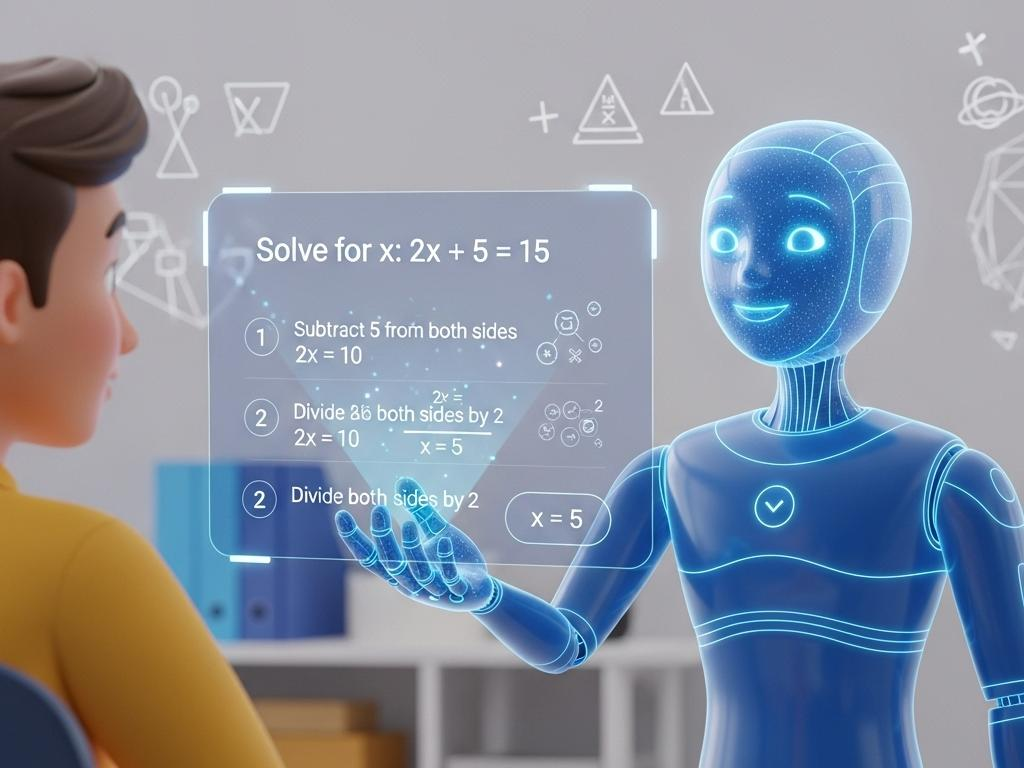
Mathematics requires students to understand concepts, recognize patterns, apply formulas, and develop logical solutions. However, students often struggle because they miss an important step in the learning process.
AI-powered tutoring can help address this problem through personalized mathematical instruction.
Step-by-Step Mathematical Problem Solving
One of the most promising applications of AI tutoring is its ability to explain mathematical problems through individual steps.
Consider the equation:
\[ 2x+5=15 \]
A traditional answer-focused system might simply provide:
\[ x=5 \]
However, a guided AI tutor can explain the complete process.
Step 1: Start with the original equation.
\[ 2x+5=15 \]
Step 2: Subtract 5 from both sides.
\[ 2x=15-5 \]
Step 3: Simplify the equation.
\[ 2x=10 \]
Step 4: Divide both sides by 2.
\[ x=5 \]
Step 5: Verify the answer.
\[ 2(5)+5=15 \]
The student learns not only the correct answer but also why each operation is necessary.
AI tutors can extend this approach by asking students to complete individual steps themselves. If a student makes a mistake, the system can offer a hint instead of immediately revealing the solution.
Identifying Individual Learning Difficulties
Students do not always struggle with an entire mathematics topic. Sometimes, their difficulties are connected to a specific foundational concept.
For example, a student learning calculus might struggle with differentiation because they have not fully understood algebraic simplification or exponent rules.
An adaptive AI tutor can analyze repeated mistakes and recommend revision exercises based on the student’s responses.
This approach can be useful for:
- Algebra and quadratic equations.
- Geometry and trigonometry.
- Calculus and differential equations.
- Probability and statistics.
- Linear algebra.
- Numerical methods.
- Mathematical reasoning and logical problem-solving.
Personalized practice can help students strengthen foundational knowledge before moving towards more advanced topics.
Improving Mathematical Confidence
Mathematics anxiety can prevent students from participating actively in classrooms. Some learners hesitate to ask questions because they fear making mistakes in front of classmates.
An AI tutor offers a private environment where students can ask basic questions repeatedly without feeling embarrassed.
They can request simpler explanations, explore alternative methods, and practise difficult problems at their own pace.
However, confidence should ultimately develop through independent problem-solving. An AI system that constantly supplies answers may create temporary confidence without building genuine mathematical ability.
How AI-Powered Guided Learning Can Improve Science Education
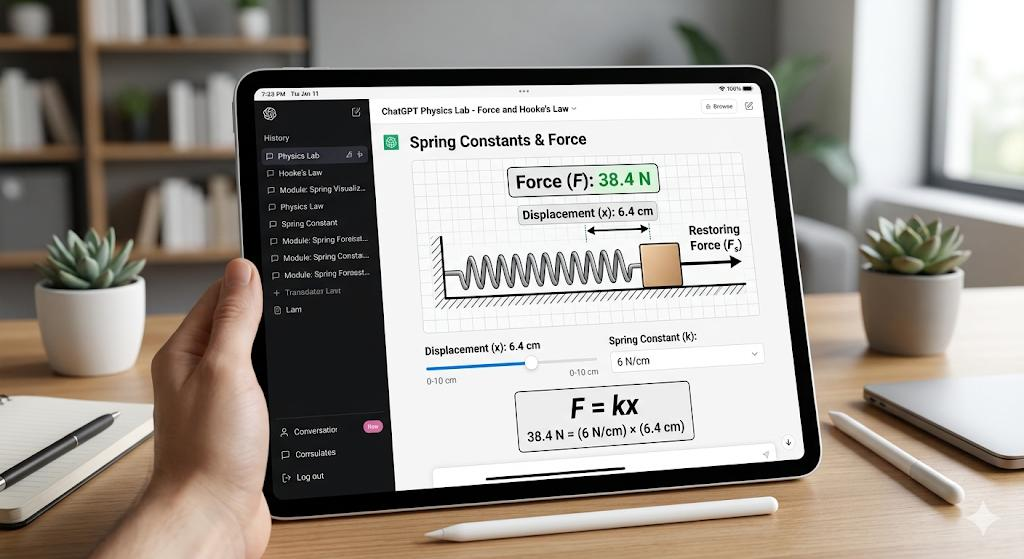
Science education involves understanding natural phenomena, scientific principles, experiments, observations, and evidence. Students must connect theoretical knowledge with real-world applications.
AI-powered learning tools can make scientific concepts easier to explore through interactive explanations and virtual learning environments.
Making Complex Scientific Concepts Easier to Understand
Some scientific concepts are difficult to understand through textbooks alone. Topics such as molecular structures, electromagnetic fields, cellular processes, and planetary motion often require visual explanations.
AI tutors can simplify complex concepts by providing:
- Step-by-step scientific explanations.
- Interactive diagrams and visual descriptions.
- Everyday examples of scientific principles.
- Comparisons between related scientific concepts.
- Questions that test conceptual understanding.
For example, when studying photosynthesis, students can explore how plants use sunlight, carbon dioxide, and water to produce glucose and release oxygen.
An AI tutor can explain the process in stages, clarify the role of chlorophyll, and ask students to identify what happens when light availability changes.
Supporting Physics and Numerical Problem Solving
Physics combines theoretical understanding with mathematical calculations. Students must understand formulas, units, relationships between variables, and the physical meaning of numerical results.
An AI tutor can guide students through problems involving:
- Newton’s laws of motion.
- Work, energy, and power.
- Electricity and magnetism.
- Waves and sound.
- Heat and thermodynamics.
- Gravitation and circular motion.
For example, a student calculating the speed of an object can receive guidance on identifying distance and time, selecting the appropriate formula, substituting values, and checking units.
This approach can help learners understand why a formula is used rather than simply memorizing it.
Virtual Experiments and Scientific Exploration
Laboratory experiments are an important part of science education, but schools may have limited equipment, laboratory facilities, or opportunities for repeated experimentation.
AI-supported simulations can provide additional opportunities to explore scientific concepts.
Students can investigate how changing temperature affects chemical reactions, how forces influence moving objects, or how different environmental conditions influence plant growth.
Virtual laboratories can also allow learners to repeat experiments and compare results without consuming physical materials.
However, simulations should complement rather than replace practical laboratory activities. Students still need experience handling equipment, making observations, following safety procedures, and understanding experimental uncertainty.
Major Benefits of AI-Powered Guided Learning
AI tutoring offers several potential benefits when it is incorporated into well-designed educational programmes.
Personalized Learning Experiences
Every student has different strengths, weaknesses, learning speeds, and educational requirements. Traditional classroom instruction cannot always accommodate these differences.
AI systems can adjust explanations and exercises according to individual performance. Students who understand a topic quickly can explore more challenging problems, while those who need additional support can revisit foundational concepts.
Immediate Feedback and Error Correction
Traditional assignments may take several hours or days to receive feedback. AI tutoring systems can respond immediately when students submit answers or explain their reasoning.
This allows learners to recognize mistakes while the problem is still fresh in their minds.
Importantly, effective feedback should explain the nature of an error and suggest how to correct it, rather than simply marking an answer wrong.
Encouraging Independent Learning
Students can use AI tutors to explore topics beyond classroom lessons. They can ask follow-up questions, request additional examples, and practise unfamiliar concepts.
This can encourage curiosity and self-directed learning, particularly when students use AI to investigate questions rather than simply complete assignments.
Supporting Teachers
AI systems can also help teachers identify common learning difficulties and understand which topics require additional classroom attention.
For example, if several students repeatedly make mistakes involving fractions or chemical equations, teachers can use that information to plan revision lessons.
AI can assist with practice-question generation, formative assessment, and differentiated learning materials, leaving teachers more time for individual guidance and classroom interaction.
Improving Accessibility
Students who need additional explanations, flexible learning schedules, or alternative ways of presenting information may benefit from AI-supported learning.
Conversational interfaces can also help learners who are uncomfortable asking questions in traditional classroom settings.
Nevertheless, accessibility depends on language support, device availability, connectivity, and the quality of the educational platform.
What Does Recent Research Reveal About AI Tutoring?
Research published during 2025 and 2026 provides encouraging but mixed evidence about the educational value of AI-powered guided learning.
Several studies suggest that AI tutoring can improve learning outcomes, while others highlight the importance of instructional design, student engagement, and independent assessment.
A 2026 Systematic Review of AI-Based Mathematics Tutoring
A systematic review published in Discover Education on July 9, 2026, examined research on AI-based tutoring and assessment systems in mathematics education.
The researchers screened 1,749 records and included 12 studies in their final synthesis. The findings generally indicated improvements in mathematics achievement, particularly among lower-performing learners.
However, the review also highlighted an important distinction: evidence of improved achievement from established adaptive tutoring systems was stronger than evidence of direct achievement gains from generative AI tools such as ChatGPT. Springer Nature Link
A Two-Year Experiment Using Khanmigo
A particularly interesting study published as an August 2026 National Bureau of Economic Research working paper examined Khanmigo, an AI tutor integrated into Khan Academy.
The research involved a two-year cluster randomized trial across 18 middle schools in Tennessee.
Students assigned access to the AI-supported mathematics programme achieved approximately 1.3 national percentile ranks more per term, equivalent to around 0.06–0.08 standard deviations over a school year.
However, the researchers found that students did not consistently engage in meaningful mathematical conversations with the tutor. Although 96% tried Khanmigo at least once, the median student messaged it on only about one-third of their practice days.
The findings suggest that simply providing access to an AI tutor is not enough. Students must actively engage with its explanations and guidance to benefit from the technology. SCALE Initiative+1
A 2026 Study on Mathematics Achievement and Retention
A study published in Scientific Reports on July 22, 2026, investigated an AI-based tutoring system called Edmentum Exact Path.
The research involved 97 Grade 12 male mathematics students from four public high schools in Iran.
The researchers reported that students using the AI-supported system performed better in immediate mathematics assessments and delayed retention tests than students receiving conventional teacher-led instruction during the study.
They also reported improvements in cognitive, behavioural, and emotional engagement.
However, the study involved a relatively small and specific student population, so its findings should not automatically be generalized to all educational settings. Scientific Reports
Research Warns Against Giving Students Direct Answers
An important 2025 study published in the Proceedings of the National Academy of Sciences examined how generative AI affects mathematics learning among nearly 1,000 high school students.
Researchers compared a standard GPT-4 interface with a specially designed tutoring version that used safeguards to support learning.
During practice, students with access to the standard AI system performed better. However, when AI assistance was removed, students who had relied on the unrestricted system performed worse than students who had not received that assistance.
The researchers found that carefully designed tutoring safeguards could mitigate these negative effects.
This research demonstrates why AI systems should encourage reasoning, hints, and independent attempts instead of automatically completing mathematical problems. PMC+1
What the Evidence Means
| Research finding | Educational implication |
|---|---|
| Adaptive tutoring can improve mathematics achievement | Personalization has potential value |
| AI access alone may produce limited gains | Active student engagement matters |
| Guided hints can support learning | Tutors should avoid premature answers |
| Some studies report better retention | Delayed assessments are important |
| Results differ across studies | More large-scale research is necessary |
Overall, the research supports cautious optimism. AI-powered tutoring has genuine educational potential, but its effectiveness depends on the quality of guidance and how students interact with the technology.
The Risks and Limitations of AI-Powered Guided Learning
Despite its potential benefits, AI-powered education also introduces challenges that schools, teachers, parents, and policymakers must address.
Overdependence on AI Tools
One of the biggest concerns is that students may become dependent on AI-generated answers.
If learners use AI to solve every mathematical problem or write every scientific explanation, they may gradually lose opportunities to develop independent reasoning skills.
For example, a student who repeatedly copies AI-generated solutions may achieve good homework scores but struggle during examinations where external assistance is unavailable.
Educational institutions should therefore encourage students to attempt problems independently before requesting AI assistance.
Incorrect Scientific and Mathematical Explanations
AI systems can generate inaccurate information, incorrect calculations, and misleading explanations.
This is particularly concerning in mathematics and science, where even a small error in a formula, unit, assumption, or calculation can produce an incorrect result.
Students may not always have enough subject knowledge to recognize these mistakes.
AI tutors should therefore incorporate reliable mathematical tools, verified educational content, scientific references, and teacher-reviewed learning materials wherever possible.
Reduced Critical Thinking
Critical thinking requires students to question information, evaluate evidence, compare explanations, and develop independent conclusions.
If AI provides complete explanations immediately, students may spend less time investigating problems themselves.
Guided learning systems should encourage students to explain their reasoning, evaluate alternative solutions, and justify their conclusions.
Digital Inequality
Not every student has access to a reliable internet connection, a personal computer, or a modern smartphone.
This creates the possibility that students from economically disadvantaged communities may receive fewer benefits from AI-supported education.
Schools should consider affordable devices, offline learning resources, shared computer facilities, and accessible educational platforms.
Student Data Privacy
AI tutoring platforms may collect information about student performance, learning behaviour, assessment results, and interactions.
Educational institutions must ensure that student information is collected responsibly, stored securely, and used only for legitimate educational purposes.
Schools should also establish clear policies regarding parental consent, data retention, third-party access, and the use of student information for AI training.
AI Tutors vs Traditional Teaching: Which Is Better?
AI tutors and human teachers provide different forms of educational support. Comparing them is useful, but treating them as competing replacements oversimplifies the role of education.
| Educational factor | AI-powered tutor | Human teacher |
|---|---|---|
| Personalized explanations | Can adapt explanations to responses | Can understand broader individual needs |
| Immediate feedback | Available throughout practice | Depends on classroom availability |
| Emotional support | Limited and simulated | Human empathy and encouragement |
| Mathematical practice | Can generate many exercises | Can select and discuss meaningful problems |
| Scientific demonstrations | Can support digital simulations | Can conduct practical experiments |
| Classroom interaction | Limited conversational interaction | Supports peer discussion and collaboration |
| Misconception detection | Depends on available data and system design | Can observe behaviour and reasoning |
| Ethical guidance | Requires programmed safeguards | Can exercise human judgment |
The strongest approach is not necessarily choosing one over the other. It is combining AI’s ability to provide personalized practice with teachers’ expertise, emotional understanding, and instructional judgment.
How Schools Can Implement AI-Guided Learning Effectively
Introducing AI tutoring into schools requires more than providing students with access to a chatbot. Educational institutions need a structured approach that prioritizes learning outcomes.
Integrate AI With Existing Curricula
AI tutoring should support the mathematics and science curriculum rather than operate as a separate learning activity.
For example, when students study algebra, AI-generated practice questions should match their current grade level and learning objectives.
Similarly, science tutoring should follow established curriculum requirements and use scientifically accurate explanations.
Train Teachers to Use AI Effectively
Teachers need training to understand AI capabilities, limitations, and appropriate classroom applications.
Professional development programmes should help educators create effective prompts, evaluate AI-generated explanations, identify inaccurate information, and design activities that encourage independent thinking.
Teachers should remain responsible for deciding when and how AI assistance is appropriate.
Establish Guided Learning Rules
Schools can introduce simple rules that encourage students to use AI responsibly.
For example:
- Attempt the problem independently.
- Identify the specific step that is difficult.
- Ask AI for a hint rather than the complete answer.
- Complete the next step independently.
- Verify the final solution.
- Explain the reasoning in their own words.
This process can help students develop stronger problem-solving habits.
Evaluate Actual Learning Outcomes
Schools should not measure the success of AI tutoring only through student satisfaction, usage statistics, or homework completion rates.
They should assess whether students can solve unfamiliar problems independently.
Useful evaluation methods include pre-tests, post-tests, delayed assessments, classroom observations, practical experiments, and student explanations.
The Future of AI-Powered Mathematics and Science Education
The next generation of AI educational tools may offer more sophisticated learning experiences through multimodal AI, adaptive assessment, virtual laboratories, and conversational tutoring.
Multimodal AI Tutoring
Future AI tutors may interpret handwritten equations, mathematical diagrams, scientific illustrations, and photographs of experiments.
This could allow students to upload their attempted solutions and receive feedback about specific steps.
For example, a student struggling with a geometry problem could share a diagram and ask the AI tutor to explain the relationship between angles.
Such capabilities could make digital tutoring more natural and interactive.
AI-Powered Virtual Science Laboratories
Virtual laboratories may become increasingly sophisticated, allowing students to explore complex experiments through interactive simulations.
Learners could investigate chemical reactions, electrical circuits, biological systems, and physical processes under different conditions.
These environments could provide additional learning opportunities when physical laboratory resources are limited.
Personalized Learning Pathways
Future educational platforms may develop individual learning pathways based on student performance.
A learner who struggles with fractions could receive additional exercises before beginning more advanced algebra.
Another student who demonstrates strong mathematical understanding could move towards more challenging applications.
This could make education more responsive to individual learning requirements.
AI-Assisted STEM Education
AI could also support interdisciplinary learning by connecting mathematics, physics, chemistry, biology, engineering, and computer science.
For example, students could use mathematical modelling to understand environmental changes, apply physics to engineering problems, or analyse biological data using statistical methods.
Such activities could help students understand how scientific knowledge is applied beyond textbooks.
Opportunities for AI-Guided Learning in India
India has a particularly important opportunity to explore AI-powered guided learning because of its large student population and diverse educational requirements.
Students across urban, semi-urban, and rural communities often experience differences in access to educational resources, qualified teachers, laboratories, and individual academic support.
AI tutoring could help provide additional practice and explanations, particularly in mathematics and science subjects where students may require repeated concept clarification.
However, successful implementation requires attention to several priorities.
Regional-language learning: AI tutors should support Indian languages, including Hindi, Odia, Bengali, Tamil, Telugu, and other regional languages. Students should be able to understand complex scientific and mathematical concepts in languages they are comfortable using.
Affordable access: Low-cost platforms, shared devices, and offline-compatible educational resources could make AI tutoring more accessible.
Alignment with school curricula: AI learning systems should support the relevant NCERT, CBSE, and state-board curricula rather than provide unrelated or unnecessarily advanced content.
Teacher involvement: Teachers should supervise AI-supported activities and help students distinguish reliable explanations from inaccurate information.
Digital literacy: Students should learn how to question AI responses, verify information, and use educational technology responsibly.
For India, the goal should not simply be introducing AI into classrooms. It should be using technology to improve the quality, accessibility, and effectiveness of education.
A Practical Example: How an AI Tutor Can Guide a Student
Imagine a student learning Newton’s second law of motion.
Instead of immediately providing the formula and a completed solution, a well-designed AI tutor could structure the learning experience as follows.
Example of an AI-guided physics lesson
Guided approach
AI tutor
What happens when a force acts on an object?
Student
The object may accelerate.
AI tutor
Good! Newton’s second law connects force, mass, and acceleration. Can you identify the formula?
Student
F = ma.
AI tutor
Correct. Now suppose a 5 kg object experiences a net force of 20 N. What is its acceleration?
Try solving the problem
\[ a=\frac{F}{m} \]
Check answer
Illustrative learning example, not a live external AI tutoring service.
This example demonstrates how AI tutoring can transform a simple formula-based lesson into an interactive learning activity.
The student participates in the reasoning process, answers questions, and receives feedback instead of passively reading a completed solution.
Recommendations for Responsible AI Integration
To achieve meaningful educational benefits, AI-powered guided learning should follow several important principles.
- Learning before convenience: AI should help students understand concepts rather than simply complete assignments.
- Hints before answers: Tutoring systems should encourage independent attempts before providing complete solutions.
- Accuracy and verification: Mathematical calculations and scientific explanations should be checked against reliable educational sources.
- Human supervision: Teachers should guide AI-supported activities and evaluate student progress.
- Independent assessment: Students should demonstrate their understanding without AI assistance.
- Equal educational opportunities: Schools should consider affordability, accessibility, language support, and digital infrastructure.
- Responsible data practices: Student privacy and information security must remain priorities.
These principles can help ensure that AI becomes a supportive educational resource rather than a shortcut that weakens the learning process.
Conclusion
AI-powered guided learning has the potential to improve mathematics and science education by making instruction more personalized, interactive, and responsive to individual student needs. Through step-by-step explanations, adaptive exercises, immediate feedback, and interactive scientific exploration, AI tutors can help students understand difficult concepts and develop stronger problem-solving abilities.
Recent research offers encouraging evidence that AI-supported tutoring can improve mathematics achievement and student engagement. However, the findings also demonstrate that access to AI does not automatically produce better learning outcomes. Poorly designed systems can encourage answer copying, dependency, and reduced independent skill development.
The most important factor is therefore not how advanced an AI tutor becomes, but how effectively it supports the learning process. Students need opportunities to think independently, teachers need to maintain instructional control, and educational institutions must establish appropriate safeguards.
AI should not replace the teacher or the student’s thinking process. Instead, it should help students become more confident, curious, and independent learners. When combined with effective teaching practices, AI-powered guided learning could become an important part of the future of mathematics and science education.