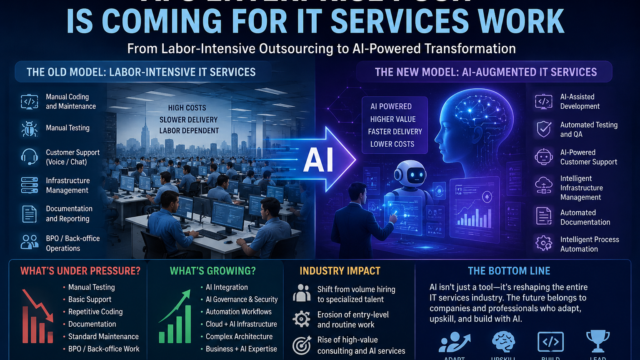
The rapid expansion of artificial intelligence into the enterprise world is beginning to reshape the global IT services industry. For decades, major technology outsourcing firms built their businesses around large workforces handling software maintenance, customer support, testing, infrastructure management, and back-office operations. Now, AI is changing how that work is performed — and in some cases, reducing the need for large teams altogether.
AI Is Transforming Traditional IT Services
Enterprise AI tools are becoming more capable of handling repetitive and time-consuming tasks that were once managed by human employees. AI-powered coding assistants can generate software code, automation tools can monitor infrastructure, and intelligent systems can manage customer support requests with minimal human involvement.
This shift is creating pressure on traditional outsourcing models that rely heavily on labor-intensive work. Tasks such as manual testing, basic software maintenance, documentation, and repetitive operational support are increasingly being automated through generative AI and machine learning systems.
Large enterprises are also investing directly in AI transformation projects instead of simply outsourcing routine operations. Companies now want AI-driven efficiency, faster deployment cycles, and lower operational costs.
IT Companies Are Adapting to a New Reality
Major IT service providers are responding by restructuring their strategies around AI integration and digital transformation. Instead of focusing only on large-scale staffing contracts, companies are moving toward higher-value consulting services that involve AI implementation, cloud modernization, cybersecurity, and enterprise automation.
The demand for professionals with expertise in AI engineering, cloud platforms, data science, and cybersecurity is growing rapidly. Organizations still require skilled workers who can integrate AI systems into legacy infrastructure, ensure compliance, manage governance, and oversee security risks.
At the same time, entry-level and repetitive IT jobs are facing increased uncertainty as AI systems become more efficient.
The Rise of AI-Augmented Workplaces
Rather than completely replacing IT workers, AI is changing the nature of their roles. Many professionals are now expected to work alongside AI tools that improve productivity and automate repetitive tasks.
Software developers increasingly use AI coding assistants to accelerate development. Customer service teams rely on AI chatbots for first-level support. Infrastructure teams use predictive AI systems to detect outages and optimize performance.
This evolution is creating what many analysts describe as an “AI-augmented workforce,” where human expertise remains essential for strategy, oversight, decision-making, and complex problem-solving.
Challenges Facing the Industry
Despite rapid adoption, enterprises still face major concerns regarding AI reliability, security, and governance. AI systems can generate inaccurate outputs, expose sensitive data, or create compliance risks if not carefully monitored.
Businesses also worry about workforce disruption. As automation expands, companies must retrain employees and prepare workers for more specialized technical roles. Governments and industry leaders are increasingly discussing the long-term impact of AI on employment and economic stability.
Another challenge is balancing cost savings with innovation. While AI can reduce operational expenses, implementing enterprise-grade AI systems requires significant investment in infrastructure, talent, and cybersecurity.
The Future of IT Services in the AI Era
The IT services industry is entering a major transition period. Traditional outsourcing models based on large labor pools may gradually decline, while AI-focused consulting and automation services continue to grow.
Companies that successfully adapt to AI-driven enterprise demand are likely to remain competitive. Businesses that fail to modernize may struggle as clients seek faster, more efficient, and AI-powered solutions.
Ultimately, AI is not eliminating the IT services sector — it is reshaping it into a more specialized, technology-driven industry where human expertise and intelligent automation work together.
Conclusion
AI’s growing presence in enterprise technology is redefining the future of IT services work. Automation is reducing reliance on repetitive tasks while increasing demand for advanced technical expertise in AI integration, cybersecurity, cloud computing, and data management. As organizations continue investing in AI transformation, the global IT industry will likely experience both disruption and opportunity in equal measure.