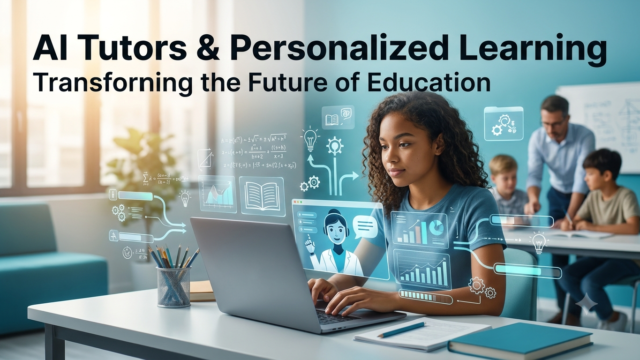

Category: Artificial Intelligence · Education Technology · Digital Learning
Research focus: How AI tutors can personalize lessons, identify learning gaps, provide instant feedback, and support students while preserving the essential role of human teachers.
Introduction: A New Era of Personalized Education
Artificial intelligence (AI) is changing how students learn, practise, and prepare for examinations. Traditional classrooms generally follow a common syllabus and teaching schedule, even though students have different abilities, interests, learning speeds, and educational needs. Some students understand mathematical concepts quickly, while others need additional explanations and repeated practice. Similarly, some learners excel at reading but struggle with scientific reasoning or problem-solving.
AI-powered tutoring systems aim to address these differences by adapting learning activities to individual students. They can explain difficult concepts, generate practice questions, provide feedback, and recommend suitable learning materials based on a student’s progress.
Unlike traditional educational software that follows a fixed sequence of lessons, more advanced AI tutors can respond conversationally to student questions. A learner studying calculus, for example, can request a step-by-step explanation of differentiation, ask for another example, and practise similar problems until the concept becomes clearer.
However, personalized learning through AI also raises important questions. Can AI tutors genuinely improve learning outcomes? Can they reduce educational inequality? How can schools protect students’ privacy and prevent excessive dependence on technology?
How AI Tutors Work

AI tutors combine technologies such as natural language processing, machine learning, educational data analysis, and generative AI to support learning.
Natural language processing allows systems to interpret questions written or spoken in everyday language. Generative AI helps create explanations, examples, summaries, and practice exercises. Adaptive learning systems use information about student performance to adjust the difficulty and sequence of activities.
For example, a student learning algebra might repeatedly make mistakes when solving linear equations. An AI tutor could identify the recurring error, revisit the relevant concept, demonstrate a simpler example, and then provide a new exercise.
This approach shifts learning away from simply completing lessons toward identifying and addressing specific knowledge gaps.
Major Benefits of AI-Powered Personalized Learning
Learning at an Individual Pace
Students do not always learn effectively at the same speed. AI tutors can allow learners to revisit difficult subjects without feeling embarrassed about asking repeated questions. Students who master a concept quickly can move to more advanced material, while others receive additional practice.
Instant Feedback and Guided Practice
Instead of waiting for an assignment to be checked, students can receive immediate feedback. A well-designed tutor can explain why an answer is incorrect and guide learners toward the right approach rather than simply revealing the answer.
Support for Mathematics and Science
AI tutors can generate problems at different difficulty levels, explain formulas, and provide worked examples. They can be particularly useful for practising algebra, calculus, statistics, physics, and chemistry.
Nevertheless, mathematical calculations and scientific explanations should be verified when accuracy is important because AI systems can produce convincing but incorrect answers.
Greater Accessibility
AI tools can support learners who need alternative explanations, translation, text-to-speech, speech-to-text, or adjustable reading levels. These capabilities may help students with disabilities or language barriers, provided that the tools are designed accessibly.
Support Beyond Classroom Hours
Students can use AI tutors for revision and independent practice outside school hours. This can be particularly helpful when access to private tutoring is limited by cost or location. However, effective access still depends on devices, connectivity, language support, and the quality of the educational tool.
The Role of AI Tutors in Indian Education

India presents an important setting for exploring AI-assisted education because students study across a wide range of linguistic, economic, and educational environments.
AI tutors could support learners preparing for school examinations, university assessments, and competitive examinations. They may also help students revise foundational mathematics, practise English, understand science concepts, and explore unfamiliar topics.
In rural and underserved communities, carefully implemented AI learning systems could supplement classroom instruction where subject-specific educational support is limited. However, AI cannot independently resolve challenges such as insufficient infrastructure, teacher shortages, or unreliable internet access.
Multilingual AI tools may also make educational resources more accessible to students who prefer learning in Indian languages. Their effectiveness depends on how accurately they understand local languages, regional expressions, subject-specific terminology, and different educational curricula.
For students preparing for competitive examinations, AI can generate practice questions, explain incorrect answers, and organise revision schedules. Students should still check factual information against official syllabi, textbooks, and reliable examination resources.
Risks and Challenges of AI Tutors
Incorrect Information and Hallucinations
AI systems sometimes generate inaccurate explanations, fabricated references, or incorrect answers. Students who lack subject knowledge may struggle to recognise these errors.
Educational AI should therefore be tested against reliable curricula and use appropriate verification methods, especially for high-stakes subjects.
Student Privacy
Personalized systems may collect information about student performance, learning difficulties, and study habits. Schools and developers must protect this information, limit unnecessary data collection, and provide clear rules about storage and access.
Overdependence on Technology
If students ask AI to complete every assignment, they may miss opportunities to develop independent reasoning, writing, and problem-solving skills.
AI tutors should encourage students to attempt problems, explain their reasoning, and reflect on mistakes instead of simply supplying finished answers.
The Digital Divide
Students without reliable devices, internet access, or suitable learning environments may receive fewer benefits. Educational institutions should consider offline resources, accessible devices, and teacher-supported alternatives.
AI Tutors Versus Human Teachers
AI tutors and human teachers have different strengths. AI can offer scalable practice, immediate responses, and repeated explanations. Human teachers contribute professional judgement, emotional understanding, classroom leadership, mentorship, and awareness of students’ broader circumstances.
The most promising approach is not necessarily to replace teachers but to combine AI-assisted practice with human guidance.
Teachers can use insights from learning systems to identify common difficulties and adapt classroom instruction. Students can use AI for revision while continuing to participate in discussions, group projects, experiments, and independent assessments.
What Does Research Say About AI in Education?
Research on intelligent tutoring systems has examined whether immediate feedback, adaptive practice, and guided problem-solving can improve learning. Findings across educational technologies are encouraging in some settings, but outcomes vary according to the subject, design, implementation, and quality of instruction.
Generative AI tutors require additional scrutiny because producing a fluent explanation is not the same as ensuring that a student understands or remembers the material.
Future research should measure more than the number of questions answered or the time spent using an app. Important outcomes include knowledge retention, transfer of skills to unfamiliar problems, critical thinking, student motivation, accessibility, and differences in results across socioeconomic groups.
Researchers should also investigate whether AI benefits persist after students stop using the tool and whether students can solve problems independently during assessments.
The Future of AI-Powered Learning

Future AI tutors may integrate conversational assistants with interactive simulations, speech recognition, educational games, and digital learning platforms. Students could receive more detailed feedback on their reasoning, explore virtual science experiments, or practise speaking another language through realistic conversations.
AI systems may also help teachers prepare differentiated lesson plans, create accessible materials, and identify class-wide learning gaps.
Responsible implementation will require transparent systems, teacher training, independent evaluations, privacy safeguards, and clear accountability when AI tools provide harmful or inaccurate guidance.
Conclusion
AI tutors have the potential to make education more adaptive, accessible, and responsive to individual learning needs. They can help students practise difficult concepts, receive immediate feedback, and prepare for examinations at their own pace.
However, their effectiveness depends on educational quality, factual accuracy, equitable access, data protection, and responsible use. AI should encourage curiosity and independent thinking rather than replace them.
The future of education will be strongest when artificial intelligence supports human teachers, empowers students, and makes high-quality learning opportunities more widely available.