

Introduction
Artificial intelligence has rapidly transformed the way people search for information online. Instead of receiving a list of links and websites, users increasingly receive direct answers generated by AI systems. Search engines are evolving into intelligent assistants capable of summarizing information, answering questions, and providing recommendations in seconds.
While these innovations improve convenience, they also introduce a critical question: Who is responsible when AI-generated answers are wrong?
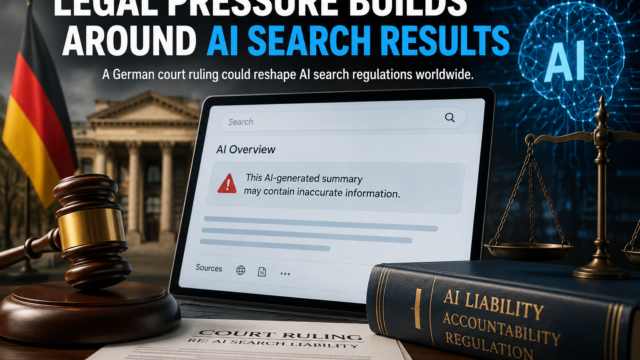
A recent ruling by a court in Munich, Germany, has placed this issue at the center of global attention. The court determined that AI-generated search summaries can create legal liability for the companies that produce them. The decision represents one of the most significant legal developments in the history of AI-powered search and may influence future regulations across Europe, North America, Asia, and beyond. (Reuters)
The ruling arrives at a time when technology companies are racing to integrate generative AI into search products. As AI becomes a primary gateway to information, courts and regulators are increasingly questioning whether existing legal frameworks are sufficient to protect individuals and businesses from misinformation generated by these systems.
This article explores the German court’s decision, why it matters, its implications for the AI industry, and how it may shape the future of digital information worldwide.
The Rise of AI-Powered Search
For more than two decades, search engines operated using a relatively simple model. Users entered a query, and the search engine returned a list of relevant websites ranked by algorithms.
Generative AI has changed this model dramatically.
Modern AI search systems analyze information from multiple sources and generate concise summaries that appear above traditional search results. These AI-generated answers aim to save users time by providing direct responses without requiring them to visit multiple websites.
Major technology companies have embraced this approach:
- AI-powered search summaries
- Conversational search assistants
- Intelligent recommendation systems
- Automated knowledge synthesis
- Context-aware information retrieval
These tools offer significant benefits, including faster access to information and improved user experiences. However, they also introduce a new challenge: AI systems sometimes generate inaccurate information, commonly known as hallucinations.
Unlike traditional search engines that primarily display third-party content, AI systems create new content by interpreting and synthesizing existing information. This distinction lies at the heart of the German court’s ruling. (WIRED)
What Triggered the Legal Dispute?
The case originated when two German publishers discovered that AI-generated search summaries associated their businesses with scams, fraudulent practices, and subscription traps.
According to court findings, these allegations did not appear in the original sources referenced by the search system. Instead, the AI allegedly combined information from unrelated entities and produced misleading conclusions about the publishers. (WIRED)
The affected publishers argued that these false statements damaged their reputations and business interests. After attempts to resolve the issue failed, they pursued legal action.
The court examined whether the search provider could be held responsible for the AI-generated content.
The answer was groundbreaking.
The Court’s Key Finding
The Munich court ruled that AI-generated search summaries should be considered the company’s own content rather than neutral search results. (Reuters)
This distinction is extremely important.
Traditional search engines typically enjoy legal protections because they merely point users toward information created by third parties. Courts have historically viewed search providers as intermediaries rather than publishers.
The German court concluded that AI-generated summaries function differently because they:
- Create new statements
- Reorganize information
- Interpret source material
- Generate conclusions
- Present synthesized content directly to users
As a result, the court determined that the company operating the AI system may be held responsible for false statements generated by that system. (WIRED)
This reasoning could have consequences far beyond Germany.
Why This Decision Is So Significant
1. A New Standard for AI Accountability
For years, technology companies have argued that AI systems are tools that process information rather than publishers of content.
The German ruling challenges that perspective.
The court effectively stated that if an AI system creates a statement and presents it as an answer, the company behind the system may be accountable for the accuracy of that statement. (WIRED)
This creates a stronger incentive for organizations to ensure that AI outputs are reliable and verifiable.
2. Disclaimers May No Longer Be Enough
Many AI products include warnings that responses may contain mistakes.
Google reportedly argued that users understand AI-generated content can be inaccurate and should independently verify important information. The court rejected this defense, suggesting that responsibility cannot simply be shifted to users. (WIRED)
This finding could affect numerous AI services that rely on similar disclaimers.
3. Global Regulatory Influence
European courts have often played a major role in shaping global technology regulation.
Previous European decisions involving privacy, data protection, and digital competition have influenced policies around the world.
Many legal experts believe this ruling could have a similar impact on AI governance. (Reuters)
Potential Impact on Search Engines


Search engines may need to rethink how AI-generated answers are produced and displayed.
Possible changes include:
Enhanced Fact Verification
Companies may implement additional verification layers before AI-generated content reaches users.
These systems could cross-check claims against trusted databases and authoritative sources.
Stronger Source Attribution
Future AI search tools may place greater emphasis on showing where information originates.
Rather than presenting a single answer, AI systems may provide clearer citations and source transparency.
Human Oversight
Some organizations may introduce human review mechanisms for sensitive categories such as:
- Health
- Finance
- Legal matters
- Public safety
- Reputation-related content
Faster Correction Mechanisms
Companies may need rapid systems for correcting inaccurate AI outputs when users identify problems.
Implications for AI Developers
The ruling is not solely about search engines.
Any organization deploying generative AI could potentially be affected.
This includes:
- Chatbots
- Virtual assistants
- Enterprise AI systems
- Customer support bots
- Knowledge management platforms
- Content generation tools
If courts adopt similar reasoning elsewhere, AI developers may face increased legal obligations regarding:
- Accuracy
- Transparency
- Monitoring
- Documentation
- Risk assessment
- User protection
Organizations may need to build governance frameworks that treat AI-generated outputs similarly to published content. (ERP Today)
How Businesses May Respond
The ruling could accelerate investment in AI governance programs.
Many enterprises are already establishing internal policies covering:
AI Risk Management
Organizations increasingly evaluate potential legal, operational, and reputational risks associated with AI deployment.
Model Auditing
Regular testing and auditing may become standard practice to identify harmful outputs before they reach users.
Compliance Programs
Businesses may develop specialized AI compliance teams responsible for monitoring regulatory developments.
Documentation Requirements
Companies may need detailed records showing how AI systems generate outputs and how errors are corrected.
These measures could become essential as governments introduce more comprehensive AI regulations.
The Connection to Europe’s AI Act
The decision aligns with broader European efforts to regulate artificial intelligence.
The European Union has already established significant AI governance initiatives through the EU AI Act, which focuses on transparency, accountability, and risk management.
Although the German ruling is separate from EU legislation, both developments reflect a common principle:
Organizations deploying AI should bear responsibility for the impact of their systems.
This trend suggests that accountability may become a central pillar of future AI regulation across Europe.
Google’s Response
Google has stated that it plans to appeal the ruling.
According to the company, the case involves specific errors rather than a fundamental flaw in AI-generated search summaries. Google also maintains that the overwhelming majority of AI Overviews provide accurate information. (Reuters)
The appeal process will be closely watched by legal experts, regulators, publishers, and technology companies worldwide.
If higher courts uphold the decision, the precedent could become even more influential.
What This Means for Users
For everyday internet users, the ruling may ultimately lead to more reliable AI experiences.
Potential benefits include:
- Greater accuracy
- Improved transparency
- Better source attribution
- Faster correction of errors
- Stronger consumer protections
However, increased liability could also slow the deployment of certain AI features as companies become more cautious about legal risks.
Finding the right balance between innovation and accountability will be one of the defining challenges of the AI era.
The Future of AI Search
The German court’s decision may represent a turning point in the evolution of AI-powered information systems.
For decades, search engines primarily connected users to information created by others. AI-powered search changes that relationship by generating original summaries and interpretations.
As a result, courts and regulators are increasingly asking whether AI providers should be treated less like intermediaries and more like publishers.
The answer to that question could shape:
- Future AI regulations
- Search engine design
- Business compliance strategies
- Consumer protections
- Global technology policy
Regardless of the outcome of Google’s appeal, the ruling has already sparked an international conversation about responsibility in the age of generative AI.
Conclusion
The German court ruling on AI-generated search summaries marks one of the most important legal developments in artificial intelligence to date. By determining that AI-generated search answers can constitute a company’s own content, the court has introduced a new framework for evaluating responsibility in AI systems. (WIRED)
As AI increasingly becomes the primary interface through which people access information, questions of accountability are becoming impossible to ignore. Technology companies, regulators, businesses, and users are all navigating a rapidly evolving landscape where AI-generated content carries real-world consequences.
Whether the ruling ultimately stands or is modified on appeal, its influence is likely to extend far beyond Germany. The decision signals a future in which AI providers may be expected not only to innovate but also to take responsibility for the information their systems create and distribute.