How AI Is Used in Social Media Algorithms

Artificial Intelligence (AI) is the invisible engine behind almost everything you see on social media today. From what appears on your feed to the ads you’re shown, AI systems continuously analyze behavior, predict interests, and decide what content keeps you engaged the longest.


1. Personalized Feeds and Content Ranking

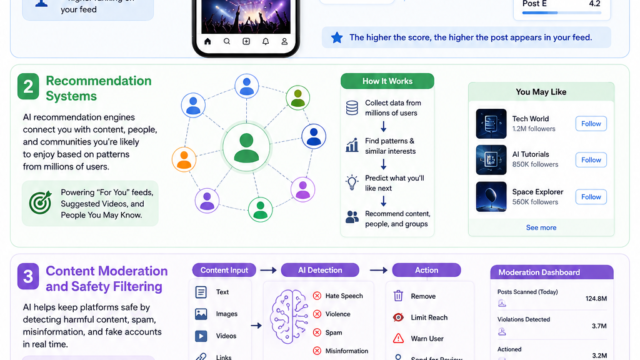
Every time you scroll through platforms like Instagram, Facebook, or X, AI is working in the background to rank posts. It studies what you like, comment on, share, and even how long you pause on a post.

https://images.openai.com/static-rsc-4/ZqXnISPF2w4wUvuzkVxi-BNlI1tp5njk2Ep5ESBKLStagJD52VN4SZ63f-UGmVU0o2wT6IQLUMw0IQVkHIR76TYLKXszyjDEValdLC6i5RsorHf86CZQp8rydmlZJUh7qNyO0Db5ZtpDDFWcla_VVX5QS91tc910y2iz0Ix4zsA3a8vfsSnsuJWVT2GM5Me0?purpose=fullsize
https://images.openai.com/static-rsc-4/x32kOe9HKxb363pIMbZ7xQAGhr1bs2aPvtQIqfjfXVJQmOjk4-nl0r8TsQcNliDh8crYdHVmuVY2zo2rhS929OU0LNlI4ECV0seBu3FapkOuxgEr22laKYJdQXVj1vMEepg3x7NLd3z3PLqri5mJKCPECVDevBMzmmVlsQ_weAqnyfSvgQpXTk-8dqTtbE0b?purpose=fullsize
https://images.openai.com/static-rsc-4/JM9z-g7OB2LR74zGzJvwnM9pdiL-0KIsgmUzKXtrdBar-M2vcj4rrMenFGblJ1qFcns7g-wsQHKSyPFcVfaszVaVa0Oq7t25cyIoUr8ah1LEAEZcXFPnZkDklubQZWebLG1x0xPjZR6yOL83NMkUxXtgpZ3JYFZpdB0C_bYNg0brJTOXVNSmjUG-VCmNohn4?purpose=fullsize

9

Machine learning models assign a “relevance score” to each post. Higher scores mean the post appears closer to the top of your feed. This is why two users rarely see the same timeline in the same order.


2. Recommendation Systems (What You Should Watch Next)

Recommendation engines power features like “Suggested Videos,” “People You May Know,” and “For You Pages.”

https://images.openai.com/static-rsc-4/1B-MwKneOumo1aOCYjwR8u3RF9okfs3nLm29ZV9AQ12nWae66k8BfCOomrBI6Dl9rzB4KSq_FdMeDOjwxeLv-HH242HkxqEw75k0qWeG9-pjWmejwlEIGkoRXvl554eVftv_wQVRAXRBQGhWlHy4wKnzgoh01t7zJtwraKiWbw0YWjP1VMN1W_aUzFHvlTmo?purpose=fullsize
https://images.openai.com/static-rsc-4/_Y3c2npEqIw_atQamDUKffbVD9J1duWvP9R5bF2QBu8E0ITUvMUnbP93vToQ7tzCSy5ySN4LX_UN24eDDMSpQil_O7HEou_iPaf7auXn32E2urmTeZZj0Bi3i9KZfh8RYtf12SObsxVzmYjMFrQlaLoHpDTvNWOK8lJ8KQvYHBbOqTZt4etGg8EGvrBY3Wtw?purpose=fullsize
https://images.openai.com/static-rsc-4/18Oca6__sR1zH6-o4Mvo29MwWsi4Ii8uAPcViMzR-XErzOUwGpT1RBitMTGEHrNv6Qg9W2ouddfOQmHhVx_FswssFDiWaM4wJwZY0YnX4euO9SR-pfLFbIUEUU2X8ortkCpI8r8HvlVCE9kKkFSH8eA6huXOgJB-T8a_GLD-Cva2LPxylO2zPu-VW7Ky8XD1?purpose=fullsize

8

These systems use collaborative filtering and deep learning to connect users with similar interests. For example, if many users who like tech videos also watch AI tutorials, the algorithm will recommend AI content to you even if you’ve never searched for it.


3. Content Moderation and Safety Filtering

AI also plays a major role in keeping social platforms safe by detecting harmful content, spam, misinformation, and fake accounts.

https://images.openai.com/static-rsc-4/HOgnphyAIhjLU__JuxiPZVn1zaU18RoKVc_s-nqo6fhG0a5x4iKeaapkZBy_-av-GjJUG3JpUDbUZlnwIgA5sizIlZ0-ARqoeKOt0KgFYXqYteteMoqPa7PCIAaYJN2vybqy3VS6Vk1zhYqzYMvgsm4HH5KSySxYIiN2BZXxIYorqM55uC30vV11OWqInbKl?purpose=fullsize
https://images.openai.com/static-rsc-4/aZg9CE_dA6lkge3iHv4fuvR3Qq37_6Swl242jp1P7ux9z_udVEfsGbmH_Y_6RU5UlxKlv8ELhvvlQ2uQzGSXrpUKPQ9g3dlGo5gVmhgWuvNkRLQoO7-JYSYvYwAmcROBCOGKN5DP1UbVkH2-Ca8qx1ZbzecUgUgNH7fal439AB-b4SnbLh-gi0SmtGPdkgZf?purpose=fullsize
https://images.openai.com/static-rsc-4/VSwMec-jqFbKhIvZtAnAxlvy7lfjwsKjOkxwoM8AsdNrfLRjwHlLszUShukYxGeDALETDbPpH-sR3iaKdF0H-FYb3V8TvqkJQWrwEgos_Gy1t7iTNp-bIEhnN5TGpKI_YQr4ehFxRV9_CBNQ1eCRyxtWvhlGBOkcxgx7-fku3wfZPB5I6H24cbFeqxbxoGRo?purpose=fullsize

7

Computer vision and natural language processing models scan text, images, and videos in real time. While not perfect, these systems help remove millions of violating posts every day before humans even see them.


4. Targeted Advertising and User Profiling

One of the most powerful uses of AI in social media is advertising. Platforms use AI to decide which ads you are most likely to click or buy from.

https://images.openai.com/static-rsc-4/LtbXU-NEmFpuKHp68Dxi-uTfX6kmzuIOfre2yc3t5IQipkrPLAkXWYHsxgyE4716e5-H-k_laq6zIkcPaAVAD3d9vQnNdQGR2EXPxBSPsUKhaeuedowlTauRJDpMuSi0pk6xy9kAR_lEy1qTQJ05C1Jsk0Q0B3fQWU22L5tCYL2DeQpy0gSvWVVWGEt7CVpg?purpose=fullsize
https://images.openai.com/static-rsc-4/S_ADokusYdYdBEFUtklHOYPjV4r2mYTwW8zOmFGgiBqEkYpeJc-TDX1rL9LaXEr3NkcIZ-6R9uDpAADQ7v9PfThbNfIdbIBstvTtVApFgW0CfQf8jJjYQ0yG4pbJA6yBiqFXdVBG0j_mspNnatbMYuf-4vKDI0pHY3p-OTomgiHLP2dqU-uiDtzSSUSAGEM2?purpose=fullsize
https://images.openai.com/static-rsc-4/7vUDHCOPOFk7RPyTmuhF3znAwf6akfl49VSQaB-3BhLjRfe1aszq7H0LQ35hf6KD7lxBBuWaMhQkrZXBZaXzKGkcF_5i9uBHR7GndNzxnv1LWkL0SdzosVd1QaVies3zPK5X3L3vvtNIbR4Qtu5IEUT4kuF0xG9q5LxU1FpWD1oCcFebU3cFnRA6ncwuNqNb?purpose=fullsize

6

AI builds detailed user profiles based on demographics, interests, and behavior patterns. This allows advertisers to reach highly specific audiences, improving conversion rates while making ads feel “personally relevant.”


Conclusion

AI is deeply embedded in social media, shaping what we see, how we interact, and even what we buy. While it improves personalization and safety, it also raises concerns about privacy, echo chambers, and over-personalization.

Competition Pressure in AI: How It Is Accelerating Innovation in 2026

The global artificial intelligence industry is evolving at an extremely fast pace, driven largely by intense competition among major technology companies. This competition is reshaping how quickly models are released, how capable they become, and how deeply they are integrated into everyday digital tools.

1. The Shift from Slow Releases to Rapid Iteration

In earlier years of AI development, major model upgrades took significant time—often years between large releases. However, the competitive landscape has changed dramatically.

Today, companies are prioritizing rapid iteration cycles, where models are updated frequently with incremental improvements. These updates may not always be massive breakthroughs individually, but together they create continuous performance gains in reasoning, coding, speed, and multimodal understanding.

This shift allows companies to respond quickly to user feedback and stay ahead in a highly competitive market.

2. OpenAI’s Push Toward Faster, Smarter Systems

OpenAI continues to accelerate its development cycle, focusing on improving reasoning ability, long-context understanding, and agent-like behavior.

Instead of building only conversational tools, the direction is now toward AI systems that can complete tasks, use tools, and perform multi-step workflows with minimal human input. This reflects a broader transition from chat-based models to action-oriented AI agents.

3. Google’s Ecosystem-Driven AI Strategy

Google is advancing its Gemini models with a strong emphasis on integration across its ecosystem, including Search, Android, and Workspace tools.

Rather than treating AI as a standalone product, Google is embedding intelligence directly into the services billions of users already rely on. This approach aims to make AI a seamless part of productivity, communication, and information discovery.

4. Meta’s Focus on Open and Social AI

Meta is taking a different but equally aggressive approach by focusing on open-source models and AI integration within social platforms.

By embedding AI into apps like WhatsApp, Instagram, and Facebook, Meta is scaling AI usage across global social networks. Their open model strategy also encourages developers to build new applications on top of their systems, increasing innovation outside the company itself.

5. The Result: A Fast-Moving AI Race

The combined pressure from these companies has created a rapid innovation cycle across the entire industry. Key outcomes include:

  • Faster model releases and updates
  • Continuous performance improvements instead of slow generational leaps
  • Stronger focus on AI agents that can perform real tasks
  • Wider integration of AI into everyday apps and devices

Conclusion

Competition in the AI industry is no longer just about who has the most powerful model—it is about who can iterate the fastest, integrate the deepest, and deliver the most useful real-world capabilities. As companies like OpenAI, Google, and Meta continue to push each other, the pace of innovation is likely to remain extremely high, shaping a future where AI systems become more capable, more embedded, and more autonomous.

How to Start a Career in Artificial Intelligence and Machine Learning

Starting a career in Artificial Intelligence (AI) and Machine Learning (ML) is very achievable today, but it requires a clear roadmap because the field combines math, programming, and real-world problem solving.

Here’s a structured path you can follow:


1. Understand What AI & ML Really Are

Before jumping in, get clarity:

  • Artificial Intelligence is the broader field of making machines “think” or simulate human intelligence.
  • Machine Learning is a subset of AI where systems learn patterns from data instead of being explicitly programmed.

Common areas:

  • Computer Vision (images, video)
  • Natural Language Processing (chatbots, translation)
  • Predictive Analytics (finance, business forecasting)

2. Build Strong Programming Foundations

Most AI/ML work is done in Python.

Focus on:

  • Python basics (functions, loops, OOP)
  • Libraries:
    • NumPy (math operations)
    • Pandas (data handling)
    • Matplotlib / Seaborn (visualization)

Practice platforms:

  • LeetCode (logic building)
  • HackerRank (Python practice)

3. Learn Math (Important but Practical)

You don’t need to be a mathematician, but you must understand:

  • Linear Algebra (vectors, matrices)
  • Probability & Statistics
  • Basic Calculus (gradients, optimization)

These concepts help you understand how ML models actually “learn.”


4. Learn Core Machine Learning Concepts

Start with classical ML before deep learning.

Key topics:

  • Regression (linear, logistic)
  • Classification
  • Clustering (K-Means)
  • Decision Trees & Random Forests
  • Model evaluation (accuracy, precision, recall)

Use:

  • Scikit-learn (main ML library)

5. Move to Deep Learning

Once ML basics are clear:

Learn:

  • Neural Networks
  • CNN (images)
  • RNN / Transformers (text, AI chat systems)

Frameworks:

  • TensorFlow
  • PyTorch (very popular in research & industry)

6. Work on Real Projects (Most Important Step)

Projects matter more than certificates.

Beginner ideas:

  • Spam email classifier
  • House price prediction
  • Handwritten digit recognition
  • Chatbot using NLP

Advanced ideas:

  • Fake news detection system
  • Image recognition app
  • Recommendation system (like Netflix/YouTube)

Put projects on:

  • GitHub (must-have for portfolio)

7. Learn Data Handling & Tools

Real AI work is mostly data work.

Learn:

  • SQL (databases)
  • Data cleaning techniques
  • Feature engineering
  • Basic cloud tools (AWS / Google Cloud optional)

8. Build a Portfolio + Resume

Employers look for proof of skill:

Include:

  • 3–6 strong projects
  • GitHub links
  • Kaggle profile (competitions help a lot)
  • Internship or freelance experience if possible

9. Join AI Communities

This helps you grow faster:

  • Kaggle (competitions + datasets)
  • GitHub (open-source projects)
  • Reddit / Discord AI groups
  • LinkedIn AI communities

10. Choose a Career Path

AI/ML is broad. You can specialize:

  • ML Engineer (industry-focused)
  • Data Scientist (analytics + insights)
  • AI Researcher (advanced math + innovation)
  • NLP Engineer (chatbots, language models)
  • Computer Vision Engineer (image/video AI)

11. Suggested Learning Timeline (Simple Plan)

  • Months 1–2: Python + basics of math
  • Months 3–4: Machine Learning (Scikit-learn)
  • Months 5–6: Deep Learning + first projects
  • Months 6+: Portfolio + internships + specialization

Top Careers in Artificial Intelligence for the Future

Here are some of the top careers in Artificial Intelligence for the future, along with what each role typically does and why it’s in demand.


1. AI Engineer

An AI Engineer designs and builds intelligent systems that can perform tasks like reasoning, decision-making, and automation.

They often work on:

  • Developing AI models and APIs
  • Integrating AI into apps and software
  • Working with frameworks like TensorFlow or PyTorch

Why it’s in demand:
Almost every industry—healthcare, finance, education, and tech—now uses AI-powered systems.


2. Data Scientist

A Data Scientist analyzes large datasets to find patterns, trends, and insights that help businesses make decisions.

Key responsibilities:

  • Data cleaning and preprocessing
  • Building predictive models
  • Data visualization and reporting

Why it’s in demand:
Companies rely on data-driven decisions more than ever before.


3. Machine Learning (ML) Engineer

A Machine Learning Engineer focuses on building algorithms that allow machines to learn from data automatically.

They typically:

  • Train and optimize ML models
  • Deploy models into production systems
  • Improve model accuracy and performance

Why it’s in demand:
ML powers recommendation systems, fraud detection, and autonomous systems.


4. AI Research Scientist

An AI Research Scientist works on advancing the theory and capabilities of AI.

Their work includes:

  • Developing new AI algorithms
  • Publishing research papers
  • Exploring advanced fields like deep learning and NLP

Why it’s in demand:
They push the boundaries of what AI can do.


5. Natural Language Processing (NLP) Engineer

An NLP Engineer builds systems that understand and generate human language.

They work on:

  • Chatbots and virtual assistants
  • Translation systems
  • Speech recognition tools

Why it’s in demand:
Used in tools like chatbots, voice assistants, and search engines.


6. Computer Vision Engineer

A Computer Vision Engineer enables machines to interpret images and videos.

Common applications:

  • Facial recognition
  • Autonomous vehicles
  • Medical image analysis

Why it’s in demand:
Crucial for robotics, healthcare, and security systems.


7. AI Product Manager

An AI Product Manager bridges the gap between AI teams and business goals.

They handle:

  • Defining AI product strategy
  • Coordinating between engineers and stakeholders
  • Ensuring real-world usability of AI solutions

Why it’s in demand:
AI products need strong direction to deliver real value.


8. Robotics Engineer (AI-focused)

A Robotics Engineer combines AI with mechanical systems to build intelligent machines.

They work on:

  • Autonomous robots
  • Industrial automation
  • Smart manufacturing systems

Why it’s in demand:
Automation is rapidly expanding across industries.


9. AI Ethics Specialist

An AI Ethics Specialist ensures AI systems are fair, transparent, and unbiased.

Responsibilities include:

  • Monitoring bias in algorithms
  • Creating ethical AI guidelines
  • Ensuring regulatory compliance

Why it’s in demand:
AI misuse and bias are major global concerns.


10. AI Solutions Architect

An AI Solutions Architect designs large-scale AI systems for organizations.

They focus on:

  • System architecture design
  • Cloud integration
  • Scalable AI deployment

Why it’s in demand:
Companies need end-to-end AI systems, not just models.


Conclusion

The future of AI careers is extremely diverse, ranging from technical roles like AI engineers and ML specialists to strategic roles like product managers and ethics experts. As AI continues to grow, these careers will become even more important across every industry.

Machine Learning vs Deep Learning: What’s the Difference?

Machine Learning (ML) and Deep Learning (DL) are closely related fields under the umbrella of Artificial Intelligence, but they differ in how they learn from data and how much human guidance they need.

Machine Learning: Learning with Human Guidance

Machine Learning is a method where computers learn patterns from data to make predictions or decisions without being explicitly programmed for every task.

In traditional ML:

  • Humans select and design features (important input details).
  • The model learns patterns based on those features.
  • Works well with smaller to medium-sized datasets.

Example:
To detect spam emails, engineers might manually identify features like:

  • Number of links
  • Presence of certain keywords
  • Email sender reputation

Common ML algorithms include:

  • Decision Trees
  • Support Vector Machines (SVM)
  • Logistic Regression
  • Random Forests

Deep Learning: Learning Like a Human Brain (Neural Networks)

Deep Learning is a specialized subset of Machine Learning that uses neural networks with many layers (hence “deep”) to automatically learn patterns from raw data.

In deep learning:

  • The system automatically learns features (no manual feature engineering needed).
  • Requires large amounts of data and high computing power.
  • Excels in complex tasks like images, speech, and natural language.

Example:
For image recognition, instead of telling the model what to look for, it learns:

  • edges → shapes → objects → meaning (step by step)

Common deep learning models include:

  • Convolutional Neural Networks (CNNs) – image tasks
  • Recurrent Neural Networks (RNNs) – sequence data
  • Transformers – language models (like chatbots)

Key Differences Between ML and DL

FeatureMachine LearningDeep Learning
Feature selectionManually doneAutomatically learned
Data requirementWorks with less dataNeeds large datasets
HardwareCan run on CPUsOften needs GPUs/TPUs
PerformanceGood for simpler tasksBest for complex tasks
InterpretabilityMore explainableOften a “black box”

Relationship Between ML and DL

Deep Learning is actually a subset of Machine Learning.

Think of it like this:

  • Artificial Intelligence → the big umbrella
  • Machine Learning → a branch of AI
  • Deep Learning → a deeper branch inside ML

So all deep learning is machine learning, but not all machine learning is deep learning.


In Simple Terms

  • Machine Learning: You guide the computer on what to look for.
  • Deep Learning: The computer figures out what to look for on its own.

AI’s Enterprise Push Is Coming for IT Services Work

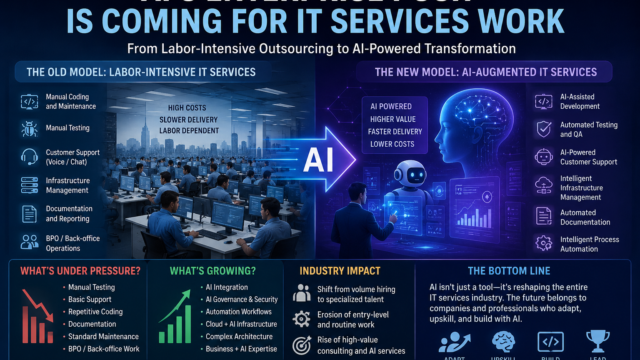
The rapid expansion of artificial intelligence into the enterprise world is beginning to reshape the global IT services industry. For decades, major technology outsourcing firms built their businesses around large workforces handling software maintenance, customer support, testing, infrastructure management, and back-office operations. Now, AI is changing how that work is performed — and in some cases, reducing the need for large teams altogether.

AI Is Transforming Traditional IT Services

Enterprise AI tools are becoming more capable of handling repetitive and time-consuming tasks that were once managed by human employees. AI-powered coding assistants can generate software code, automation tools can monitor infrastructure, and intelligent systems can manage customer support requests with minimal human involvement.

This shift is creating pressure on traditional outsourcing models that rely heavily on labor-intensive work. Tasks such as manual testing, basic software maintenance, documentation, and repetitive operational support are increasingly being automated through generative AI and machine learning systems.

Large enterprises are also investing directly in AI transformation projects instead of simply outsourcing routine operations. Companies now want AI-driven efficiency, faster deployment cycles, and lower operational costs.

IT Companies Are Adapting to a New Reality

Major IT service providers are responding by restructuring their strategies around AI integration and digital transformation. Instead of focusing only on large-scale staffing contracts, companies are moving toward higher-value consulting services that involve AI implementation, cloud modernization, cybersecurity, and enterprise automation.

The demand for professionals with expertise in AI engineering, cloud platforms, data science, and cybersecurity is growing rapidly. Organizations still require skilled workers who can integrate AI systems into legacy infrastructure, ensure compliance, manage governance, and oversee security risks.

At the same time, entry-level and repetitive IT jobs are facing increased uncertainty as AI systems become more efficient.

The Rise of AI-Augmented Workplaces

Rather than completely replacing IT workers, AI is changing the nature of their roles. Many professionals are now expected to work alongside AI tools that improve productivity and automate repetitive tasks.

Software developers increasingly use AI coding assistants to accelerate development. Customer service teams rely on AI chatbots for first-level support. Infrastructure teams use predictive AI systems to detect outages and optimize performance.

This evolution is creating what many analysts describe as an “AI-augmented workforce,” where human expertise remains essential for strategy, oversight, decision-making, and complex problem-solving.

Challenges Facing the Industry

Despite rapid adoption, enterprises still face major concerns regarding AI reliability, security, and governance. AI systems can generate inaccurate outputs, expose sensitive data, or create compliance risks if not carefully monitored.

Businesses also worry about workforce disruption. As automation expands, companies must retrain employees and prepare workers for more specialized technical roles. Governments and industry leaders are increasingly discussing the long-term impact of AI on employment and economic stability.

Another challenge is balancing cost savings with innovation. While AI can reduce operational expenses, implementing enterprise-grade AI systems requires significant investment in infrastructure, talent, and cybersecurity.

The Future of IT Services in the AI Era

The IT services industry is entering a major transition period. Traditional outsourcing models based on large labor pools may gradually decline, while AI-focused consulting and automation services continue to grow.

Companies that successfully adapt to AI-driven enterprise demand are likely to remain competitive. Businesses that fail to modernize may struggle as clients seek faster, more efficient, and AI-powered solutions.

Ultimately, AI is not eliminating the IT services sector — it is reshaping it into a more specialized, technology-driven industry where human expertise and intelligent automation work together.

Conclusion

AI’s growing presence in enterprise technology is redefining the future of IT services work. Automation is reducing reliance on repetitive tasks while increasing demand for advanced technical expertise in AI integration, cybersecurity, cloud computing, and data management. As organizations continue investing in AI transformation, the global IT industry will likely experience both disruption and opportunity in equal measure.

ChatGPT Introduces Trusted Contact Feature for Mental Health Emergencies

How OpenAI’s New Safety Tool Could Help Users During Emotional Crises

![Featured Image: A digital illustration showing a person using ChatGPT with a trusted contact notification system and mental health support icons in the background]

Artificial intelligence is becoming an increasingly important part of daily life, helping people with education, productivity, creativity, and emotional support. However, as AI tools become more personal and conversational, concerns about mental health and emotional dependency are also growing.

In response to these concerns, OpenAI has introduced a new ChatGPT safety feature called Trusted Contact. The feature is designed to provide additional support during potential mental health emergencies by allowing users to connect a trusted person to their account.

The goal is not to replace professional mental health care, but to encourage real-world human support when someone may be experiencing emotional distress.


What Is the Trusted Contact Feature?

![Image Suggestion: Smartphone screen displaying ChatGPT settings with a “Trusted Contact” option highlighted]

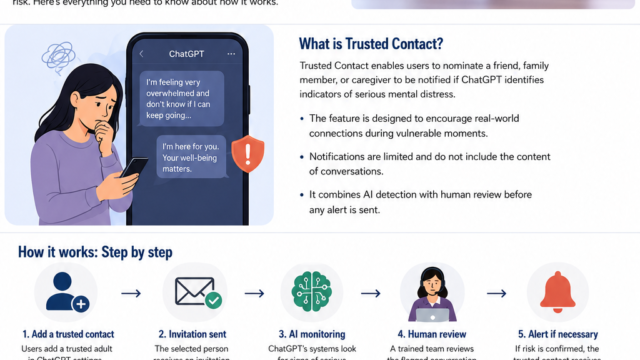
The Trusted Contact feature allows eligible users to add one trusted adult contact to their ChatGPT account. This trusted person can be a family member, close friend, caregiver, or someone the user feels comfortable relying on during difficult moments.

If ChatGPT’s safety systems detect conversations that may indicate a serious risk of self-harm or emotional crisis, OpenAI may send a notification to that trusted contact after additional human review.

The feature is intended to create an extra layer of protection while respecting user privacy.

Key Features Include:

  • One trusted contact per account
  • Human-reviewed safety alerts
  • No sharing of full chat conversations
  • Optional setup controlled by the user
  • Global availability for adult users

This marks one of the first major AI safety systems focused specifically on emotional well-being and crisis response.


How the Feature Works

![Image Suggestion: Workflow infographic showing AI detection, human review, and trusted contact notification steps]

The process behind the Trusted Contact system combines artificial intelligence with trained human oversight.

Step 1: Adding a Trusted Contact

Users can add a trusted adult through ChatGPT settings. The selected person receives an invitation through email, SMS, WhatsApp, or another supported method.

The invitation must be accepted within seven days for the feature to become active.

Step 2: AI Safety Monitoring

OpenAI’s systems monitor conversations for signs that may indicate severe emotional distress or self-harm risk.

These systems are designed to identify patterns and language associated with crisis situations.

Step 3: Human Review

Before any alert is sent, trained reviewers evaluate the flagged conversation to reduce false alarms and ensure appropriate action.

Step 4: Trusted Contact Notification

If the situation appears serious, the trusted contact receives a brief alert encouraging them to check in with the user.

Importantly, OpenAI says the notification does not include full chat logs or detailed personal conversations.


Why OpenAI Introduced This Feature

![Image Suggestion: Person talking with AI chatbot while friends and family appear connected through supportive digital links]

The rise of conversational AI has led many users to interact with chatbots for emotional support, companionship, and stress relief. While these tools can sometimes help people feel heard, experts have raised concerns about users becoming overly dependent on AI systems.

Mental health professionals warn that AI should not replace genuine human relationships or professional therapy.

OpenAI says the Trusted Contact feature is designed to encourage users to maintain real-world social connections during emotionally vulnerable moments.

The company also hopes the feature will help families and caregivers intervene earlier if someone may be struggling.


Privacy and Safety Concerns

![Image Suggestion: Cybersecurity shield protecting private chats and user data]

Although many people welcome the idea of additional safety tools, the feature has also sparked conversations about privacy and AI monitoring.

Some users worry about:

  • How conversations are analyzed
  • Potential false alerts
  • Data privacy and confidentiality
  • Emotional dependency on AI
  • Ethical use of sensitive information

OpenAI states that user privacy remains a priority and that only limited information is shared with trusted contacts.

The company also emphasizes that the feature is entirely optional.

Still, experts believe transparency and responsible oversight will be essential as AI systems become more integrated into emotional and mental health spaces.


The Future of AI and Mental Health Support

![Image Suggestion: Futuristic healthcare and AI support network connecting people globally]

The Trusted Contact feature represents a growing trend toward AI systems that prioritize user safety and emotional well-being.

As artificial intelligence becomes more advanced, companies may continue developing tools that:

  • Detect emotional distress earlier
  • Encourage healthy digital habits
  • Connect users with human support systems
  • Improve crisis prevention resources
  • Provide safer AI interactions

However, experts agree that AI should complement — not replace — professional mental health care and real human relationships.

The future of AI safety will likely depend on finding the right balance between innovation, privacy, and compassionate human support.


Final Thoughts

OpenAI’s Trusted Contact feature highlights the growing responsibility technology companies face as AI becomes more emotionally interactive.

By combining AI monitoring with human oversight and real-world social support, the feature aims to provide users with an added layer of protection during difficult moments.

While questions about privacy and ethics remain, the initiative reflects a broader effort to make AI systems safer, more responsible, and more supportive for users around the world.
Beginner’s Guide to AI: What You Need to Know in Simple Terms

Artificial Intelligence (AI) is no longer a futuristic idea—it’s part of everyday life. From unlocking your phone with face recognition to getting personalized recommendations on Netflix or YouTube, AI is already working behind the scenes. But for beginners, it can feel confusing or overly technical. This guide breaks it down in simple terms so you can understand what AI really is, how it works, and why it matters.


What is Artificial Intelligence?

Artificial Intelligence is the ability of machines or software to perform tasks that normally require human intelligence. These tasks include learning, problem-solving, understanding language, recognizing images, and making decisions.

In simple terms, AI is when computers are trained to “think” and “learn” from data so they can do things on their own without being explicitly programmed for every step.


How Does AI Actually Work?

AI works by using large amounts of data and algorithms (step-by-step instructions) to find patterns.

Here’s a simple breakdown:

  • Data Input: AI systems are fed massive amounts of information (text, images, videos, etc.).
  • Learning Patterns: The system analyzes the data to find patterns and relationships.
  • Making Predictions: Based on what it has learned, AI makes decisions or predictions.
  • Improving Over Time: The more data it processes, the smarter it becomes.

For example, if you keep watching cooking videos, AI learns your interest and suggests similar content.


Types of AI You See in Daily Life

AI is not just one thing—it appears in different forms:

1. Narrow AI

This is the most common type of AI today. It is designed for specific tasks like voice assistants, chatbots, or recommendation systems.

2. Machine Learning

A subset of AI where systems learn from data instead of being directly programmed. For example, spam filters in email.

3. Deep Learning

A more advanced form of machine learning that uses neural networks, similar to how the human brain works. It powers things like facial recognition and self-driving technology.


Real-World Examples of AI

You probably use AI more than you realize:

  • Voice assistants like Siri or Google Assistant
  • Social media feeds that show personalized content
  • Online shopping recommendations on Amazon or Flipkart
  • Navigation apps like Google Maps
  • Chatbots on websites for customer support

AI is silently improving convenience and speed in many daily activities.


Why AI is Important

AI is changing the way the world works. Here’s why it matters:

  • Saves time: Automates repetitive tasks
  • Improves accuracy: Reduces human errors
  • Boosts productivity: Helps businesses work faster and smarter
  • Enhances decision-making: Uses data to provide better insights
  • Drives innovation: Powers new technologies like self-driving cars and smart devices

Should Beginners Learn AI?

Yes—AI is becoming a valuable skill in many industries. You don’t need to be a tech expert to start. Beginners can begin with:

  • Basic computer knowledge
  • Understanding data and logic
  • Learning simple tools like ChatGPT, Excel AI features, or beginner coding platforms

Over time, you can explore programming languages like Python or dive into machine learning concepts.


Conclusion

Artificial Intelligence may sound complex, but at its core, it’s just technology designed to learn and make decisions like humans. As AI continues to grow, understanding the basics will help you stay ahead in both your personal and professional life. Whether you’re a student, professional, or curious learner, AI is worth exploring because it’s shaping the future right now.