How OpenAI’s New Safety Tool Could Help Users During Emotional Crises
![Featured Image: A digital illustration showing a person using ChatGPT with a trusted contact notification system and mental health support icons in the background]
Artificial intelligence is becoming an increasingly important part of daily life, helping people with education, productivity, creativity, and emotional support. However, as AI tools become more personal and conversational, concerns about mental health and emotional dependency are also growing.
In response to these concerns, OpenAI has introduced a new ChatGPT safety feature called Trusted Contact. The feature is designed to provide additional support during potential mental health emergencies by allowing users to connect a trusted person to their account.
The goal is not to replace professional mental health care, but to encourage real-world human support when someone may be experiencing emotional distress.
What Is the Trusted Contact Feature?
![Image Suggestion: Smartphone screen displaying ChatGPT settings with a “Trusted Contact” option highlighted]
The Trusted Contact feature allows eligible users to add one trusted adult contact to their ChatGPT account. This trusted person can be a family member, close friend, caregiver, or someone the user feels comfortable relying on during difficult moments.
If ChatGPT’s safety systems detect conversations that may indicate a serious risk of self-harm or emotional crisis, OpenAI may send a notification to that trusted contact after additional human review.
The feature is intended to create an extra layer of protection while respecting user privacy.
Key Features Include:
- One trusted contact per account
- Human-reviewed safety alerts
- No sharing of full chat conversations
- Optional setup controlled by the user
- Global availability for adult users
This marks one of the first major AI safety systems focused specifically on emotional well-being and crisis response.
How the Feature Works
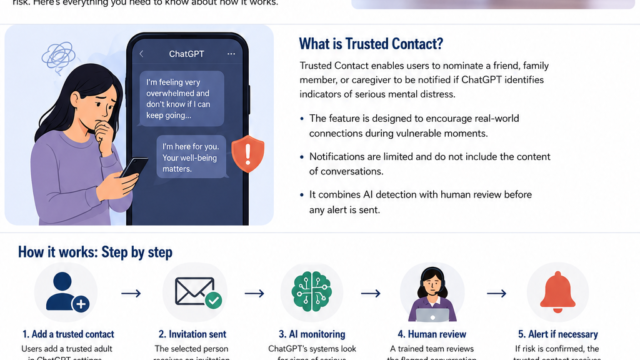
![Image Suggestion: Workflow infographic showing AI detection, human review, and trusted contact notification steps]
The process behind the Trusted Contact system combines artificial intelligence with trained human oversight.
Step 1: Adding a Trusted Contact
Users can add a trusted adult through ChatGPT settings. The selected person receives an invitation through email, SMS, WhatsApp, or another supported method.
The invitation must be accepted within seven days for the feature to become active.
Step 2: AI Safety Monitoring
OpenAI’s systems monitor conversations for signs that may indicate severe emotional distress or self-harm risk.
These systems are designed to identify patterns and language associated with crisis situations.
Step 3: Human Review
Before any alert is sent, trained reviewers evaluate the flagged conversation to reduce false alarms and ensure appropriate action.
Step 4: Trusted Contact Notification
If the situation appears serious, the trusted contact receives a brief alert encouraging them to check in with the user.
Importantly, OpenAI says the notification does not include full chat logs or detailed personal conversations.
Why OpenAI Introduced This Feature
![Image Suggestion: Person talking with AI chatbot while friends and family appear connected through supportive digital links]
The rise of conversational AI has led many users to interact with chatbots for emotional support, companionship, and stress relief. While these tools can sometimes help people feel heard, experts have raised concerns about users becoming overly dependent on AI systems.
Mental health professionals warn that AI should not replace genuine human relationships or professional therapy.
OpenAI says the Trusted Contact feature is designed to encourage users to maintain real-world social connections during emotionally vulnerable moments.
The company also hopes the feature will help families and caregivers intervene earlier if someone may be struggling.
Privacy and Safety Concerns
![Image Suggestion: Cybersecurity shield protecting private chats and user data]
Although many people welcome the idea of additional safety tools, the feature has also sparked conversations about privacy and AI monitoring.
Some users worry about:
- How conversations are analyzed
- Potential false alerts
- Data privacy and confidentiality
- Emotional dependency on AI
- Ethical use of sensitive information
OpenAI states that user privacy remains a priority and that only limited information is shared with trusted contacts.
The company also emphasizes that the feature is entirely optional.
Still, experts believe transparency and responsible oversight will be essential as AI systems become more integrated into emotional and mental health spaces.
The Future of AI and Mental Health Support
![Image Suggestion: Futuristic healthcare and AI support network connecting people globally]
The Trusted Contact feature represents a growing trend toward AI systems that prioritize user safety and emotional well-being.
As artificial intelligence becomes more advanced, companies may continue developing tools that:
- Detect emotional distress earlier
- Encourage healthy digital habits
- Connect users with human support systems
- Improve crisis prevention resources
- Provide safer AI interactions
However, experts agree that AI should complement — not replace — professional mental health care and real human relationships.
The future of AI safety will likely depend on finding the right balance between innovation, privacy, and compassionate human support.
Final Thoughts
OpenAI’s Trusted Contact feature highlights the growing responsibility technology companies face as AI becomes more emotionally interactive.
By combining AI monitoring with human oversight and real-world social support, the feature aims to provide users with an added layer of protection during difficult moments.
While questions about privacy and ethics remain, the initiative reflects a broader effort to make AI systems safer, more responsible, and more supportive for users around the world.