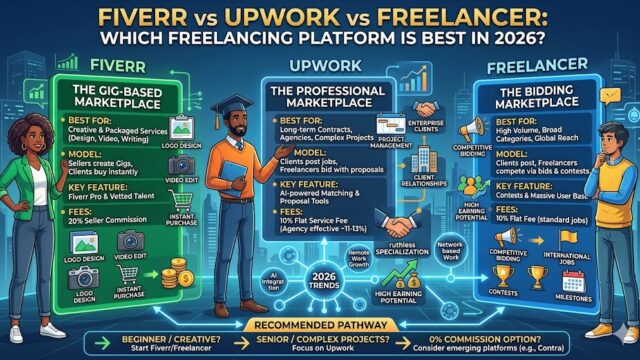
Freelancing has become one of the best ways for students, professionals, and beginners to earn money online. Platforms like Fiverr, Upwork, and Freelancer are helping millions of people build careers from home.
In this blog, we’ll compare these three popular freelancing platforms and help you decide which one is best for your skills and goals.
What Is Fiverr?
Fiverr is a platform where freelancers create services called “Gigs.” Clients browse these gigs and directly hire freelancers.
Advantages of Fiverr
Easy for beginners
Quick profile setup
Clients come to you
Great for creative work
Best Skills for Fiverr
Graphic Design
AI Prompt Writing
Video Editing
Resume Design
Voice Over
Disadvantages
High competition
20% commission fee
New gigs take time to rank
What Is Upwork?
Upwork is a professional freelancing platform where clients post jobs and freelancers send proposals.
Advantages of Upwork
High-paying clients
Long-term contracts
Professional reputation
Secure payments
Best Skills for Upwork
Web Development
SEO
Content Writing
Digital Marketing
AI Automation
Disadvantages
Hard for beginners
Proposal competition
Requires Connects for applications
What Is Freelancer?
Freelancer mainly focuses on bidding and contests. Freelancers compete for projects by submitting proposals.
Advantages of Freelancer
Large number of projects
Good for gaining experience
Useful design contests
Flexible categories
Best Skills for Freelancer
Data Entry
Graphic Design
Website Development
Technical Support
Writing
Disadvantages
Very high competition
Many low-budget projects
Harder to win bids initially
Fiverr vs Upwork vs Freelancer Comparison
Feature
Fiverr
Upwork
Freelancer
Best For
Beginners
Professionals
Bidding Projects
Setup Difficulty
Easy
Medium
Medium
Client Quality
Mixed
High
Mixed
Income Potential
Good
Very High
Good
Work Style
Gig-Based
Proposal-Based
Bidding-Based
Beginner Friendly
Yes
Moderate
Moderate
Long-Term Clients
Limited
Excellent
Moderate
Which Platform Should You Choose?
Choose Fiverr if:
You are a beginner
You want quick setup
You sell creative services
Choose Upwork if:
You want professional clients
You have advanced skills
You want long-term work
Choose Freelancer if:
You enjoy competition
You want practice projects
You like bidding systems
Tips for Freelancing Success
1. Build a Strong Portfolio
Show your best work clearly.
2. Communicate Professionally
Fast replies increase client trust.
3. Learn High-Income Skills
AI, coding, marketing, and editing skills are highly valuable.
4. Start Small
Take smaller projects first to gain reviews.
Final Verdict
Fiverr is best for beginners and quick online earning.
Upwork is best for professional freelancing careers.
Freelancer is best for bidding competitions and experience building.
Many successful freelancers use all three platforms together to maximize opportunities.
The field of airesearch is rapidly transforming how humans discover new knowledge, conduct experiments, and solve global problems. By combining artificial intelligence with traditional scientific methods, researchers are building systems that can analyze data, generate hypotheses, and even run experiments with minimal human intervention.
This shift is not just an upgrade in tools—it is a structural change in how science itself works. From healthcare and climate studies to physics and material science, airesearch is opening a new era of faster, more scalable, and more intelligent discovery.
1. Understanding the Core Idea of airesearch
At its core, airesearch refers to the use of artificial intelligence systems to support or fully automate parts of the research process. These systems can read millions of scientific papers, identify patterns in complex datasets, and suggest new directions for investigation.
Instead of replacing scientists, AI acts as a powerful assistant that accelerates discovery. Researchers still define goals and interpret results, but AI handles repetitive and data-heavy tasks.
In modern labs, AI tools are already being used to support genomics, drug discovery, environmental modeling, and physics simulations. The result is a hybrid model where human intelligence and machine intelligence work together.
2. Opportunities Created by airesearch
The rise of airesearch brings massive opportunities across industries. One of the most important is speed. Scientific discoveries that once took years can now be achieved in months or even weeks.
AI systems can process enormous datasets in seconds and identify insights that would take humans much longer to find. This accelerates innovation in fields like medicine, where faster drug discovery can save lives.
Another opportunity is accessibility. Smaller research teams and universities can now compete with larger institutions because AI reduces the need for massive manual labor and resources.
In medicine, airesearch is helping identify new treatments, predict disease outbreaks, and design personalized therapies. In environmental science, it helps model climate change and predict extreme weather events. In materials science, AI helps design stronger, lighter, and more efficient materials.
3. The Rise of Autonomous Research Labs
One of the most exciting developments in airesearch is the emergence of autonomous research labs. These are environments where AI systems not only analyze data but also control robotic equipment to run physical experiments.
In these labs, robots perform tests, sensors collect results, and AI systems immediately analyze outcomes. If results do not match expectations, the AI adjusts the experiment automatically and tries again.
This creates a continuous cycle of experimentation without constant human supervision. Scientists still guide the research direction, but the execution becomes highly automated.
Autonomous labs are already being tested in pharmaceuticals, where they help identify drug compounds faster than traditional methods. In the future, they could become standard in many scientific fields.
4. Ethical Challenges in airesearch
Despite its advantages, airesearch raises serious ethical concerns that must be addressed carefully.
One major issue is transparency. AI systems often act like “black boxes,” meaning it is difficult to understand how they reach certain conclusions. This becomes a problem in scientific research, where explainability is critical.
Another concern is bias. If AI models are trained on incomplete or biased datasets, they may produce inaccurate or misleading results. This can negatively affect research outcomes.
Accountability is also a major question. If an AI system produces incorrect scientific results, responsibility becomes unclear—whether it lies with developers, researchers, or institutions.
5. Human Role in an AI-Driven Research World
Even in a highly automated airesearch ecosystem, humans remain essential. AI can process data and suggest ideas, but human scientists provide creativity, intuition, and ethical judgment.
Researchers decide which problems are worth solving and how results should be interpreted. They also ensure that AI-generated findings are valid, safe, and meaningful.
The future of science is not about replacing humans but enhancing their capabilities through collaboration with intelligent systems.
6. AI in Drug Discovery and Healthcare Research
One of the most impactful uses of airesearch is in healthcare. Drug discovery traditionally takes more than a decade and costs billions of dollars. AI dramatically reduces this timeline.
AI systems can simulate molecular interactions, predict how compounds behave in the human body, and identify promising drug candidates much faster than traditional methods.
This is also leading to personalized medicine, where treatments are tailored to individual genetic profiles. As airesearch evolves, healthcare will become more predictive, precise, and preventive.
7. Environmental and Climate Applications
Another important application of airesearch is climate science. AI systems analyze satellite data, ocean patterns, and atmospheric conditions to understand climate change more accurately.
They help predict natural disasters, track deforestation, and model long-term environmental changes. This allows governments and organizations to make better decisions for sustainability.
8. Challenges in Scaling airesearch Systems
Scaling airesearch systems globally comes with technical and organizational challenges. High-quality data is required for accurate results, but such data is not always available or standardized.
Computing power is another limitation, especially for large-scale simulations. Integrating AI with physical lab equipment also requires advanced robotics and engineering.
There is also a need for global regulations to ensure responsible use of AI in scientific research.
9. The Future of airesearch
The future of airesearch is moving toward fully autonomous scientific ecosystems. AI systems may soon generate hypotheses, design experiments, execute them, and publish findings with minimal human involvement.
We may also see highly specialized AI research systems focused on fields like neuroscience, astrophysics, and biotechnology.
As these systems evolve, scientific discovery will become faster, more efficient, and more interconnected than ever before.
Conclusion
The rise of airesearch marks a turning point in the history of science. By combining human intelligence with artificial intelligence, research is becoming faster, more scalable, and more innovative.
From autonomous labs to AI-driven drug discovery and climate modeling, the possibilities are enormous. However, ethical challenges such as transparency, bias, and accountability must be carefully managed.
Ultimately, airesearch will not replace scientists but empower them—creating a future where discovery happens at a pace never seen before, and where humanity can solve complex global challenges with greater intelligence and efficiency.
The Growing Influence of AIResearch in Modern Society
The rapid advancement of artificial intelligence is reshaping industries and changing how organizations operate across the world. At the center of this transformation is airesearch, which represents the continuous development of intelligent systems capable of learning, analyzing data, and solving complex problems with remarkable efficiency. Businesses, educational institutions, and healthcare organizations are increasingly relying on AI-powered technologies to improve productivity, decision-making, and innovation in a highly competitive digital environment.
Modern AI research focuses on machine learning, automation, predictive analytics, and neural networks that allow systems to process information faster and more accurately than traditional methods. These technologies are helping organizations reduce operational costs, improve customer experiences, and discover new opportunities for growth. As artificial intelligence continues evolving, AIResearch is becoming one of the most influential forces driving digital transformation and global innovation.
AIResearch and the Future of Business Innovation
One of the most important impacts of airesearch can be seen in the business world. Companies across industries are integrating AI-powered systems into their operations to improve efficiency, automate repetitive tasks, and make smarter strategic decisions. Businesses today generate massive amounts of data, and AI research helps organizations analyze this information quickly to identify trends, customer behaviors, and market opportunities.
AI-powered business tools support areas such as customer service, financial analysis, marketing automation, and supply chain management. Intelligent systems can predict consumer preferences, optimize advertising campaigns, and improve inventory management through data-driven insights. These capabilities allow businesses to operate more efficiently while responding faster to market changes.
Automation is another major advantage connected with AIResearch. Many organizations use artificial intelligence to automate administrative tasks, process transactions, and manage workflows that previously required extensive human involvement. This reduces operational costs while allowing employees to focus on creativity, innovation, and strategic problem-solving.
Businesses that invest in AI-driven innovation gain a competitive advantage in increasingly digital markets. As artificial intelligence technologies become more advanced, companies will continue adopting smarter systems capable of improving productivity and accelerating long-term growth.
Personalized Learning Through AIResearch in Education
The education sector is also experiencing major transformation through airesearch and intelligent learning technologies. Traditional educational models often struggle to meet the diverse learning needs of students, especially in digital and remote learning environments. Artificial intelligence is helping educators create more personalized and adaptive learning experiences that improve student engagement and academic performance.
AI-powered educational platforms can analyze learning patterns, identify student strengths and weaknesses, and recommend customized study materials based on individual progress. This personalized approach allows students to learn at their own pace while receiving targeted support in areas where improvement is needed. Intelligent tutoring systems and virtual learning assistants are becoming increasingly popular in modern classrooms and online education programs.
AIResearch also supports educators by automating administrative tasks such as grading, scheduling, and performance analysis. This allows teachers to spend more time focusing on instruction, mentorship, and student development rather than repetitive paperwork.
In addition, digital learning platforms powered by artificial intelligence are expanding access to education globally. Students from different regions can access online courses, virtual classrooms, and AI-driven educational resources regardless of geographic limitations. This increased accessibility is helping create more inclusive and globally connected learning environments.
Healthcare Innovation Driven by AIResearch
Healthcare is one of the industries benefiting most from advancements in airesearch. Medical organizations generate enormous amounts of data every day, including patient records, imaging scans, laboratory results, and treatment histories. Artificial intelligence helps healthcare professionals analyze this information more accurately and efficiently, leading to improved diagnostics, treatment planning, and patient care.
AI-powered medical imaging systems can identify diseases such as cancer, cardiovascular conditions, and neurological disorders with remarkable precision. Machine learning algorithms analyze patterns within medical scans and patient data to support early disease detection and more accurate diagnoses. Early identification of medical conditions increases treatment success rates and improves long-term patient outcomes.
AIResearch is also accelerating drug discovery and pharmaceutical development. Researchers use artificial intelligence to simulate biological processes, predict treatment effectiveness, and identify potential compounds much faster than traditional research methods. This reduces development time and helps bring life-saving treatments to patients more efficiently.
In addition to diagnostics and research, AI-powered healthcare systems improve hospital management, patient monitoring, and personalized medicine. Intelligent platforms can track patient conditions in real time, recommend customized treatment plans, and optimize healthcare operations for better efficiency and accessibility.
Automation and Predictive Analytics in AIResearch
Automation and predictive analytics are among the most powerful contributions of airesearch to modern industries. Predictive AI systems analyze historical data, identify patterns, and forecast future outcomes with increasing accuracy. Businesses, educators, and healthcare providers use these insights to make proactive decisions and improve long-term planning.
In business environments, predictive analytics helps organizations anticipate customer behavior, monitor financial risks, and optimize operational strategies. Educational institutions use AI systems to identify students who may need additional academic support, while healthcare providers predict disease trends and improve preventive care planning.
Automation powered by AIResearch reduces the need for repetitive manual tasks while improving speed and accuracy. Intelligent systems can process information continuously, monitor performance metrics, and respond to changes in real time. This level of efficiency is especially valuable in industries where rapid decision-making and large-scale data management are essential.
As automation technologies continue evolving, organizations will increasingly rely on AI-driven systems to support productivity, reduce errors, and improve overall operational performance.
Ethical Challenges and Responsible AIResearch
While airesearch offers enormous benefits, it also raises important ethical and social considerations. Issues related to data privacy, algorithmic bias, cybersecurity, and workforce automation require careful management to ensure artificial intelligence is used responsibly and fairly.
Researchers and technology companies are working to develop ethical AI systems that prioritize transparency, accountability, and human oversight. Responsible AIResearch focuses on creating technologies that support society while minimizing risks associated with misuse or discrimination. Governments and international organizations are also developing regulations and standards to guide the ethical development of artificial intelligence.
Education and public awareness are essential for ensuring that AI technologies are used effectively and responsibly. As AI systems become more integrated into daily life, businesses and institutions must balance innovation with ethical considerations to maintain trust and social responsibility.
The Future of AIResearch and Global Transformation
The future of airesearch is expected to bring even greater advancements across business, education, healthcare, and many other industries. Emerging technologies such as advanced neural networks, quantum computing, and autonomous AI systems will likely accelerate innovation and create new possibilities for solving complex global challenges.
Future AI systems may provide highly personalized healthcare treatments, fully adaptive educational experiences, and intelligent business automation capable of operating with minimal human intervention. These advancements have the potential to improve efficiency, accessibility, and quality of life on a global scale.
AIResearch represents more than technological progress; it symbolizes a shift toward smarter, more connected, and data-driven societies. Through innovation, collaboration, and responsible development, artificial intelligence will continue transforming industries and helping organizations create solutions that shape the future of the modern world.
The rapid development of artificial intelligence has transformed the way businesses, educational institutions, and technology companies operate. One of the most discussed concepts in modern innovation is airesearch, a term that represents the use of AI-powered systems to improve research, automation, and digital decision-making. From healthcare to finance, companies are now investing heavily in AI-driven research tools to gain faster insights and improve productivity.
The rise of airesearch is closely connected with the increasing amount of digital information available online. Traditional research methods often require long hours of data collection and analysis, while AI systems can process millions of data points within seconds. This ability allows organizations to identify trends, predict future outcomes, and develop smarter strategies in competitive industries.
How airesearch Is Transforming Modern Businesses
Businesses across the world are embracing airesearch to streamline operations and enhance customer experiences. AI-based research platforms help companies analyze consumer behavior, monitor market trends, and optimize advertising campaigns with greater accuracy. Instead of relying solely on human analysis, organizations now combine human creativity with AI intelligence to make more effective business decisions.
One major advantage of airesearch is automation. AI tools can automatically gather information from multiple sources, organize large datasets, and generate reports in real time. This reduces operational costs and improves efficiency for startups and global enterprises alike. Marketing teams, for example, use AI analytics to understand customer preferences and create personalized campaigns that deliver higher engagement.
In the healthcare sector, airesearch contributes to faster medical discoveries and more accurate diagnoses. AI systems can study medical records, research papers, and clinical trials to help doctors identify treatment possibilities. This technology has significantly accelerated pharmaceutical research and disease prediction in recent years.
The Role of airesearch in Education and Learning
Education has also benefited greatly from the expansion of airesearch technologies. Students and researchers now have access to AI-powered tools that simplify complex topics, summarize information, and recommend relevant learning materials. Educational platforms powered by AI can personalize lessons according to a student’s learning speed and performance.
Universities and research institutions are increasingly using airesearch systems to improve academic productivity. Researchers can analyze scientific data more efficiently and discover patterns that may have been difficult to detect manually. AI-assisted tools also help in language translation, academic writing support, and plagiarism detection, making research activities faster and more reliable.
Another important advantage is accessibility. People from different parts of the world can access intelligent learning systems online, reducing barriers to quality education. As internet connectivity expands globally, airesearch is expected to become an essential component of digital education ecosystems.
The Connection Between airesearch and Big Data
Big data and airesearch work together to create powerful digital solutions. Modern organizations generate massive amounts of information every day through websites, mobile apps, social media, and online transactions. Managing this information manually is nearly impossible, which is why AI-powered research systems are becoming increasingly important.
AI algorithms can process structured and unstructured data efficiently, identifying valuable insights hidden within large databases. Companies use these insights to improve customer service, detect fraud, forecast sales, and optimize logistics operations. Financial institutions, for example, rely on airesearch technologies to analyze market fluctuations and reduce investment risks.
The combination of big data and AI also supports smart city development. Governments can analyze transportation patterns, energy consumption, and public safety data to improve urban planning and public services. This demonstrates how airesearch is not only transforming businesses but also contributing to broader societal improvements.
Challenges and Ethical Concerns in airesearch
Despite its many advantages, airesearch also presents several challenges and ethical concerns. One major issue is data privacy. AI systems often require large amounts of personal information to function effectively, raising concerns about how data is collected, stored, and used. Companies must ensure strong cybersecurity measures to protect user information from misuse or unauthorized access.
Another challenge involves bias in AI algorithms. If the training data used by AI systems contains biased information, the results generated may also be unfair or inaccurate. This can affect hiring systems, financial decisions, and even healthcare recommendations. Developers and researchers must therefore focus on creating transparent and ethical AI models.
There is also concern about job displacement caused by automation. While airesearch creates new opportunities in technology and data science, some traditional jobs may become less necessary due to AI-driven systems. The future workforce will likely require new digital skills to adapt to this technological transformation.
The Future Potential of airesearch
The future of airesearch appears extremely promising as AI technology continues to evolve. Experts predict that AI-powered research systems will become even more intelligent, capable of understanding human behavior, emotions, and complex decision-making processes. Industries such as robotics, cybersecurity, biotechnology, and environmental science are expected to benefit greatly from future AI innovations.
Businesses that adopt airesearch early may gain a strong competitive advantage in the digital economy. Faster analysis, smarter automation, and improved predictive capabilities can help organizations remain adaptable in rapidly changing markets. Consumers will also experience more personalized services and improved digital interactions powered by AI-driven technologies.
As technology advances, airesearch will likely become an essential foundation for innovation across multiple industries. By combining human creativity with artificial intelligence, society can unlock new possibilities that were once considered impossible. The ongoing development of AI research tools is shaping a future where information becomes more accessible, decisions become smarter, and digital transformation continues to accelerate worldwide.
In many digital game interfaces, especially those built around high-engagement mechanics often associated with “situs slot gacor”-style systems, players are frequently placed in environments driven by randomness. Despite this, users often report a strong feeling of control over outcomes. This perception does not come from the underlying logic of the system, but from how choices, timing, and feedback are presented through the interface. The brain naturally looks for patterns and agency, even in systems governed by probability.
Interactive UI Elements That Simulate Agency
Game interfaces often include interactive components that give the illusion of influence over results. Buttons, toggles, speed controls, and timing-based inputs make users feel like their actions directly shape outcomes. Even when the core result is determined by a random number generator, the presence of interactive steps before the outcome creates a psychological bridge between action and result. This design strengthens engagement by making users feel actively involved rather than passively observing.
Timing, Anticipation, and the “Near Influence” Effect
Timing-based interactions play a major role in reinforcing perceived control. When users initiate an action and then wait for a brief animation or sequence, they subconsciously associate their input with the final result. This delay creates anticipation and allows the brain to overestimate the impact of timing precision. Even small variations in animation speed or reveal timing can amplify the feeling that user input had a meaningful effect on outcomes.
Feedback Loops That Reinforce Decision Confidence
Immediate feedback is another key factor in building the illusion of control. Visual effects, sound cues, and animated transitions reinforce the idea that each action has consequences. When users receive consistent and polished feedback after every interaction, they develop confidence in their decision-making process. This reinforcement loop encourages continued interaction, even when outcomes are statistically independent of user choices.
Choice Architecture and Guided Interaction
Choice design heavily influences how much control users believe they have. By offering multiple options—such as different modes, buttons, or paths—interfaces create a sense of strategic decision-making. However, in many systems, these choices may ultimately converge toward similar probabilistic outcomes. The presence of choice itself, rather than its actual impact, is enough to enhance engagement and make the experience feel more personalized and controllable.
Visual Cues That Suggest Influence
Subtle visual cues also contribute to situs slot gacor perceived control. Highlighted buttons, glowing states, directional animations, and responsive hover effects suggest that the system is reacting directly to user intent. Even decorative animations can reinforce this illusion by aligning visually with user actions. The more responsive and synchronized the interface appears, the stronger the belief that the user is influencing outcomes.
Randomness Hidden Behind Structured Presentation
At the core of these systems is randomness, but it is rarely presented in a raw or transparent form. Instead, outcomes are wrapped in structured animations, staged reveals, and layered transitions. This presentation transforms statistical randomness into a narrative experience. Users interpret the sequence of events as meaningful progression rather than independent probabilistic events, strengthening the perception of control.
Conclusion
The illusion of control in game interfaces emerges from a combination of timing, feedback, choice design, and visual responsiveness. In systems inspired by “situs slot gacor”-style engagement patterns, randomness remains the underlying mechanism, but UI design reshapes how that randomness is experienced. By embedding agency into interactions and reinforcing every action with immediate feedback, these interfaces make users feel actively in control—even when outcomes are entirely determined by chance.
MPO slot gaming has become one of the most recognizable trends in today’s online entertainment industry. As digital gaming culture continues to expand, slot platforms are attracting players from different age groups and backgrounds through accessible gameplay, modern visuals, and rewarding interactive features. The rise of mobile technology and online communities has also helped MPO slot gaming become a major part of modern gaming culture worldwide.
What once began as a simple form of digital casino entertainment has evolved into a highly interactive experience filled with creative themes, bonus systems, and social engagement. The continued growth of MPO slot gaming reflects how online entertainment is adapting to the changing habits and preferences of modern users.
The Simplicity That Attracts New Players
One of the biggest reasons mpo slot games remain popular is their simplicity. Unlike competitive online games that require advanced strategies or long learning periods, slot games are easy to understand and accessible for beginners.
Players can quickly learn the basic mechanics:
Choose a bet amount Spin the reels Trigger bonus features Collect potential rewards
This easy entry point makes MPO slot gaming attractive for casual users who want entertainment without complicated gameplay systems. The balance between simplicity and excitement has helped slots maintain broad appeal within modern gaming culture.
Mobile Gaming Has Expanded Accessibility
The growth of smartphone technology has played a major role in the success of MPO slot platforms. Mobile gaming allows users to access slot games anytime and almost anywhere through devices they already use daily.
Modern MPO slot platforms are optimized for:
Smartphones Tablets Mobile browsers Touchscreen controls Fast-loading gameplay
This flexibility fits modern lifestyles where people prefer portable entertainment options that can be enjoyed during travel, breaks, or leisure time.
Mobile accessibility has introduced online slot gaming to wider audiences across different regions and demographics.
Visual Innovation and Interactive Design
Modern MPO slot games are designed to provide more than traditional reel-spinning experiences. Developers now focus heavily on visual storytelling, cinematic animations, and interactive gameplay features.
Popular slot themes include:
Fantasy adventures Ancient mythology Treasure hunting Historical civilizations Asian-inspired aesthetics Sci-fi and futuristic worlds
Bonus systems such as cascading reels, multipliers, free spins, and mini-games add additional excitement and variety to gameplay sessions.
These visual and interactive improvements make online slots feel more similar to modern video games while still remaining easy to play.
The Influence of Social Media and Streaming
Social media has become an important factor in the growth of MPO slot gaming culture. Players frequently share gameplay highlights, large wins, bonus features, and game recommendations through streaming platforms and online communities.
Content creators and gaming influencers help introduce new slot titles to wider audiences by showcasing:
Gameplay strategies Bonus rounds Trending games Platform reviews Mobile gaming experiences
This constant online exposure keeps slot gaming visible within digital entertainment culture and encourages community discussions around popular titles.
Streaming culture has transformed slot gaming into a more social experience rather than purely individual entertainment.
Bonuses and Reward Systems Increase Engagement
Promotions are another reason MPO slot gaming remains highly attractive in modern gaming culture. Platforms regularly provide:
These systems encourage player participation and create additional excitement around gameplay sessions. For beginners, bonuses also reduce the initial barrier to entry and allow exploration of different games with greater flexibility.
Reward systems help strengthen long-term engagement between players and online gaming platforms.
Variety of Gameplay Styles
Modern MPO slot platforms offer a huge range of gameplay options suitable for different preferences and risk levels. Some players enjoy low-volatility games with frequent smaller rewards, while others prefer high-volatility maxwin slots with larger payout potential.
This variety allows users to personalize their gaming experiences based on:
The constant release of new slot titles also helps maintain player interest over time.
Technology Continues Driving Growth
Technological advancement continues shaping the future of MPO slot gaming culture. Faster internet speeds, advanced graphics engines, artificial intelligence, and cloud gaming systems are helping developers create increasingly immersive experiences.
Future innovations may include:
Virtual reality slot environments Personalized game recommendations Interactive tournaments Cross-platform gaming integration Enhanced social gaming features
These developments are expected to strengthen the role of slot gaming within the larger digital entertainment ecosystem.
Responsible Gaming Awareness
As MPO slot gaming grows, responsible gaming awareness has also become more important. Many platforms now include tools that help players manage their gaming activity responsibly, such as:
Spending limits Session reminders Self-control settings Gameplay tracking systems
Modern gaming culture increasingly emphasizes balance and responsible participation alongside entertainment value.
This shift supports healthier gaming environments and contributes to the long-term sustainability of the online gaming industry.
MPO Slot Gaming as Part of Modern Digital Entertainment
The popularity of MPO slot gaming reflects broader trends in digital culture where convenience, interactivity, and mobile accessibility are highly valued. By combining simple gameplay with immersive visuals, rewarding features, and strong community engagement, MPO slot platforms continue to hold a major position within modern online entertainment.
As technology and gaming culture continue evolving, MPO slot games are likely to remain a significant part of the digital entertainment landscape for years to come.
Data-driven personalization in learning platforms refers to using AI systems to continuously analyze user behavior and then adapt content, difficulty, and learning paths in real time. For “slot gacor maxwin member baru” users—framed here as new users in a skill-building digital environment—this approach can significantly improve how quickly and effectively they develop competence.
Adaptive Learning Paths Based on Behavior
AI systems track how users interact with lessons: what they click, how long they stay, where they struggle, and what they repeat. Based on this, the platform dynamically adjusts the learning journey.
For example, if a beginner repeatedly struggles with a concept, the system can:
Break it into smaller micro-lessons Provide additional visual explanations Delay advanced topics until mastery is achieved
This prevents cognitive overload and keeps learning progression smooth.
Real-Time Feedback Loops
One of the strongest benefits of AI personalization is instant feedback. Instead of waiting for manual review or fixed assessments, users receive immediate insights such as:
What they did correctly What needs improvement Suggested next steps
This accelerates skill correction and helps users build accurate understanding faster.
Predictive Skill Gap Detection
AI can predict where a user is likely to struggle before it happens. By comparing patterns with thousands of similar learners, the system identifies skill gaps early.
For instance:
If a user shows inconsistent performance in early modules, the system may reinforce foundational lessons If progress is strong, it may introduce slightly more complex challenges to maintain engagement
This keeps the learning curve balanced—not too easy, not too overwhelming.
Personalized Motivation Systems
Different users respond to different motivational triggers. AI can personalize:
Some users may respond better to short challenges, while others prefer structured long-term goals. Personalization ensures motivation stays consistent without relying on one-size-fits-all gamification.
Content Recommendation Engines
Just like streaming platforms recommend shows, learning platforms recommend:
Relevant next lessons Practice exercises Revision modules
These recommendations are based on user slot gacor maxwin member baru history, performance trends, and learning goals, making the experience more efficient and less random.
Conclusion
AI-driven personalization transforms learning into a responsive system rather than a fixed curriculum. For beginner users in skill-focused platforms, it ensures smoother onboarding, faster improvement, and reduced frustration by tailoring every step to individual progress. Over time, this creates a more efficient and sustainable learning experience where each user follows a path optimized specifically for them.
Modern businesses no longer rely only on intuition or past sales reports to understand customers. Today, companies use predictive artificial intelligence (AI) to analyze massive amounts of data and forecast what consumers are likely to buy, search for, or engage with next. Predictive AI has become one of the most valuable technologies in retail, marketing, e-commerce, finance, and entertainment because it helps brands stay ahead of changing consumer behavior.
From personalized product recommendations to demand forecasting and dynamic pricing, predictive AI is reshaping how businesses make decisions. Companies that successfully adopt AI-driven analytics can improve customer satisfaction, reduce operational waste, and increase revenue through smarter strategies. According to recent industry reports, predictive analytics and personalized marketing remain among the top AI use cases in retail and consumer industries.
What Is Predictive AI?
Predictive AI refers to artificial intelligence systems that use historical data, machine learning algorithms, and statistical modeling to predict future outcomes. Instead of simply analyzing what happened in the past, predictive AI estimates what is likely to happen next.
Businesses feed AI systems with data such as:
Customer purchase history
Website browsing behavior
Social media activity
Product reviews
Geographic trends
Seasonal buying patterns
Advertising engagement metrics
The AI system then identifies patterns that humans may overlook. Over time, the model improves its accuracy as it processes more information.
For example, an online retailer can use predictive AI to determine:
Which products customers may purchase next
When demand for a product may increase
Which shoppers are likely to stop buying
What type of advertisement performs best for specific audiences
This allows companies to make faster and more informed decisions.
Why Predictive AI Matters in Modern Business
Consumer behavior changes rapidly. Social media trends, economic shifts, viral content, and changing lifestyles influence buying decisions almost instantly. Traditional market research methods are often too slow to keep up.
Predictive AI solves this problem by processing real-time information and identifying trends early. Many retailers and marketers now use AI to personalize experiences, forecast inventory needs, and improve advertising performance.
Key advantages include:
Faster trend detection
Improved customer personalization
More accurate sales forecasting
Better inventory management
Reduced marketing waste
Higher customer retention
Businesses that fail to adapt risk losing market share to competitors using AI-powered insights.
How Predictive AI Understands Consumer Trends
1. Analyzing Customer Behavior
One of the most important uses of predictive AI is customer behavior analysis.
AI systems track how users interact with websites, apps, advertisements, and products. By analyzing clicks, watch time, purchases, and browsing patterns, businesses can understand what customers truly want.
For example:
Streaming platforms predict which shows users will enjoy
Online stores recommend products based on browsing history
Food delivery apps predict ordering habits during weekends or holidays
This level of analysis helps businesses create highly personalized experiences.
Research in consumer analytics shows that AI models can identify hidden consumer preferences more effectively than traditional statistical methods.
Personalized Recommendations and Smart Marketing
Predictive AI powers recommendation systems used by many global companies.
When consumers see “Recommended for You” sections on shopping websites or streaming platforms, predictive algorithms are working behind the scenes.
These systems analyze:
Similar customer behavior
Product interactions
Purchase frequency
Demographic patterns
Viewing history
The result is a personalized experience that increases engagement and conversion rates.
Retailers increasingly use AI-driven personalization because consumers now expect tailored shopping experiences instead of generic advertising. Industry reports highlight hyper-personalization as one of the strongest AI-driven retail trends.
Businesses also use predictive AI in email marketing and digital advertising. AI can determine:
The best time to send emails
Which products to promote
Which customers are likely to click ads
What messaging style performs best
This improves marketing efficiency while reducing unnecessary advertising costs.
Demand Forecasting and Inventory Management
Another major advantage of predictive AI is demand forecasting.
Retailers must predict which products consumers will want weeks or months in advance. Poor forecasting can lead to overstocking or inventory shortages.
Predictive AI analyzes:
Historical sales data
Weather patterns
Seasonal demand
Economic conditions
Social media discussions
Geographic trends
By combining these signals, businesses can predict demand more accurately.
For example, fashion retailers can detect rising interest in certain styles before they become mainstream. Large retailers now use AI systems to identify fashion trends from social media and shopping behavior to speed up product launches.
AI-driven inventory systems help businesses:
Reduce warehouse costs
Avoid stock shortages
Improve delivery efficiency
Increase customer satisfaction
Advanced forecasting models are becoming increasingly important in modern supply chain management.
Social Media Trend Prediction
Social media platforms contain enormous amounts of consumer data. Predictive AI tools analyze conversations, hashtags, comments, and viral content to detect emerging trends early.
Brands monitor platforms like:
Instagram
TikTok
X (Twitter)
YouTube
Reddit
AI systems identify which products, topics, or aesthetics are gaining momentum. This helps companies respond before competitors.
For example:
Beauty brands track skincare trends
Fashion companies monitor viral styles
Food chains analyze recipe trends
Entertainment companies study audience reactions
Some businesses even use sentiment analysis to measure how consumers feel about products or campaigns.
Reddit discussions and online communities often reveal early consumer opinions and purchasing behaviors before they appear in mainstream analytics.
Dynamic Pricing Strategies
Predictive AI also helps businesses adjust prices in real time.
Dynamic pricing systems analyze:
Consumer demand
Competitor pricing
Seasonal behavior
Shopping activity
Product popularity
Airlines, hotels, e-commerce stores, and ride-sharing platforms frequently use predictive pricing models.
For example:
Prices may rise during high demand
Discounts may appear when inventory is high
Loyal customers may receive personalized offers
This strategy helps companies maximize revenue while remaining competitive.
AI-Powered Customer Retention
Acquiring new customers is expensive. Predictive AI helps companies retain existing customers by identifying signs of disengagement early.
AI systems can predict:
Which customers may stop subscribing
Which users are losing interest
Which buyers are likely to switch brands
Businesses then create targeted retention campaigns, such as:
Personalized discounts
Loyalty rewards
Special promotions
Tailored recommendations
This proactive approach improves customer loyalty and long-term profitability.
Studies on AI-supported consumer engagement show that personalized AI interactions can positively influence satisfaction, trust, and purchasing decisions. (arXiv)
Industries Using Predictive AI
Retail and E-Commerce
Retail companies use predictive AI for:
Product recommendations
Inventory forecasting
Personalized promotions
Shopping assistants
Dynamic pricing
Many retailers are rapidly increasing AI investment to improve customer engagement and operational efficiency.
Banking and Finance
Banks use predictive AI to:
Detect fraud
Analyze spending habits
Assess credit risk
Predict customer needs
AI systems can detect suspicious transactions in real time, improving security.
Entertainment and Streaming
Streaming services use predictive AI to recommend movies, music, and shows based on user behavior.
This increases viewing time and customer satisfaction.
Healthcare
Healthcare organizations use predictive AI to forecast patient needs, identify health risks, and improve treatment planning.
Travel and Hospitality
Travel companies predict booking patterns, seasonal demand, and customer preferences to optimize pricing and improve experiences.
Challenges of Predictive AI
Despite its benefits, predictive AI also presents several challenges.
Data Privacy Concerns
AI systems rely heavily on customer data. Businesses must comply with privacy regulations and protect sensitive information.
Consumers are increasingly concerned about how companies collect and use personal data.
Bias in AI Models
If training data contains bias, AI predictions may become unfair or inaccurate.
Businesses must continuously monitor and improve AI systems to ensure ethical decision-making.
High Implementation Costs
Building AI infrastructure requires investment in:
Data systems
Cloud computing
Skilled professionals
Security measures
Smaller businesses may struggle with adoption costs.
Dependence on Data Quality
Predictive AI is only as effective as the data it receives. Inaccurate or incomplete data can lead to poor predictions.
The Future of Predictive AI in Consumer Trends
Predictive AI is expected to become even more advanced in the coming years.
Future developments may include:
Real-time hyper-personalization
AI-powered virtual shopping assistants
Advanced emotional analysis
Fully automated marketing systems
Smarter supply chain forecasting
Industry experts predict that AI will continue transforming retail, advertising, and customer engagement throughout the decade.
Businesses are moving toward AI systems that not only predict trends but also automate decision-making processes in real time.
Conclusion
Predictive AI is changing how businesses understand and respond to consumer trends. By analyzing massive amounts of data, AI systems can forecast customer behavior, personalize experiences, optimize inventory, and improve marketing strategies.
Companies across retail, finance, entertainment, healthcare, and travel increasingly rely on predictive analytics to stay competitive in rapidly changing markets. While challenges such as data privacy and implementation costs remain important concerns, the benefits of predictive AI continue to drive adoption worldwide.
As AI technology evolves, businesses that successfully combine predictive intelligence with ethical and customer-focused strategies will likely lead the next generation of innovation. Consumers now expect personalized, fast, and intelligent experiences, and predictive AI is becoming the foundation that powers those expectations.
AI in gaming enables smarter NPCs, adaptive storytelling, and dynamic worlds. Games now respond to player choices, creating unique experiences with evolving narratives, realistic behavior, and endless replayability.
Gaming has always been a space where technology and creativity evolve together. From pixelated arcade characters to hyper-realistic open worlds, every leap in computing power has reshaped how games are played and experienced. Now, artificial intelligence (AI) is driving the next major transformation—making non-player characters (NPCs) smarter, worlds more reactive, and stories more dynamic than ever before.
In this blog, we’ll explore how AI is reshaping gaming through intelligent NPC behavior, adaptive storytelling, procedural content generation, and what this means for the future of interactive entertainment.
The Evolution of NPCs: From Scripted to Intelligent
Non-player characters (NPCs) used to follow rigid scripts. In early games, NPCs had predictable patterns: they would repeat the same dialogue, follow fixed patrol routes, and respond only to specific player actions. While this worked for simple gameplay, it often broke immersion.
AI has changed that dramatically.
Modern NPCs use a combination of machine learning, behavior trees, and decision-making algorithms to react dynamically to players. Instead of repeating fixed lines, they can:
Adjust dialogue based on player reputation or past choices
React emotionally to events in the game world
Coordinate with other NPCs in real time
Adapt strategies in combat situations
For example, in modern open-world games, enemies don’t just attack blindly—they flank, retreat, call reinforcements, or even change tactics depending on how the player behaves.
This shift transforms NPCs from background props into living participants in the game world.
Smarter AI Systems Behind Game Worlds
Behind the scenes, gaming AI is powered by several advanced techniques:
1. Behavior Trees and Decision Systems
Behavior trees allow NPCs to make decisions based on conditions. Instead of a single scripted response, NPCs evaluate multiple possibilities before acting.
Example:
If health is low → retreat
If player is weak → attack aggressively
If allies are nearby → coordinate attack
2. Pathfinding Algorithms
Algorithms like A* (A-star) help NPCs navigate complex environments efficiently. This is why enemies in modern games can move naturally through cities, forests, or dungeons without getting stuck.
3. Reinforcement Learning
Some modern games experiment with reinforcement learning, where AI agents learn from repeated play sessions. Over time, these NPCs improve their strategies by “learning” what works against players.
4. Procedural Generation
AI is also used to generate worlds, maps, quests, and even items. Instead of manually designing every detail, developers can rely on algorithms to create vast, varied environments.
Together, these systems create game worlds that feel alive and unpredictable.
Dynamic Storytelling: Games That Adapt to You
One of the most exciting applications of AI in gaming is dynamic storytelling.
Traditionally, game narratives are linear or semi-linear. Players follow a fixed story path with limited branching choices. But AI enables something more powerful: stories that adapt in real time.
How It Works
AI-driven storytelling systems track player behavior such as:
Moral decisions
Combat style (aggressive vs stealth)
Dialogue choices
Exploration patterns
Based on this data, the game adjusts:
NPC relationships
Available missions
World events
Story outcomes
This creates a personalized narrative experience where no two players experience the exact same story.
Example in Practice
Imagine a fantasy RPG:
If you consistently spare enemies, NPC factions begin to trust you.
If you frequently steal, towns may lock you out or send guards after you.
If you help a kingdom, it may rise in power and alter the political map.
The result is a living narrative that evolves with your actions, making the player feel truly responsible for the world’s outcome.
One of the biggest breakthroughs in gaming AI is natural language interaction.
Instead of selecting from pre-written dialogue options, players can now sometimes type or speak freely to NPCs. AI systems interpret the input and generate appropriate responses in real time.
This creates several advantages:
More immersive role-playing experiences
Less repetitive dialogue trees
Greater emotional depth in conversations
Emergent storytelling possibilities
For example, instead of choosing:
“Ask about the quest”
“Say goodbye”
You might type:
“Why should I trust you after what happened in the village?”
The NPC responds dynamically based on context, personality, and past interactions.
This kind of system blurs the line between scripted game dialogue and real conversation.
Adaptive Difficulty: Games That Learn From You
Another major AI innovation is adaptive difficulty systems.
Instead of fixed difficulty settings like Easy, Medium, or Hard, AI can continuously adjust the game based on how the player performs.
What AI Tracks:
Reaction time
Accuracy
Strategy effectiveness
Survival rate
What It Changes:
Enemy aggression
Resource availability
Puzzle complexity
Damage scaling
This ensures players stay in a “flow state”—not too easy, not too hard, but just challenging enough to stay engaged.
However, developers must balance this carefully. If players notice the game is “cheating” or adjusting too obviously, it can break immersion.
Procedural Content Generation: Infinite Game Worlds
Procedural generation is one of AI’s most powerful contributions to gaming.
Instead of manually designing every map or level, developers can use algorithms to generate content automatically.
This includes:
Landscapes and terrain
Dungeons and caves
Entire planets or galaxies
Side quests and loot systems
Games like exploration or survival titles often rely heavily on this technology to create nearly infinite replayability.
Why It Matters
No two playthroughs are identical
Developers can build massive worlds with smaller teams
Players experience constant discovery
However, procedural generation must be carefully designed to avoid repetitive or meaningless content.
The best systems combine AI randomness with handcrafted rules to maintain quality and coherence.
The Future of AI in Gaming
The future of AI in gaming is moving toward fully immersive, responsive worlds where every element reacts intelligently to the player.
Here are some trends we are likely to see:
1. Fully Autonomous NPC Societies
NPCs will have routines, jobs, relationships, and evolving goals—even without player interaction.
2. AI-Generated Story Campaigns
Games may generate entire story arcs on the fly, tailored uniquely to each player.
3. Emotion-Aware Gameplay
Future systems may detect player emotions through voice or behavior and adjust the game accordingly.
4. Hybrid Human-AI Game Design
Developers and AI will collaborate in real time to build evolving game worlds.
Challenges and Ethical Concerns
Despite its promise, AI in gaming also raises challenges:
Predictability vs chaos: Too much randomness can break game design
Fairness issues: Adaptive systems may feel inconsistent
Content control: AI-generated dialogue must remain appropriate
Performance costs: Advanced AI requires powerful hardware
Developers must strike a balance between innovation and control to ensure enjoyable gameplay.
Conclusion
AI is fundamentally reshaping the gaming industry. Smarter NPCs make worlds feel alive. Dynamic storytelling makes every choice meaningful. Procedural generation expands game universes beyond what human designers alone could build.
We are moving toward a future where games are no longer static experiences—but living systems that evolve with every player interaction.
In this new era, every playthrough tells a different story, and every decision truly matters.
Artificial Intelligence (AI) is the invisible engine behind almost everything you see on social media today. From what appears on your feed to the ads you’re shown, AI systems continuously analyze behavior, predict interests, and decide what content keeps you engaged the longest.
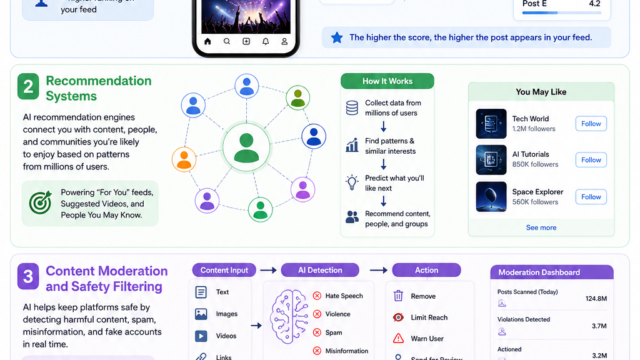
1. Personalized Feeds and Content Ranking
Every time you scroll through platforms like Instagram, Facebook, or X, AI is working in the background to rank posts. It studies what you like, comment on, share, and even how long you pause on a post.
9
Machine learning models assign a “relevance score” to each post. Higher scores mean the post appears closer to the top of your feed. This is why two users rarely see the same timeline in the same order.
2. Recommendation Systems (What You Should Watch Next)
Recommendation engines power features like “Suggested Videos,” “People You May Know,” and “For You Pages.”
8
These systems use collaborative filtering and deep learning to connect users with similar interests. For example, if many users who like tech videos also watch AI tutorials, the algorithm will recommend AI content to you even if you’ve never searched for it.
3. Content Moderation and Safety Filtering
AI also plays a major role in keeping social platforms safe by detecting harmful content, spam, misinformation, and fake accounts.
7
Computer vision and natural language processing models scan text, images, and videos in real time. While not perfect, these systems help remove millions of violating posts every day before humans even see them.
4. Targeted Advertising and User Profiling
One of the most powerful uses of AI in social media is advertising. Platforms use AI to decide which ads you are most likely to click or buy from.
6
AI builds detailed user profiles based on demographics, interests, and behavior patterns. This allows advertisers to reach highly specific audiences, improving conversion rates while making ads feel “personally relevant.”
Conclusion
AI is deeply embedded in social media, shaping what we see, how we interact, and even what we buy. While it improves personalization and safety, it also raises concerns about privacy, echo chambers, and over-personalization.